‘The Woman Who Ran’ poses questions of existence
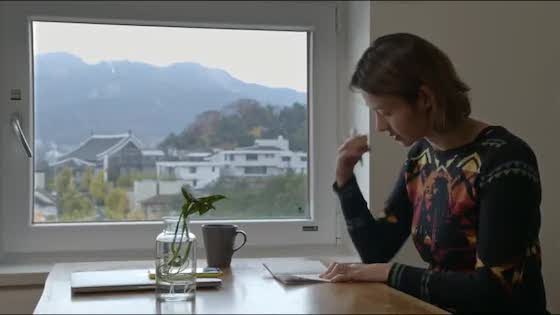
Photo : “The Woman Who Ran” is playing at the Magic Lantern Theatre. (Photo/Cinema Guild)
Movie review : “The Woman Who Ran,” directed by Hong Sang-see, starring Kim Min-hee. In Korean with English subtitles. Screening at the Magic Lantern Theatre.
All too often, mainstream movies follow plotlines in which a lot happens but very little amounts to much. Korean filmmaker Hong Sang-soo strives to give us just the opposite: movies in which little seems to happen but what does occur carries a wealth of meaning.
His latest film, “The Woman Who Ran” – which is now playing at the Magic Lantern Theatre – is a perfect example. On the surface, it involves a woman named Gam-hee (played by the actress Kim Min-hee ) who – separated from her husband for the first time in five years – ends up visiting three women acquaintances.
And that, told by writer-director Hong in an economical 77 minutes, is that.
But like a seemingly simple Monet landscape painting, what’s important about “The Woman Who Ran” is in the details. Gam-hee’s three visits play out similarly, two intentional and the third – perhaps – accidentally. But there are obvious differences.
In the first, which turns into an overnight stay, Gam-hee is treated to a home-cooked meal. In the ensuing conversations, information is passed back and forth, intimacies of a sort are shared, but everything is colored by questions: Do these two women share the same memories? Or are they merely recalling the past the way most of us do, shaped by what we want to think was real rather than facing the actual truth?
In the second, the food-sharing is less pleasurable – Gam-hee’s friend burns her first attempt at a meal and ends up preparing noodles instead. But Gam-hee finishes her plate and is full of polite compliments, which again may or may not be true.
And in the third, Gam-hee goes to a moviehouse/café. There she meets, perhaps by chance, an old acquaintance – the theater owner – whose relationship to her only gradually becomes clear. Furthermore, the reason for the awkwardness that ensues between them shows up in the form of a man – the acquaintance’s husband.
It’s important to point out that men don’t come across well in “The Woman Who Ran.” In the first visit, a neighbor interrupts things by asking Gam-hee’s friend and her roommate to stop feeding the feral cats – he refers to them as “robber cats” – that live in their neighborhood. The stance that the roommate in particular takes is one of the more polite forms of a firm “no” that you’re ever likely to see.
In the second, a young poet harasses Gam-hee’s friend for spurning his romantic advances. And in the third, the theater owner shares her disdain for her husband’s new-found fame as an author and the insincere manner he affects during interviews.
Throughout all this, Gam-hee herself relates the same story about her own marriage: This the first time she and her husband, who she says is on a business trip, have been apart. He thinks, she explains, that it’s important for married couples to spend as much time together as possible. Yet Gam-hee has trouble admitting that she feels love for her husband beyond the occasional spurt of emotion.
But is she telling the truth? Through the casual-sounding conversations, is filmmaker Hong exploring Gam-hee’s own sense of dissatisfaction? She does, after all, seem to be envious of her three friend’s lives, and not just their apartments with the gorgeous mountain views. Furthermore, is she seeing their lives with any sense of accuracy – or are her reactions merely wishful thinking? Or is this all just a cover for her attempt to escape her own marriage?
Hong leaves it up to us to decide. In any event it comes as no surprise that, given the freedom to do anything with the free time she has left before her husband’s homecoming, Gam-hee returns to the theater to watch a film that features a repetitive beach-side scene, boats sailing in the distance, scored to a mundane ukulele refrain.
That simple scene could be viewed as a shorthand version of the film’s overall message, seeming as it does to capture a wistful sense of peace that so many of us have dreamed of, on occasion, in our private moments of unbridled desires and unmet expectations.
An edited version of this review was previously broadcast on Spokane Public Radio.
* This story was originally published as a post from the blog "Movies & More." Read all stories from this blog