Disney+ ‘WandaVision’ a 1950s throwback — at first
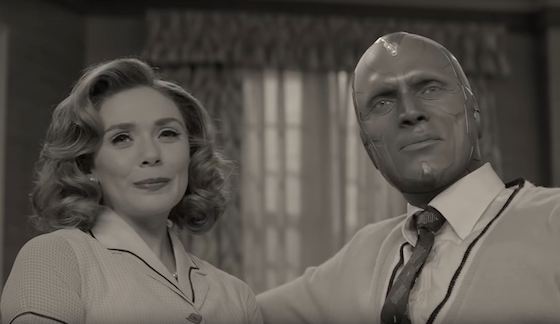
Above : Elizabeth Olsen and Paul Bettany star in “WandaVision.” (Photo: Disney Studios)
Miniseries review : “WandaVision,” created by Jacques Schaeffer, directed by Matt Shakman, starring Elizabeth Olsen, Paul Bettany, Kathryn Hahn, Teyonah Parris and Randall Park. Streaming on Disney+
One of librarian Nancy Pearl ’s more quoted remarks involves just how long you should stick with a book that doesn’t intrigue you. Pearl’s suggestion: 50 pages.
I’m not sure how Pearl would amend her dictum to apply to a seven-episode video series. The first couple of episodes? The first episode alone? The first couple of minutes?
I’ve given up on a number of series after a single viewing. Some of those had even received overwhelmingly positive reviews. And, alternately, I’ve stuck with series to the bitter end, even though I never quite connected with what I was seeing.
I just finished watching all seven episodes of the Disney+ series “ WandaVision.” And I’m glad I stuck it out, because I almost turned it off halfway through Episode 1.
The first problem is that “WandaVision” is part of the Marvel Comics Universe. And its two central characters, Wanda Maximoff (played by Elizabeth Olsen ) and Vision (played by Paul Bettany ), both belong to Marvel’s “Avengers” world. So some understanding their shared history is necessary.
The second is that the series plays out – at least at first – like a 1950s family sitcom. I’m thinking of “Leave It to Beaver” or “Ozzie and Harriet,” complete with the corny, dated feel and a fake laugh track. It progresses from there, but it never completely loses its traditional sitcom feel. And after having lived through that actual era of television, I have only limited interest in the sense of nostalgia that it offers.
The set-up is this: Wanda and Vision live in the small, idealized town of Westview, New Jersey. She is a housewife, and he works for a local company. They go through their days as any typical sitcom couple would, she trying to keep house, fix meals, deal with nosy neighbors (such as Agatha, played by Kathryn Hahn), and he trying to figure out what exactly his company produces.
We know that something isn’t right, though. “Avengers” fans know who these characters are, what their powers are and especially the fact that Vision – not to put too fine a point on it – is supposed to be dead.
Death, of course, is a flexible concept in the comics world, Marvel and otherwise. How many times has DC Comics killed off Superman? Or Batman? So the fact that, in “Avengers: Infinity War,” we watch Vision die not once but twice makes little difference. Alternate timelines, right?
Well, in terms of “WandaVision,” something else is at work – something that, eventually, we begin to discover. It comes as Vision, whose natural existence is as a synthetic lifeform, transitions from his red-faced form to a more human-like mode. It comes as, on occasion, both of the characters use their super powers: Wanda to clean the kitchen and cook meals (though sometimes poorly), and Vision to – in a curious change to a serious tone – save his boss’ life.
I don’t want to give too much away. Let’s just say that if you want something bad enough, as Wanda clearly does, you can make it happen – especially if you have some magical powers at your disposal.
That’s how other actors, such as Teyonah Parris and Randall Park – who provide the kind of ethnic diversity that TV seldom addressed 60 years ago – play characters who get involved in the storyline. Created by Jac Schaeffer , directed by Matt Shakman from scripts overseen by Schaeffer and a team of writers, “WandaVision” fits well in the current movement not just to include a rainbow coalition of genders and ethnicities in terms of character – but then to feature those characters in co-starring, not just supporting, roles.
Yet it’s mainly up to Olsen, Bettany – and also Hahn – to handle the changes in tone, and all have the right mix of talent to do so. All three have extensive experience with drama over the course of their respective careers. Comedy, though, can be harder to pull off, though the magic-show sequence in Episode 2 – when Vision’s system being, uh, gummed up and Wanda has to rescue them both – is a good example of how varied their talents truly are.
It is those changes in tone, which become less and less as the series progresses, that kept me interested enough to keep watching – wondering where Schaeffer and her writers were taking me. My only qualm is that the series end on an Episode 7 cliff-hanger that screams for a Season 2.
And so far, the likelihood of a second season isn’t certain. As Kevin Feige , president of Marvel Studios, said at a recent Television Critics Association press tour, “I’ve been at Marvel too long to say a definite no or yes to anything, in regard to another season of ‘WandaVision.’ ”
If life itself had a laugh track, that statement likely would rouse a chorus of boos.
* This story was originally published as a post from the blog "Movies & More." Read all stories from this blog