‘The Father’: a study in real-life family horror
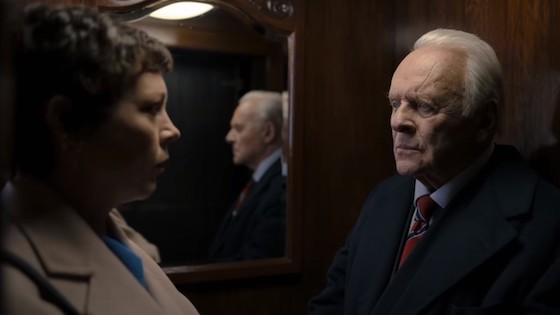
Above : Olivia Colman and Anthony Hopkins star in “The Father.” (Photo: Sony Pictures)
Movie review : “The Father,” directed by Florian Zeller, starring Anthony Hopkins, Olivia Colman, Olivia Williams, Imogen Poots, Rufus Sewell, Mark Gatiss.
Horror comes in all forms, especially when portrayed in the movies.
It can take the shape of monsters, whether vampires, great white sharks or razor-fingered killers who haunt our dreams. It can embody threats posed by everything from the people who live next door to paranormal entities that inhabit creepy dolls. It can be as literal as Frankenstein’s monster or as ephemeral as the mere feeling that an unseen somebody, or something, is haunting our every move.
In his movie, “The Father,” French-born writer-director Florian Zeller explores a different kind of horror, one closely tied to aging – and to what can happen when your mind begins to lose its ability to comprehend reality.
Zeller has based his movie on his own stage play, originally titled “Le Père,” which premiered in 2012 in Paris and which won the 2014 Molière Award for Best Play. It has since been translated into English, with productions both in London and New York, and adapted – by Zeller – into a 2015 French-language film titled “Floride.”
Now, Zeller has adapted his play for English-speaking audiences, casting Oscar veterans Anthony Hopkins and Olivia Colman in central roles. And the result is stunning, maybe as good a portrayal of the damage caused by syndromes that affect an elderly mind as has ever been filmed.
Curiously enough, “The Father” starts off seemingly as a study of simple family conflict. Colman plays Anne, a middle-age woman who, walking determinedly, arrives at what appears to be her father’s London apartment (which, being Brits, they both refer to as a “flat”). Seems he – his name is Anthony – has been rude to another care-giver that Anne has hired, causing her to quit. And now working-woman Anne is at her wit’s end.
In short order, Zeller progresses from family conflict to family dysfunction. The two characters clearly have long-standing issues. Anthony insists that he is fine, that he doesn’t need help, and that he is suspicious of Anne’s motives. For her part, Anne alternates between the role of devoted daughter and that of a frustrated woman wanting to be free to live her own life yet not free of the guilt that comes with that understandable desire.
Then, gradually, the story evolves even further. Same with the set design and, more important, the characters – all except for Anthony, whose perspective Zeller swerves away from but continually returns us to – it being both the anchor for what unfolds and the mirror for the confusion that we experience with him.
I don’t want to give too much away, because a lot of the effectiveness of “The Father” comes from rolling with the changes that Zeller throws at us. In terms of character, those shifts involve not just Colman’s Anne but also those played by the actresses Olivia Williams and Imogen Poots as well as both co-stars Rufus Sewell and Mark Gatiss.
The acting across the board is superb, which you would expect from a first-rate British cast, including the two Oscar winners – Colman and Hopkins. Both of them have been nominated yet again, Colman this time for Supporting Actress, Hopkins his fourth time as Best Actor (along with two nods in the Supporting category).
Colman shows the same versatility she displayed in 2018’s “The Favourite,” when she won her statuette by portraying a haughty, needy British Queen Anne. Here she has the unenviable task of playing a woman caught between filial duty and personal desire, tied to a man whom she clearly adores but who verbally abuses her without a second thought – and that’s when he even remembers who she is. Even worse, Anthony seldom stops referring to the mysteriously missing other daughter whom he clearly favors.
As for Hopkins, despite all his past achievements, this arguably is the best performance of his film career. As actor after actor have proven, it’s not easy to play someone with a mental and/or emotional affliction – to do so, at least, and still make the character worthy of our sympathy. And if Colman faces a daunting acting task, consider what Hopkins is required to play: a man who in one moment is strong and willful, in another confused and hesitant, in still another playful and flirty while, in the end, desperate, desolate and like a child cast alone into darkness.
That’s the kind of horror that “The Father” explores, the existential angst that comes with the realization that we humans are little more than our memories. When those begin to fade, so does our very sense of self.
And nothing, not even a horde of ravenous zombies, could match the terror that’s likely to accompany that most profound and primal kind of loss.
* This story was originally published as a post from the blog "Movies & More." Read all stories from this blog