‘Belfast’: Branagh’s dip into childhood nostalgia
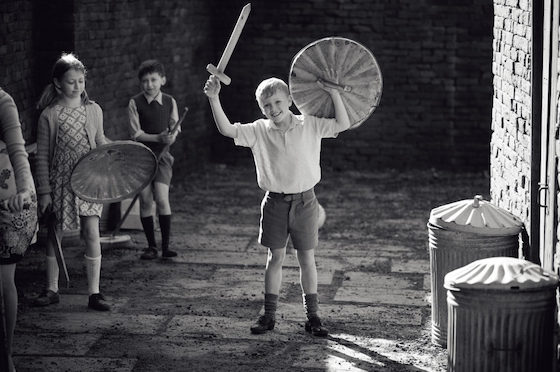
Above : Jude Hill stars in “Belfast,” written and directed by Kenneth Branagh. (Photo/Focus Features)
Movie review : “Belfast,” written and directed by Kenneth Branagh, starring Jude Hill, Caitriona Balfe, Jamie Dornan, Judi Dench, Ciarán Hinds. Playing exclusively at AMC River Park Square.
Movies that capture life as seen through the eyes of children have a long history in cinema. There’s something about the innocence of youth, and how it comprehends the often-mixed signals of adult life, that makes for great storytelling.
One of my favorite examples is “Cría Cuervos,” Spanish filmmaker Carlos Saura ’s 1976 quiet but compelling film about an 8-year-old girl named Ana (played by Ana Torrent) who is dealing with the untimely death of her mother. Writer-director Saura plays with chronology in his film, capturing Ana both as a child and as an adult, and in the end shows how the perceptions of the former come to be understood by the latter only years after the fact.
“Cría Cuervos” is fiction. But just as interesting, if not more poignant, are those films that attempt to capture the honest essences, if not specific actualities, of each filmmaker’s own childhood. Think of Francois Truffaut’s 1959 film “The 400 Blows.” Or Federico Fellini’s 1973 film “Amarcord.”
And now we have “Belfast,” a film written and directed by Kenneth Branagh . Born in Belfast, Northern Ireland’s capital city, Branagh spent the first nine years of his life there. But on the eve of what would become known as The Troubles, the sectarian civil war that was waged between Protestants and Catholics for some three decades, Branagh’s family moved to England.
While he would go on to become a noted stage and film actor and director, Branagh never forgot his native city. And “Belfast,” the movie, is his testament to that devotion.
Beginning with a panoramic overview of Belfast today, captured in living color, Branagh’s movie quickly turns back the clock, rendering the year 1969 in tones of black and white. Our focus is on one particular block, where Protestants and Catholics live in mixed company – and the only violence being performed, at first, is that by a wooden sword-wielding boy named Buddy (played by newcomer Jude Hill ).
But things quickly change as a group of Protestant protesters storm the block, demanding that any Catholics living there must leave. And so Branagh sets the backdrop for what becomes a family drama played out against larger events.
Of course, the notion of what plays large in a boy’s mind typically is dependent on his feelings at the moment. Buddy’s daily life is more involved with the absences of his father (played by Jamie Dornan ) who is away weeks at a time, working in England. Buddy’s concerns also connect him to his mother (played by Caitriona Balfe ), who worries about how to pay the bills that – we come to find out – have been added to by her husband’s past tendency to gamble.
The time Buddy spends with his grandparents is more relaxed, his grandfather (played by Ciarán Hinds ) an amiable source of Irish humor, and his grandmother (played by the great Judi Dench ) who indulges her husband even as she worries about his nagging cough (shades of things to come).
But Buddy finds his real passion at school, where he strives to get better grades so that he can sit next to the little blond girl of his dreams. So go the dreams of young boys – even those of Buddy who seems to take at face value the fact that his one peaceful block has become a barricaded fort patrolled by torch-bearing citizen-soldiers.
Tales of the so-called Troubles are often, fittingly grim. They tell of bombings and riots and murders, all done in the name of religious and nationalistic intolerance – and all echoing the millennia-long human tendency to strike out at The Other, however that Other is defined.
But that isn’t the story that Branagh wants to tell. He portrays the city of his birth as the place that he recalls existing in his childhood, a time in which he tended to see things – as children will do – in more simple terms. As such, despite the film’s obvious qualities – the acting by all involved and the sharp cinematography – “Belfast” bears a lightness of tone that makes it less a historical study than a lightly nostalgic, if at times touching, fantasy.
Nothing wrong with that, of course – as long as you don’t expect such fantasy to resonate with the power of something truly memorable. Something directed by, say, Carlos Saura.
An edited version of this review was broadcast previously on Spokane Public Radio.
* This story was originally published as a post from the blog "Movies & More." Read all stories from this blog