This column reflects the opinion of the writer. Learn about the differences between a news story and an opinion column.
Shawn Vestal: The seeds of marriage equality were planted 50 years ago with failed lawsuit

Ten years ago this fall, 1,659,915 Washingtonians voted to equalize marriage.
Fifty years ago, three Washingtonians – two gay men looking to prove a point and one county clerk – put the state on the long and winding path toward that 2012 vote and everything that’s come since.
In celebrating the values of freedom and equality inherent in that first vote – as well as the subsequent Supreme Court ruling in 2014 legalizing gay marriage nationwide – it’s important to remember the half-century or more of struggle that preceded it.
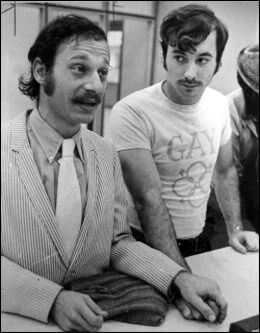
In April 1972, two men in Seattle sued the county clerk who had denied them a marriage license six months earlier.
The men, Paul Barwick and John Singer, said they were chiefly trying to raise an issue of equality under the law, and had little hope of success. They were the first gay couple to challenge Washington’s marriage laws, and the second such couple in the country. The idea of an actual court victory seemed to be a long way from their minds.
Barwick later told The Seattle Times, “Back then it was a lark – a way of getting people to realize there were gays here. We were an invisible minority.”
When the men asked for a marriage license, the clerk, Lloyd Hara, had to consult the county prosecutor, who told him he could not issue it. Though Hara would be the defendant in the lawsuit filed by Barwick and Singer, he was actually in support of their right to marry.
“As a person of color, I’ve always been concerned about discrimination against anyone,” he told The Seattle Times in 2006. “I thought it was wrong then and I still firmly feel the same way.”
The courts, to put it mildly, disagreed. A King County judge rejected the lawsuit, and the state Court of Appeals later issued a ruling that was unequivocal in its rejection of the idea that gay people had any right to expect equal treatment under the law.
“The equal protection clause of the Fourteenth Amendment,” the three-judge panel of the Washington Court of Appeals ruled in 1974, “like the due process clause, is not offended by the state’s classification of persons authorized to marry.”
As for the idea that same-sex couple could have a stable, loving family, the judges were more than dismissive – putting the word “family” into quotation marks, as it relates to a gay couple, and concluding: “People will live as they choose, but the beauty and sanctity of marriage must be preserved from such needless desecration.”
A lot of things have changed. It is now Supreme Court precedent, thanks to the ruling in Obergefell v. Hodges, that the Constitution protects the rights of all people to marry, a ruling built upon the very 14th Amendment rights to due process and equal treatment that the appeals court so glibly dismissed in 1974.
“The nature of injustice is that we may not always see it in our own times,” the Supreme Court majority held. “The generations that wrote and ratified the Bill of Rights and the Fourteenth Amendment did not presume to know the extent of freedom in all of its dimensions, and so they entrusted to future generations a charter protecting the right of all persons to enjoy liberty as we learn its meaning. When new insight reveals discord between the Constitution’s central protections and a received legal stricture, a claim to liberty must be addressed.”
There is something further in the Obergefell ruling, beyond its constitutional analysis, that is essential as a reflection of the country’s change for the better. It refers to the creation of stable, loving families as a reason for sanctioning same-sex marriage – not as a desecration.
In this distinction you see the most important evolution of all: the growing acceptance of gays and lesbians as fully human, with full citizenship. As members of society whose lives are not presumed to be unwholesome or lesser, deserving of social ostracism and legal discrimination. This is now the cultural baseline, the majority view. That change sometimes feels as if it’s been swift, but it was a long way from there to here.
It’s worth remembering how narrow these victories were. Washington voters backed marriage equality with a 54% majority. Obergefell was a 5-4 decision; you couldn’t imagine it coming from the current court.
And yet American support for marriage equality has grown steadily and is now at supermajority levels. A Gallup poll last May found 70% approval for same-sex marriage among Americans; it was less than 50% in the year Obergefell was decided. The figure was 55% among Republicans.
A long way from there to here. It didn’t begin when we voted to legalize marriage 10 years ago. And it didn’t begin with the various half-steps that came before, such as the civil-union laws or the battles over the Defense of Marriage Act.
It began – legally, anyway – on that day a half-century ago when two men filed a lawsuit and insisted they would not remain invisible.