This column reflects the opinion of the writer. Learn about the differences between a news story and an opinion column.
Shawn Vestal: Washington adopts a gun law with a growing record of effectiveness – the large-magazine ban
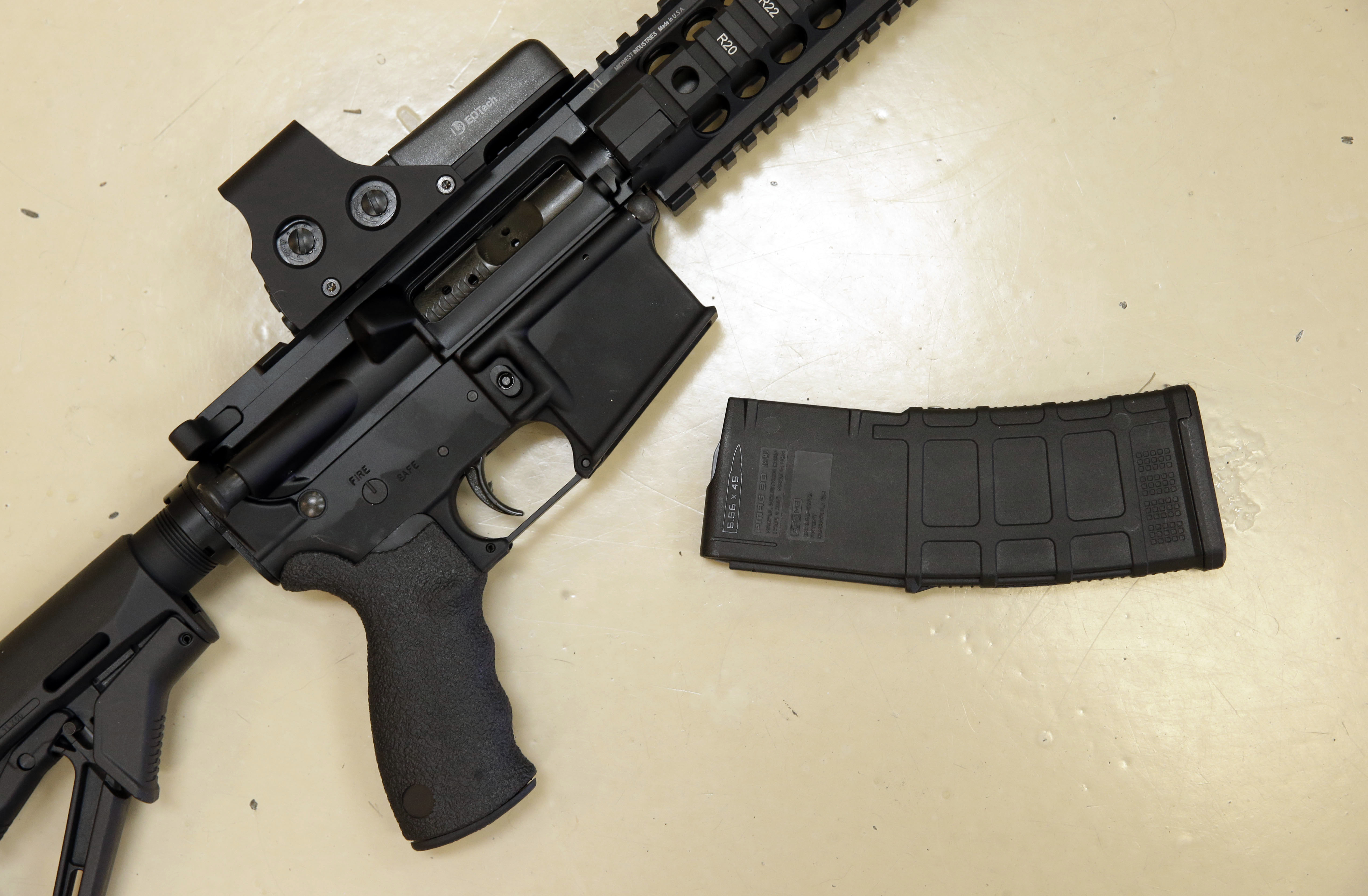

Between 1990 and 2017, there were 69 “high-fatality” mass shootings in America.
That’s according to a team of researchers at Columbia, Harvard and Quinnipiac universities, whose definition of “high fatality” is six or more deaths – in accordance with our ever-escalating sense of how many is a lot, in terms of shootings.
Researchers found a strong association between a certain kind of gun law and a lower death toll, and the good news is Washington just passed that very kind of gun law: a prohibition on large-capacity magazines.
Over that 27-year period, attacks where the shooter used a large-capacity magazine – one with more than 10 rounds – resulted in more deaths, unsurprisingly: a 62% higher mean average death toll than incidents where no such magazine was used, according to the research, published in the American Journal of Public Health in 2019.
States without large-magazine bans had more than twice the incidence of mass shootings than those that ban them. Analyzing a range of statistics, the researchers concluded that “states without an LCM ban experienced significantly more high-fatality mass shootings and a higher death rate from such incidents.”
More shootings, and more deaths per shooting.
These associations – as well as those found in other studies – suggest very strongly that these laws work. In 2017, a Boston University professor conducted an analysis for CNN and concluded that no other socioeconomic factor correlated as strongly with higher mass shootings than if a state banned big magazines.
“Whether a state has a large-capacity ammunition magazine ban is the single best predictor of the mass shooting rate in that state, ” the professor, Michael Siegel, told CNN.
His analysis concluded that those states have a 63% lower rate of mass shootings.
This, like the larger study, shows a clear association, which is not the same as a clear causation. But the associations are piling up: Attorney General Bob Ferguson, who has been calling for a large-magazine ban for six years, cited two other studies showing strong correlations between large-capacity magazine bans and fewer mass shootings – and fewer deaths and injuries in the mass shootings that do occur.
“The evidence that this policy saves lives is overwhelming,” Ferguson’s office said in a news release.
It went on to say, “Firearms equipped with high-capacity magazines have been the weapons of choice in nearly every mass shooting that has shocked the national conscience, including in Dayton (2019), El Paso (2019), Pittsburgh (2018), Parkland (2018), Las Vegas (2017), Sutherland Springs (2017), Orlando (2016), Newtown (2012), Aurora (2012) and more,” Ferguson’s office said in a news release noting the passage of the law.
The reason for this – as well as the reason for banning the magazines – are crystal clear. You can shoot more people, more times, with large magazines. Big magazines are truly the mass killer’s best friend.
If Gov. Jay Inslee signs the law, as he has said he will do, Washington will become the 10th state to limit gun magazines, prohibiting the sale of magazines larger than 10 rounds. It does not prohibit ownership of such magazines.
The practical reasons that limiting a magazine size would have an effect in a mass shooting are obvious. The researchers who performed the 27-year analysis laid them out.
The magazines reduce the number of times they must stop to reload, and those interruptions – even if very brief – are opportunities for people to defend or protect themselves or intervene. They increase the number of rounds fired in a given time, and victims who are hit more than once are more likely to die.
“These pauses provide opportunities for people to intervene and disrupt a shooting,” the researchers wrote. “Alternatively, they provide individuals in harm’s way with a chance to flee or hide.”
As Ferguson’s office noted, the shooters at Sandy Hook, Parkland, and Tucson were each stopped during breaks to reload.
The shooting at Freeman High School in 2017 would not have qualified for the “high-fatality” study cited earlier, but the mother of the one child who was killed there noted, in a legislative hearing in February, that the boy who brought his guns to school that morning started out trying to use an AR-15 with a high-capacity magazine.
It jammed, and the shooter switched to a pistol, killing 15-year-old Sam Strahan and injuring three students.
“Just imagine had his AR-15 not jammed,” Ami Strahan testified, adding “Restrictions on high capacity magazines might not have saved Sam, but it can save countless others.”
The do-nothing lobby insists, at every turn, that no gun law will make any difference on gun crimes.
The evidence is piling up that this one does.