This column reflects the opinion of the writer. Learn about the differences between a news story and an opinion column.
Spin Control: Why Washington won’t be in the gerrymandering sweepstakes
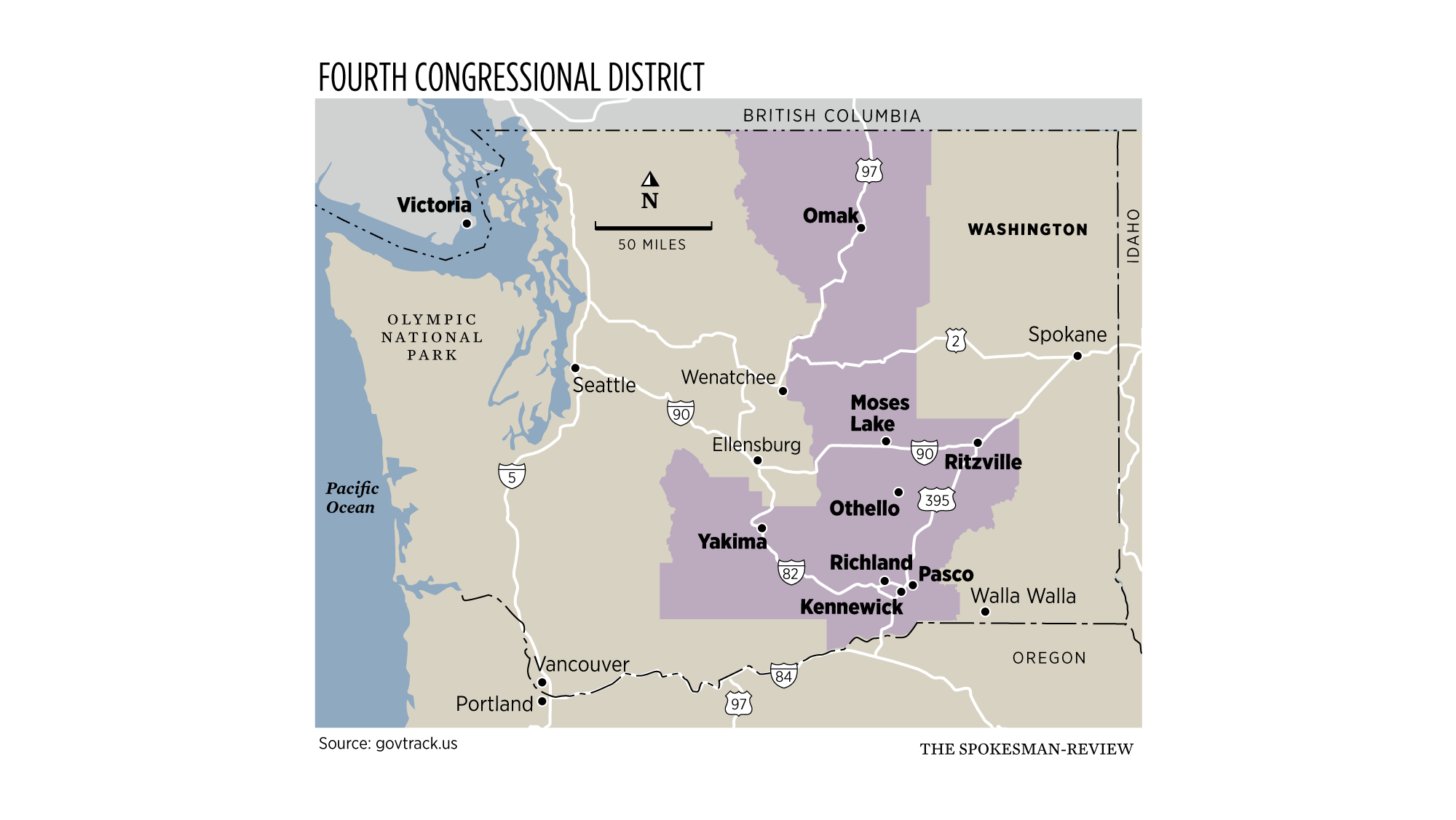
With all the talk of attempts to gerrymander new congressional districts in deep red states like Texas and deep blue states like California, some Washington residents might be wondering “What about us?”
Unfortunately for political writers – but fortunately for the 99.99% of other state residents – Washington will be left out of that scrum.
There may be an occasional reference to Washington’s blueness in national coverage that talks about a Democratic counter to the action in Texas. The state hasn’t sent a Republican to the U.S. Senate since 2000 or elected a Republican governor since 1980, but that’s hardly the point.
Some Democrats might try to apply President Donald Trump’s logic that Texas should have more Republican districts because he won that state. He got 56% of the vote in Texas compared to Kamala Harris’s 42.5%. Using that theory, Harris, who got 57% of the Washington vote to Trump’s 39%, might be entitled to an Evergreen State readjustment, too.
But redrawing congressional boundaries in Washington to reduce the number of Republicans in the U.S. House won’t happen for reasons that are legal, political and geographical.
The first hurdle – and it’s a big one – is that it violates the state constitution to go messing with congressional boundaries in the middle of a decade. Article 2, Section 43, which was overwhelmingly approved by voters in 1983, calls for a redistricting commission to be convened “in January of each year ending in one…”
That pretty much closes off any redistricting in Washington until 2031 unless someone decides to impose a new calendar system, which would be harder than switching the United States to the metric system and about as popular.
Amendments can be amended, but that would require the Legislature to start the process, and they aren’t due back in Olympia until next January, absent an emergency call from the governor. He’s unlikely to get involved in this national partisan spitting contest, regardless of what he may think about the president. Any change the Legislature could pass – in the unlikely event both chambers mustered a super majority of support – would go to voters in that November’s election. That would be too late to affect the mid-term congressional elections that everyone’s trying to mess with.
The law was passed to take redistricting out of the hands of the Legislature, which had been guilty of some partisan maneuvering in previous line drawing. Some longtime readers – and by this I mean people who can remember voting for Richard Nixon for president at least once – might recall when the 5th Congressional District boundary was an east-west line across Eastern Washington, so it encompassed most of the northern counties on that side of the Cascades, and the 4th District was most of the southern counties. That was redrawn in 1971 to divide the districts on more of a north-south line, in part to give Republicans a better shot at knocking off the incumbent Democrat.
The redistricting commission is not nonpartisan. In theory, it is a balanced bipartisan group, with one voting member chosen by the top Senate Democrat, one by the top Senate Republican, one by the top House Democrat and one by the top House Republican. In practice, the members are often experienced political operatives who tend to look out for the interests of the folks who appointed them. They may have some partisan ideas that mesh and some that clash. Any final map needs the support of at least three members, so one party’s schemes will at least tempered with some of the other party’s schemes.
The other reason a mid-decade congressional redistricting isn’t going to happen in Washington is that there’s almost no way to redraw the lines so that the two solidly Republican districts in Eastern Washington would become swing districts, let alone predictably Democratic districts. That’s not to say a Democrat could never win in one or both of them, but it would require a candidate and a political movement that hasn’t appeared in the last 30 years.
Southwest Washington’s 3rd District has become a swing district, but there’s no easy way to add or subtract predictable voting blocs to a district bounded on one side by the Columbia River and on another by the Pacific Ocean.
Regular readers might be familiar with the maps this newspaper publishes after each general election. In almost every statewide race since we started doing that some three decades ago, the east side of the maps is almost always Republican red and the west side is almost always Democratic blue. We use different shades to show how wide the margins are, but even in races where one party’s candidate is a well-qualified and experienced officeholder and the other party’s candidate is what’s technically known as a dingbat, the shades might change, yet the underlying colors hardly ever do.
One final thing to realize about gerrymandering districts: It doesn’t always work. The 5th Congressional District redraw did not knock the then-incumbent, Tom Foley, out of office. A conservative shift in the state’s rural and suburban voters, coupled with a Republican wave, did that in 1994.
When Washington got a new Congressional District after the 2010 Census, there was arguably a bit of gerrymandering – or at least some horse-trading – that made the new 10th District in Olympia and parts of the south Puget Sound solidly Democratic while making southwest Washington’s 3rd District, which had been competitive for both parties, more Republican.
That worked for the next 10 years, but in 2022 a novice Democrat Marie Gluesenkamp Perez bested Trump-endorsed Republican Joe Kent, who had finished ahead of incumbent Republican Jaime Herrera Beutler in the primary, and the GOP lost that seat.
The best laid plans of mice and gerrymanderers sometimes go astray.
Today’s trivia
Although we pronounce partisan redistricting with a soft “g,” as if it were Jerry-mandering, the process is named for one of the Founding Fathers Elbridge Gerry. He pronounced his name with a hard “g,” like Gary-mandering.
Although probably most known now for the partisan packing of districts, Gerry was a Founding Father who signed the Declaration of Independence, attended the Constitutional Convention (didn’t sign the document because it didn’t include the Bill of Rights), was elected to the first Congress, served as governor of Massachusetts and later as James Madison’s vice president.