This column reflects the opinion of the writer. Learn about the differences between a news story and an opinion column.
Spin Control: A deeper dive on Washington’s mail-in election system
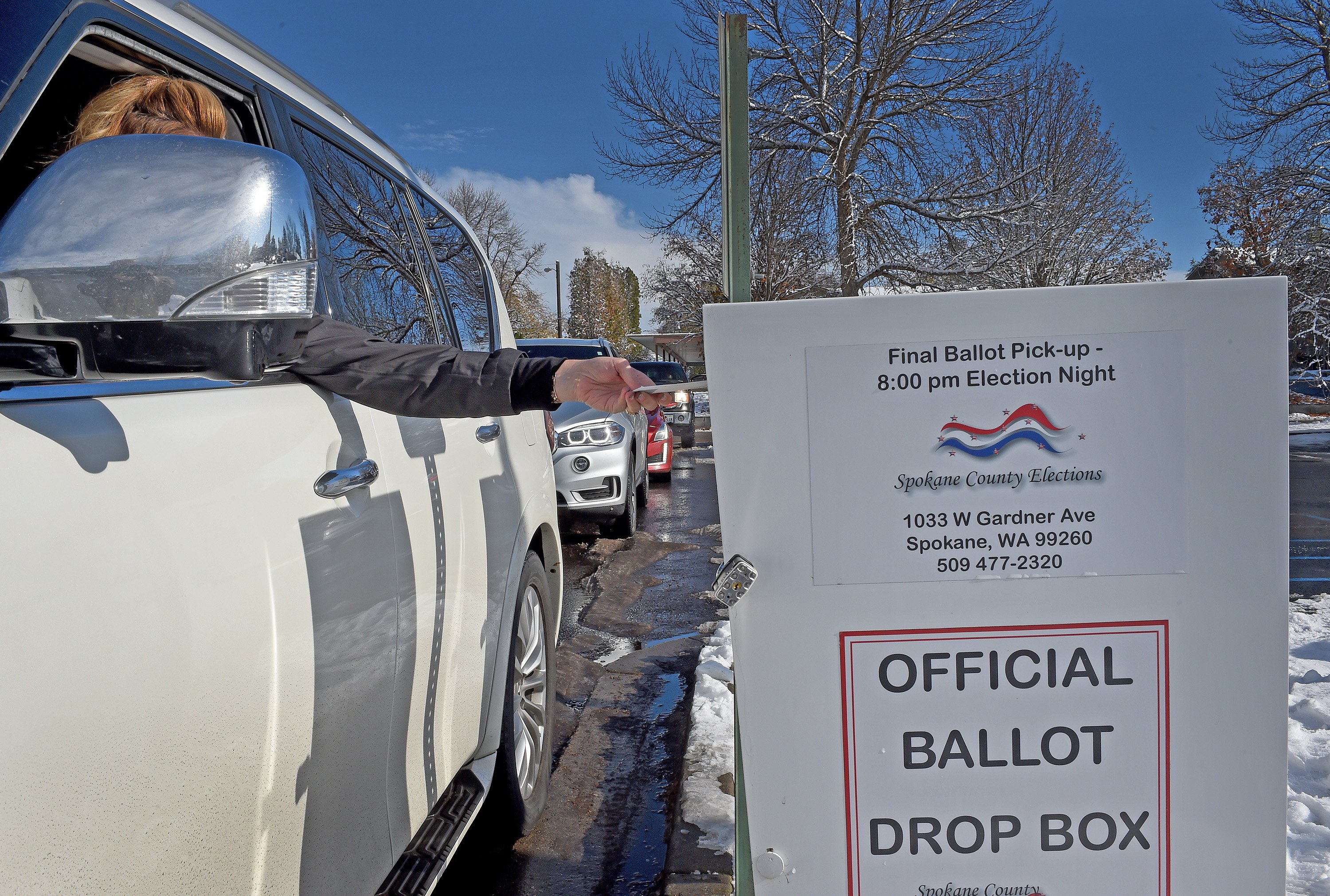
As expected, last week’s column about a possible federal challenge to the state’s election system and why mail-in voting is at least as accurate as in-person voting inspired a round of “what-abouts.”
This is a reaction that columnists learn to expect when explaining something to which unconvinced readers respond: “Well, what about…?”
Unable or at least disinclined to accept the column’s empirical evidence that supports the accuracy of Washington’s voting system, they parried with questions about whether some ballots are illegitimately cast. Let’s address some of those.
What about people who steal someone else’s ballot and cast it? While that’s theoretically possible, the thief would have to forge a signature on the return envelope that matches the one on file from the registered voter. Signatures are checked before a ballot is opened, and if they don’t match, the ballot, still in the envelope, is set aside. Because a person’s signature can change over time, the registered voter is then contacted to come in and “cure” the signature by providing identification and a new signature that would match the one on the ballot. If the ballot had been stolen, the voter likely would say they never got a ballot and didn’t send one in. If there was time, they’d be sent a new one and the old one wouldn’t be counted; if there wasn’t time, they could come to the Elections Office for a new ballot.
What about ballots sent to homes where the registered voter no longer lives? It can happen, because people move all the time but elections offices work diligently to update their lists. In 2022, a group called the Thurston Voter Research Project got a registration list and went to about 1,500 homes to ask whether voters listed at that address were there. They turned over a list of nearly 2,000 questioned registrations in Thurston County, which sounded like a big problem.
Using the most current list, the county elections office investigated and found that 43% were already listed as inactive voters; 24% were members of the military deployed overseas, who are allowed to list their previous address or that of a family as their current registration; 23% were people who had moved and already updated their mailing address, 9% were active voters who hadn’t changed their address and slightly less than 1% were voters who’d had their registration canceled. No one was voting illegally from those addresses.
It’s worth noting that even if the ballot was intercepted by a new resident wanted to cast that ballot, they would have forge the old resident’s name so that the signature passed inspection at the elections office or the ballot wouldn’t have been counted for reasons listed above.
What about votes from homeless people on the street? Homeless people who are citizens – the requirements are the same as a person with an apartment, a home or a mansion – can register to vote but they must provide an address where the ballot can be sent. That is often a shelter, where they have to go to pick up their ballot. If someone else manages to pick up their ballot and try to vote it, see above.
What about documented cases of fraud? They are rare but do exist, and are tracked, both by elections officials and independent groups. The Heritage Foundation, a conservative organization that tracks voter integrity nationwide, lists 15 cases of voter fraud in Washington on its database since 2004. Of those, four involved husbands or wives who voted for a dead spouse, usually with the explanation that they knew how their spouse would have voted. Two involved mothers who voted illegally for their son, one who was no longer a state resident and the other who was an ineligible felon. One involved a woman who registered her dog and cast that ballot, allegedly to prove flaws in the voting system (although she kind of proved the opposite). One involved a homeless man who registered twice with the same alias.
The largest case of fraud involved three people who worked for ACORN, a national liberal organization, during the group’s nationwide voter registration drive ahead of the 2008 election. It paid workers based on the number of registrations they turned in. Instead of going into neighborhoods to register new voters, some workers in Washington reportedly sat in a hotel room, went through phone book picking out names and addresses, and filing false registrations. They turned in a total of 1,762 fraudulent registrations. Five people were were convicted of registration fraud and received jail sentences and fines.
Those registrations were flagged by elections workers and never entered onto the rolls, and there were no convictions for voter fraud.
What about the changes in totals on the days after the election where one candidate is ahead on election night but the other wins after later ballots are counted? Washington law requires ballots to be mailed to voters about three weeks before Election Day. They can be returned any time before 8 p.m. Election Night. As long as they are postmarked before then, they are counted as long as they are received before the final canvassing, which is about two weeks later. Ballots mailed on or shortly before Election Day, or placed in drop boxes that day, typically are not counted for a day or two because they have to be received and verified before they are opened, scanned and counted.
Yeah, but what about the fact that in all the close races where a Republican is ahead on Election Night, a Democrat always wins in the later count? That’s actually not a “fact” because in some cases the reverse happens and a Democrat who is ahead on Election Night loses to a Republican in the final count. Such reversals also happened before the state went to mail-in voting, although they may seem to happen more frequently because the counting lasts longer and involves more ballots. The turnarounds might also be exacerbated by the fact that some people vote as soon as they receive their ballot, some vote after studying their options for a few days or weeks, and some wait until the final day, so there can be shifts in voter support.
In recent years, both parties have run campaigns to have their voters cast ballots early as a way of locking up those votes before a final round of negative ads can change some voters’ minds. Typically, districts that usually vote Democratic are going to have more Democratic votes in that later count; in Republican districts, there are going to have more GOP votes in the late counts.
In statewide races, there are more Democrats in Washington than Republicans, so later counts usually favor Democratic candidates in most cases. In Eastern Washington’s 5th Congressional District, the reverse is true.