This column reflects the opinion of the writer. Learn about the differences between a news story and an opinion column.
Spin Control: Brockett, Coe deaths so close together could make one pause
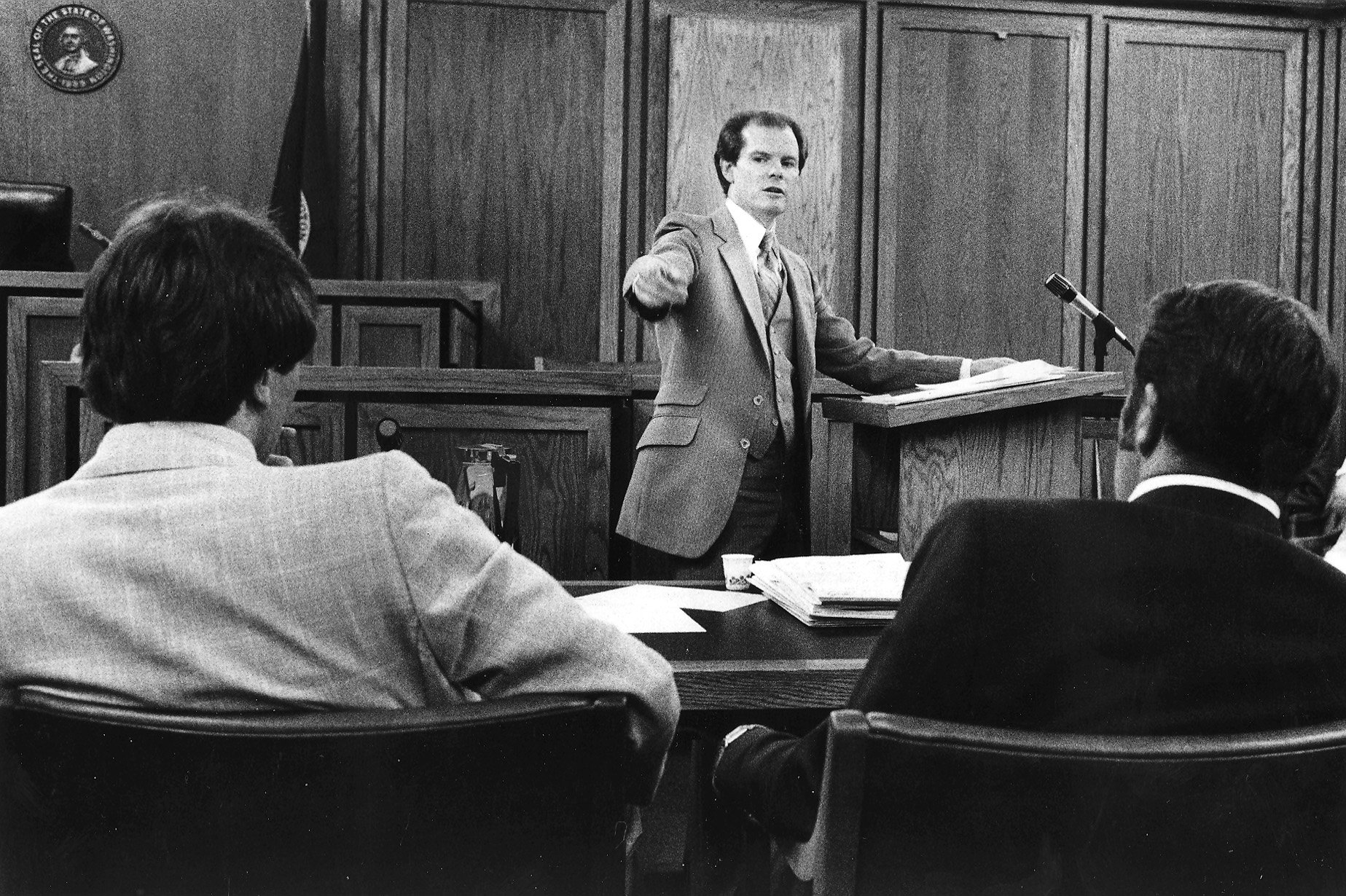
The passing, just three weeks apart, of two of Spokane’s most prominent news figures of the 1980s prompted a bit of reflection last week.
Kevin Coe, who was once accused of six sexual assaults attributed to the “South Hill rapist” – but ultimately only convicted of one – died Wednesday in Federal Way. He spent 25 years in prison and another 19 in mental health confinement on McNeill Island before being released just two months ago, after being judged too sick and frail to still be considered a threat to society.
Donald C. Brockett, Spokane County’s longest-serving prosecuting attorney who brought the charges against Coe and cross-examined him in the first of his two trials, died Nov. 14 at his home after fighting cancer for some two decades.
Those so inclined might think that those deaths coming so close together was fate, kismet or the universe balancing its books. Maybe it was just a strange coincidence, the end of a long saga that began in 1981.
Spokane was on high alert in February 1981 over a series of rapes, mostly on the South Hill, that police seemed unable to stop when I interviewed for a job at The Spokesman-Review. The paper had recently written a blockbuster story that concluded a serial rapist was stalking victims along city bus routes. During the interview, Managing Editor Don Gormley told me that after the story ran, the paper had received word from a local funeral home director about a person calling to order three caskets.
Why three, the director reportedly inquired? “One for myself. One for the chief of police. And one for that fat SOB who’s the city editor of the Spokesman Review,” the caller reportedly replied.
Gormley said the paper had hired some security to protect City Editor Bob Rose, who was, it can be acknowledged, a plus-sized person.
What a great news town, I thought, although when describing Spokane to my wife, I emphasized the wooded hillsides, the downtown park and the river that ran through the city, not the three-caskets phone call.
By the time I began working at the paper at the end of March, Coe had been arrested. The trial was that summer – unusually quick by today’s standard – and front-page news every day. On the final day, Coe took the stand to insist he had never raped anyone. When cross-examined by Brockett, Coe claimed he was in a “political trial” after being set up by police desperate to arrest someone to quiet the public and media. The fact that he was the son of an editor of the Spokane Daily Chronicle was probably a bonus, he added.
The jury went out in the late afternoon and came back just after midnight: guilty on four counts, not guilty on two.
In the hallway as he was being led out of the courtroom by deputies, Coe was asked if he had anything to say. The normally talkative Coe just stared past the questioner, stone -faced.
Brockett came out with his deputy prosecutors with a quick “No comment.” Did he have any reaction to the four convictions versus the two acquittals?
“That would be a comment,” he said with a smile and kept walking.
The next day, he said he was “pretty much convinced” Coe was the South Hill rapist, as the assaults had stopped after his arrest.
Judge George Shields would later sentence Coe to consecutive sentences of life plus 75 years. Coe would appeal, and the state Supreme Court eventually would order a retrial because some of the victims had been hypnotized to help with identifying him.
That November, the newsroom got alerted to the fact that Ruth Coe, Kevin Coe’s mother, had been arrested for trying to hire a hitman to kill Shields and either kill Brocket or make him “like an addlepated vegetable.” This being Spokane, real hitmen were rare to nonexistent, and the person she hired was actually an undercover cop.
I was sent to try to get comment at the jail, where we were told Gordon Coe, Ruth’s husband and Kevin’s father, was waiting to see his wife. As I prepared to leave, Publisher William H. Cowles 3rd came out of his office and asked if I was going to talk to the elder Coe, who until his son had been arrested had been the managing editor of the Spokane Daily Chronicle, which the Cowles family also owned.
I didn’t know Gordon Coe – he’d gone on leave when his son was arrested – but I knew he worked for the Chronicle for decades.
When you’re done with the interview, the publisher said, please tell Gordon that if there’s anything I can do for him to please call me. I said I would.
The interview was short. I asked if we could talk on the record and he said “No.” I asked a couple of times, and he didn’t relent. So I passed on Cowles’ message. He looked surprised, then said: “Tell Mr. Cowles I said thank you.”
Although I came back with nothing printable from that exchange, photographer Christopher Anderson’s black-and-white photo of Gordon Coe, clearly in despair, sitting alone on a bench outside the old jail entry, was worth more than the clichéd 1,000 words.
In 1984, the state Supreme Court overturned Coe’s four convictions based on the use of hypnotized witnesses. The retrial was moved to King County. Brockett disqualified himself from that trial, remaining in Spokane while his deputy prosecutors went to Seattle for the retrial in January on the four rape charges.
During the prosecution, a psychiatrist testified that Coe admitted to one of the rapes during a pre-sentencing investigation for the first trial. Coe later took the stand and said that he lied about the rape to the doctor as part of a “legal strategy” to get committed to a mental institution rather than prison.
The second jury convicted him of three of the four counts, voting not guilty on one because of an alibi offered for it. The defense immediately said they would appeal.
Back in Spokane, a smiling Brockett said he would consider seeking three consecutive life sentences. Asked if he was worried about another appeal to the Supreme Court striking down more convictions, Brockett said he wasn’t, contending the use of hypnosis would be “less troublesome” this time.
It wasn’t. The court eventually struck down two of the counts because of the hypnosis.
Brockett chose not to retry those two, and the resentencing on the final count was 25 years. Coe was eligible for parole before that, but that would have required him to admit to the rape, which he steadfastly refused to do. At the end of those 25 years, he was judged to be a sexual predator likely to re-offend and civilly committed to a special state facility at McNeill Island. He continued to maintain his innocence, claiming that he was the real victim, and refused to participate in treatment for his diagnosed sexual disorders, which kept him from being released from his civil commitment.
Brockett served as county prosecutor until 1995. He handled some of the community’s biggest cases, although not always by filing charges. A few months after the first Coe trial, Spokane County Coroner Lois Shanks thought Brockett should file charges against Linda O’Connor, the wife of Fire Chief Al O’Connor, who had collapsed and died earlier in the year with tranquilizers in his system. Brockett said he didn’t think there was a strong enough case.
Shanks convened a rare coroner’s inquest, hired Gonzaga Law Professor Frank Conklin to help her run it, and held a five-day hearing that featured some 50 witnesses questioned in front of a six-person jury. Brockett, who had advised against the inquest but represented the public, sat at one table and occasionally locked horns with Shanks and Conklin. Attorneys for Linda O’Connor sat at another table, and many of the late chief’s other family members, who were convinced she’d fed him drugs to kill him, sat in the front row.
It was, to be kind, a circus. After five days of testimony, the jury returned a split verdict. Two said he died of “natural causes” and four said some combination of “natural and unnatural causes”, with three of them saying Linda O’Connor may have “occasioned” his death. Asked what that split verdict meant for charges, Shanks and Conklin said they would have to ask Brockett for his advice.
Asked for a response a few minutes later in the parking lot as he was about to get in his car, Brockett was incredulous.
“I find it strange that Dr. Conklin, who had all the legal opinions available during the inquest and told me he didn’t want any from me, is now asking me what to do.”
Charges were never filed.
After he stepped down as prosecutor, Brockett battled colon cancer, wrote a book about the U.S. Supreme Court and did some work for local law firms. He occasionally made the trip to Olympia when one of the people he had convicted came before the sentencing board. He wrote letters to the newspaper supporting law enforcement, espousing conservative principles and sometimes backing local candidates.
Earlier this year, the state proposed releasing Coe from McNeill Island confinement, saying his declining mental and physical health meant he was no longer a credible threat to society. Victims were shocked, but a deputy from the Spokane County Prosecutor’s Office said there was nothing they could do because the rules for civil commitment differ than those for criminal incarceration.
The hearing was merely a formality. He was released on Oct. 1, but had trouble finding a place to live. Because he was still a registered sex offender, neighbors had to be notified he was being housed at a facility. Once notified, the community would get up in arms, and he would have to move.
Brockett died on Nov. 14, finally losing his battle with cancer. Coe died last Wednesday at a home in Federal Way, of what was listed as “natural causes.”