This column reflects the opinion of the writer. Learn about the differences between a news story and an opinion column.
Spin Control: Media struggles after Trump swears with cameras rolling
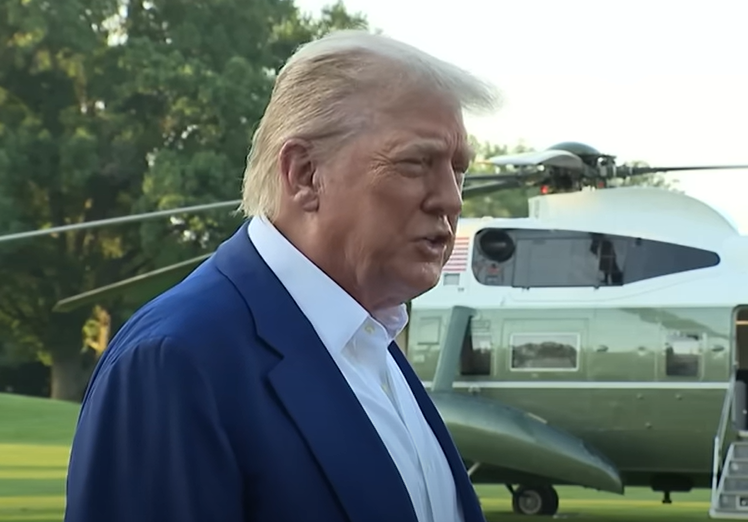
President Donald Trump may someday be recognized as the president who dropped two historic bombs in one week.
One was the Massive Ordnance Penetrator, or bunker buster bomb, used for the first time on Iranian nuclear facilities. The other was the f-bomb, dropped just as purposefully a few days later as cameras were rolling on his way to board Marine 1.
The latter created a problem for journalists of various media, which have rules on the use scatological language. It lead to variations in the efforts to get around repeating or writing down what Trump said as he suggested the Israelis and the Iranians “don’t know WTF they are doing.” Although he didn’t abbreviate it.
More than a half-century ago, George Carlin had an entire comedy routine about the seven words you can’t say on television, the third on the list being the word Trump used. When a recording of that routine was played on a radio station in 1972, a member of the Moral Majority complained, the FCC threatened sanctions if it happened again and the U.S. Supreme Court upheld the commission.
That, of course, was a much simpler time. Youngsters got their mouths washed out for saying any of those seven and quite a few more.
In the early 1960s, NBC censored a joke late -night host Jack Paar told about a toilet, even though he didn’t say toilet. He said “WC” as in the abbreviation for “water closet.” Paar quit in protest.
Ed Sullivan made the Rolling Stones change the lyrics of “Let’s Spend the Night Together” to “Let’s Spend Some Time Together.”
Radio stations refused to play rock songs that had any of those words in them.
Newspapers, which like to consider themselves family publications, developed a plethora of ways to not say certain words. Most had lists longer than Carlin’s, with local variations and restrictions. At some papers, one was allowed to write “God,” and in some contexts “damn” but never the two words combined, and “hell” might be replaced with “Hades.”
Some newspapers would replace letters of offending words with one or more asterisks. Others would insert blank spaces. Others would refuse to print anything that even hinted at the word, with instructions to reporters to “write around it.”
Some acronyms could pass muster. One could usually refer to a major problem that was halting plans or progress as a SNAFU, although if anyone asked, it stood for “situation normal, all fouled up” even though anyone who had served in the military knew better.
For several decades, Spokane’s Fairchild Air Force Base was home to B-52 bombers, which the folks in uniform referred to as “BUFFs.” When adding that bit of color to a news story, I always reported it as “Big Ugly Fat Fellows” and braced for calls from veterans eager to correct me.
Trump is not the first president to swear, and most Americans probably don’t expect their chief executive always to talk like Sunday School teachers.
President Harry Truman once called columnist Drew Pearson, a “son of a bitch,” after Pearson made a derogatory comment about his daughter Margaret’s musical abilities. The newspapers reported that as “S.O.B.,” although most people know Truman didn’t shorten it to just letters.
There was a fairly common joke that when Harry was explaining to Margaret that the garden looked so good because he’d spread manure on it and Margaret said “Oh daddy, you should say fertilizer.” Bess Truman told her “Hush Margaret. It took me weeks to get him to say manure.”
When the transcripts of the Watergate tapes were released, some of President Richard Nixon’s comments were released as “expletive deleted.” Hardly anyone thought Nixon, even though he was raised as a Quaker, was saying “gosh dang it” and “fudge.”
When he was vice president, Joe Biden was caught on a microphone using a variation of the word Trump used to describe the momentous signing of the Affordable Care Act, although many news outlets shortened it to BFD.
In the case of Trump’s remark on the wisdom of the Israelis and the Iranians continuing to lob bombs and rockets at each other despite his efforts to secure a ceasefire, some news reports ran with the actual word. Others used an acronym or a softer word or bleeped it, although it is one of the easiest words to lip read. No one who paid even the slightest bit of attention was left with any question about what was said.
While not the first president to be caught swearing, Trump may have been the first president to deliberately say that word with cameras rolling and microphones obviously open.
Some people seem willing to shrug that off, questioning the need for such prudishness as we move into the second quarter of the 21st century. Several generations of Americans have been raised with music, movies, cable TV and even common speech where that word is used variously as a noun, a verb, an adjective, an adverb, an interjection, a gerund, a participle and possibly a conjunction.
Others will be critical, saying a president has a responsibility to be a moral leader, or at least set a good example for Americans to follow.
So far, no member of the Moral Majority has filed a complaint against any station that has used an unedited version of Trump’s comments. Any furor seems to be fading with a new week of Trump social media posts and pronouncements.
But one has to think that if there’s a place in heaven for stand-up comedians, George Carlin is getting a good laugh.