Exploring fjords and dressing like Vikings
(And so I continue writing about the Norway trip that my wife, Mary Pat Treuthart, and I took in May.)
Monday, May 12, 8:41 a.m. (Central European Summer Time): I’d just finished walking my two miles (9 laps) around the Celebrity Apex’s exercise track when I spotted the first signs of Norway through the morning mist.
The Norwegian mainland was still off in the distance, but the islands that line up along the country’s coast stick out like the fingers of some giant underwater troll. I admit that may be an exaggerated simile, but it’s still somewhat appropriate because trolls are said to be integral to Norwegian culture.
Take this passage from the Visit Norway website: “Troll is a collective term for several types of human-like beings in Nordic folklore and fairy tales with roots in Norse mythology. Both appearance and characteristics vary, and trolls are usually both dangerous and stupid.”
No doubt we’ll encounter some obvious references to trolls in the days to come.
2:12 p.m.: Shortly after my first sighting of land, our liner entered the first of the fjords that we’ll be visiting, Nordfjorden. Our destination was the town of Nordfjordeid, the region’s administrative center that sits at the far end of Eidsfjorden, an offshoot of the main fjord.
Note: Norway has more than 1,700 fjords, described as “long, deep inlets with steep sides.” They formed as glaciers from the past eroded the mountainsides, leaving valleys that were eventually filled by water from the Norwegian Sea. And, by the way, according to one website, “The word fjord comes from the old Viking terms ‘where you travel across’ (der man ferder over) and ‘ferry’ (ferje).”
My first impression of a Norwegian fjord was as if somebody had combined aspects of the Columbia River Gorge, which separates Oregon from Washington, with the feel of New Zealand’s Milford Sound (which we experienced during a cruise we took in 2012). I was struck with how high the walls rise on each side of the ship, dotted here and there by what look to be houses.
And I wondered, not for the last time, how people even get to those heights, much less built their homes there.
We’ve just arrived at the dock in Nordfjordeid, and soon we’ll be disembarking to see what the town has to offer.
5:23 p.m.: And the chief thing we discover, after walking a fair bit, is the Sagastad Viking Center. I should note here that Norway is more proud of its Viking past than it is of its troll culture. Although the Vikings hailed from all parts of Scandinavia – from what is now Norway, Sweden and Denmark – the Norwegians claim that their brand was special, known especially for their prowess at building boats.
Which is what the Sagastad Viking Center emphasizes. Its central feature, the Myklebust Ship, is said to be the “largest Viking ship that has been found in Norway.” It was unearthed by the archaeologist Anders Lorange who had come to Nordfjordeid in 1874 to investigate a prominent burial mound.
What Lorange discovered was the burnt remains of what was determined to be the final resting place of a Viking king. And because of the discovery of other, smaller ships, which had been dug up more or less intact, the Myklebust Ship was soon forgotten.
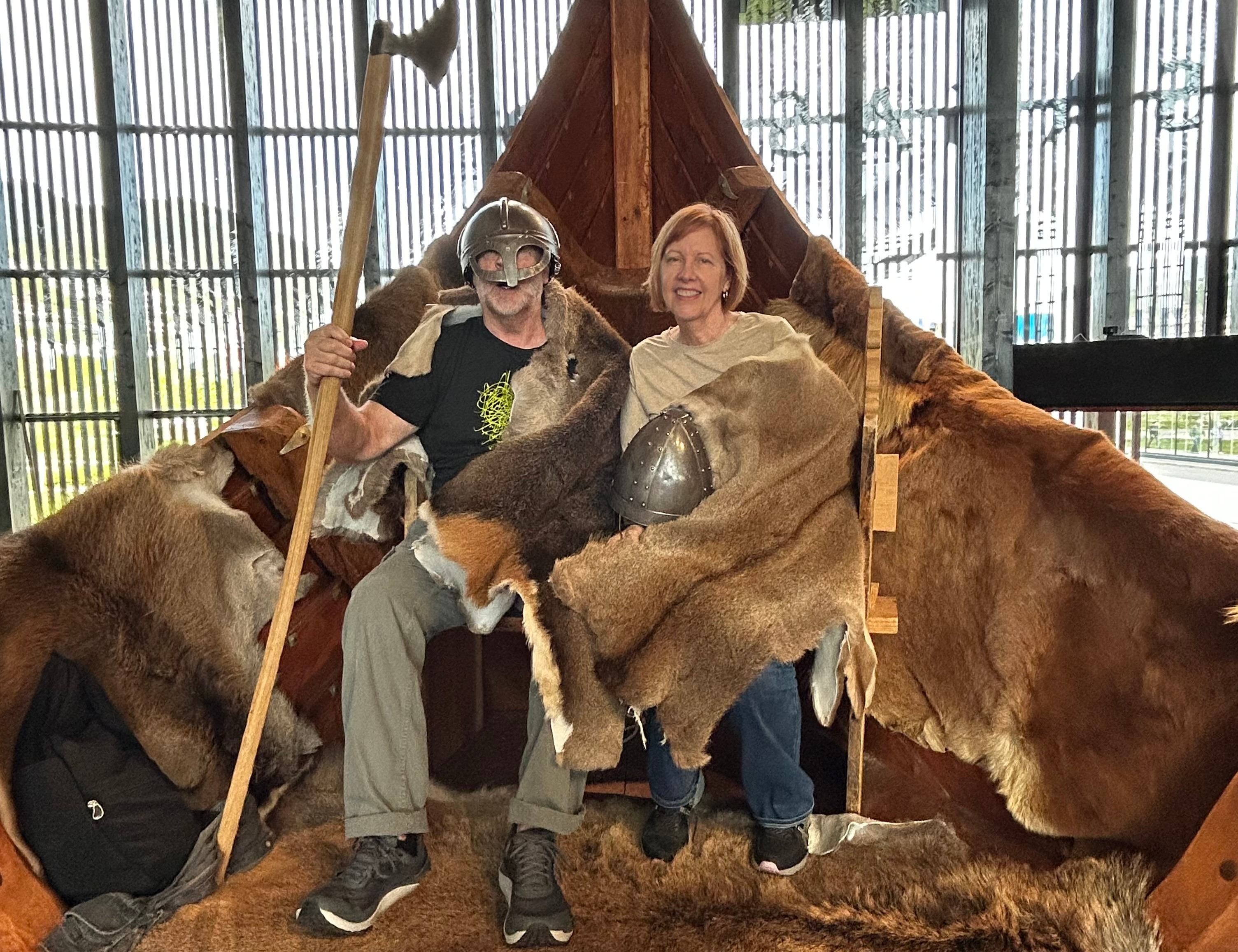
Though not completely and, in any event, not forever. Because in 2016, a plan unfolded to rebuild the ship. And so what sits in the Viking Center is a full-size reconstruction of what Lorange investigated. After watching a video explaining the ship’s significance, visitors are allowed to roam over the ship. And only a few can refrain from having their photos taken garbed in Viking gear and bearing faux Viking arms.
Mary Pat, her sister Jean and Jean’s husband Steve all followed the crowd. I acted as the photographer but otherwise refrained. No Kirk Douglas am I.
Tuesday, May 13, 9:36 a.m. (Central European Summer Time): If I was impressed by our first fjord, then our second made even more of an impact.
We were navigating first the Sognefjord – said to be the “world’s longest deepest, and wildest fjord” – before heading down a southerly branch called the Aurlandsfjord toward the town of Flåm.
And if I had been struck previously by thoughts of the Columbia Gorge, the Sognefjord hit me even harder. Whenever people talk about beautiful places they’ve visited in the world, I always tend to say, “Have you been to the Big Island of Hawaii?” or, in the case of the mountains and valleys of New Zealand and Scandinavia, “Have you been to Glacier Park?”
“But,” I wrote in my journal, the Sognefjord and Aurlandsfjord “are truly awesome, with their green, gray and black crags jutting straight up from the water, broken here and there by buildings perched on what seem to be impossible-to-reach ledges.”
I had this reaction early in the morning, standing on the exercise track as the ship cruised slowly past these geological landmarks. I stood there, drinking in the sight even as I fought the morning chill with sips of hot coffee.
I had barely warmed up when we approached our destination: a town of some 350 people that dates its founding all the way back to the year 1340.
Next up: Riding the rails and the Woman in Red.