Bergen: The pride of Norway’s west coast
(After my digressive rant about summertime air travel, I’m returning to writing about the Norway trip that my wife, Mary Pat Treuthart, and I took in May.)
And so, after our seven-hour train trek, we arrived in Bergen.
Wednesday, May 7, 8:42 a.m. (Central European Summer Time): My constant travel companion, jet lag, continued. I was up at 4 a.m., early even for industrious Norwegian street cleaners. Then I found myself, sitting alone at a breakfast table in our Bergen hotel, writing this while Mary Pat slept in.
I was stuck with the thought that 50 years ago on this very day I boarded a bus in Los Angeles and headed toward Fort Ord to begin my first days of Army basic training. I recall arriving in the dark at 2 a.m. to be greeted by men wearing Smoky-the-Bear hats yelling at us to GET OFF THE BUS NOW NOW NOW and line up in ranks.
I also recall the sounds of things hitting the bottom of trash cans, which I later understood were whatever weapons the drill instructors (or simply DIs) had ordered us to get rid of … or else. No weapons? No biggie. Soon they would be issuing us M14s.
Ah, good times. A full half century ago. Where have the years gone?
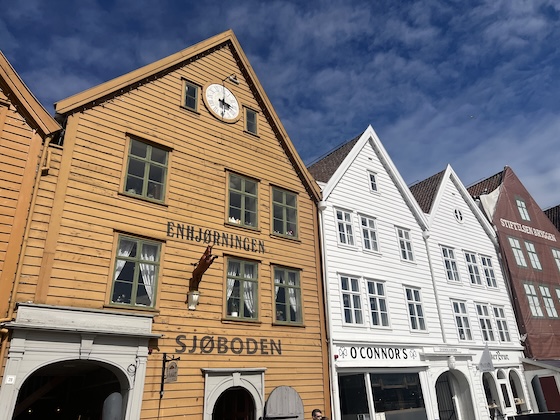
2:45 p.m.: We’re sitting outside Bergen’s Bryggen area, a World Heritage site that dates back to medieval times. It’s set in the city’s harbor district and is said to be “one of North Europe’s oldest port cities on the west coast of Norway which was established as a centre for trade by the 12th century.”
We’d just taken a guided tour of the Bryggens Museum, which opened in 1976 and holds artifacts of the city as it once stood. While fire razed much of old Bergen, maybe a quarter of the original buildings still exist.
Note: Our guide was a young, smart and knowledgeable guy who, unfortunately for me, talked fast and had a heavy accent. Also, I kept getting distracted by his nose ring. My bad.
And when I say fire, I mean Bergen burned down at least 36 times over the centuries. You can still find newspaper stories online telling tales of the 1955 blaze that caused the local citizenry to give up on a proposed housing project and band together behind a newfound desire to preserve the city’s past.
7:13 p.m.: We needed to do some laundry, so we located a self-service laundromat within walking distance of our hotel. As with other times that we’ve taken advantage of local facilities – in Florence, Italy, and Nerja, Spain, just to mention two spots – we met up with a collection of international travelers. One couple was from Canada, a posh woman hailed from London and a long-haired guy said he was Australian.
Naturally, our conversation turned to world politics and we all agreed that things don’t look particularly good. At least the others didn’t betray any obvious anti-American feelings, for which I was grateful, even if the Aussie guy did say, “What the U.S. does affects the rest of us.” Duly noted, I replied.
In the midst of our talks, a group of young Norwegians came in and began filming what they said was part of a marketing campaign for the clothing that one young man was wearing. Not everyone was pleased at the ruckus they caused, particularly the Londoner. But I thought it was nice to see young Bergeners communing in their natural state. I could almost hear David Attenborough narrating the action.
After nearly three hours – those industrial dryers were as slow as the ones in the U.S. – we were finished. And we headed back to the hotel for our free dinner.
Thursday, May 8, 7:53 p.m.: We had a full day, which included a tour of the Bergenhuss Fortress. Before we entered, two young women at the ticket counter told us that we might want to wait a couple of minutes because a celebration of Norway’s “Liberation Day” was about to occur. And sure enough, a series of 21 thundering cannon volleys soon went off.
The fortress itself is a bare-bones kind of stone castle, the most interesting aspect of which – aside from its 13th-century origins – was the 1944 explosion that heavily damaged the fort. It wasn’t rebuilt until the 1960s. From the top of the fortress, though, we got a pretty good view of the whole harbor district.
Afterward, we visited the Kode Art Museum, which in one building houses 19th-century paintings (include some by Edvard Munch) and in another a more contemporary collection.
Then we made a mistake: We chose to eat at the Bergen Fish Market, which we thought had the potential to offer decent fish dishes. Instead, we were served what has to be the worst fish and chips I’ve ever had the misfortune to order.
We topped off our day, though, by taking the Fløibanen funicular, which is just a block or so up from the harbor district (a five-minute walk from the Bergen Fish Market). It runs smoothly up the mountain overlooking Bergen and offers an awesome view of the whole city.
A six-minute ride takes you to the top, in cars that are as clean and contemporary as much of the rest of Norway. The funicular has operated for a century or so, and once up there you can hike, bike ride, eat at the restaurant, buy souvenirs or simply take in the view.
That may have been the highlight of our whole Bergen visit. And it just underscored how lucky we were with the weather, considering the city endures an annual average of 250 days of rain. My friends Tom and Mary, who visited a couple of years ago, endured two full days of pouring rain.
The wet weather kept them from riding the funicular. That was the bad news. The good news was that it kept them from wasting any money at the Bergen Fish Market.
Next up: On to the UK and then it’s cruise time.