Oslo’s treasures are a portrait of its past
I woke on Tuesday at 4:57 a.m. and, after tossing and turning, ended up rising from bed some 15 minutes later.
That’s not normal, not for me at any rate. And certainly not at this stage of life when I have no need to punch a clock or impress a boss by showing up early.
But as I have written in the past, it’s what tends to happen when I travel across several times zones – as I did recently when I flew home from the United Kingdom.
I had been in the UK with my wife, Mary Pat Treuthart, because we had just finished sailing on a cruise. We’d sailed from the English port of Southampton to the coast of Norway, then down the Norwegian coast, hitting some of the more scenic fjords. We continued on to the Belgian port of Zeebrugge, which serves the city of Bruge, before returning to Southampton and then taking the train to London. Two days later we flew home.
By traveling both ways, across some eight time zones, I’ve been forced to endure the effects that tend to hit all travelers: jet lag. And it’s gotten worse as I’ve aged.
Anyway, I’m in the process of describing our trip, which began May 1 when we flew from Spokane to Seattle and then to Amsterdam’s Schiphol Airport before catching our flight to Oslo, Norway:
Friday, May 2, 11:51 a.m. (Central European Summer Time): We’re on the plane, bound for Oslo. Our time in Schiphol was barely two hours, which is fine with me. On a recent trip to New York, Mary Pat and I had missed connections both going and returning, necessitating overnight layovers first in Washington, D.C., and then Minneapolis. Thanks, Delta.
Both the pilot and the flight attendant tell us we should be in the air just an hour and 20 minutes, which is good news. I’m tired of sitting in cramped airline seats.
14:24 p.m.: We’re headed toward our hotel in Oslo. I stopped at an ATM to get some Norwegian Kroner and had trouble figuring out just how much I needed. I finally settled on 1,000 K, which at the time turned out to be just about $100, the exchange rate being almost exactly 10-to-1. And I chastise myself, once again, for being a math dunce.
During the 50-minute ride, we notice something peculiar: We count eight, yes, eight Tesla sedans. Turns out Norway was an early adopter of electric vehicles, backed by a government subsidy, and Tesla certainly benefitted. I will refrain from further comment.
10:06 p.m.: Oh, man, we may have screwed up. We arrived at our hotel – Hotel Christiana Teater – at little after 3, and we decided to take a short nap. I set an alarm for 5, but we slept right through it and didn’t rise until 6:30.
We went downstairs to the hotel restaurant, which strangely enough serves only pizza. It’s good pizza, sure, but the décor would suggest that this is not your typical pizza hut but a place that uses white-linen napkins. When I mention this to our server, she just smiles. Maybe she’s heard this comment before?
We followed dinner with a walk. The Hotel Christiana Teater is centrally located, fronted by the scenic square known as Eidsvolls plass, which is ringed by the Parliament of Norway Building (or Stortinget), the Royal Palace and the National Theatre.
Historic note: Dating back to 1918, the building that since 2006 has been known as the Christiana Teater houses not just the hotel but a theater, the restaurant and a bar.
A second historic note: Following a 1624 fire that razed Oslo, then King Christian IV rebuilt the city on a new location with better fire protection. This version took the name Christiana in his honor. In 1925, the city reverted to its previous name of Oslo (originally Ánslo). Anyway, we then headed back to the hotel. And tried to sleep.
Saturday, May 3, 10:07 a.m.: We rise, somewhat refreshed but still loopy from what a young Norwegian woman at the front desk pronounces as “yet lag.” We manage, after some effort, to purchase bus tickets online that will take us to a couple of the city’s more popular tourist sites.
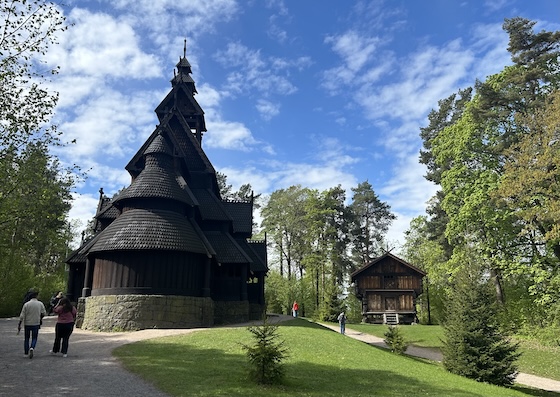
The first is the Norwegian Museum of Cultural History, which is an attempt to show visitors how the native folk lived from the 13th century on. Built on not quite two acres, the open-air site boasts some 160 buildings that capture the past, from the Gol Stave Church to a recreation of an early 20th-century village.
A Viking Ship Museum – the Norwegians are clearly proud of their Viking past – is closed until 2027. This was, of course, disappointing but was something that got remedied later in our trip. More on that later.
Afterward, we catch another bus and travel on to the Kon-Tiki Museum, which honors the historic 1947 ocean voyage of Thor Heyerdahl and his crew that proved it was possible to sail from Peru to the islands of Polynesia. Not only did we watch the hour-long documentary, which won the 1951 Oscar for Best Documentary Feature, but we were able to see the balsa-wood raft itself.
Oh, and backing up a bit, I need to note that while riding through Oslo’s suburbs, I couldn’t help but feel how much the city reminded me of Seattle – though minus the homeless folk huddling in various doorways.
I felt much the same way on our drive in from the airport. I was struck with how much the surrounding countryside reminded me of the times I’d driven to Chewelah.
Now I know why there’s a Sons of Norway chapter in Spokane.
Up next: Edvard Munch’s “Scream” and Alfred Nobel’s legacy.