Olso’s museums and parks boast the naked truth
And so I continue with the trip to Norway that my wife and I made earlier this month, which culminated with a cruise through the country’s famous fjords:
Sunday, May 4: One thing that might people not know about Norway is that it, not Sweden, is the country that awards the Nobel Peace Prize.
Yeah, Norway. Not Sweden.
Alfred Bernhard Nobel, of course, was the Swedish scientist whose expertise wasn’t just in chemistry but extended to engineering as well. In addition, he was both an inventor and an entrepreneur. After making a fortune by inventing dynamite, he – for reasons that are still debated – ended up donating much of his estate to establish what would be called the Nobel Prize.
The prize was initially planned to be given in five different areas. Three were to go to individuals showing “eminence” in physical science, chemistry and medical science. A fourth was for literary work, and a fifth – the Nobel Peace Prize – was to be awarded to someone who had “done the most or the best work for fraternity between nations, for the abolition or reduction of standing armies and for the holding and promotion of peace congresses.”
(For whatever reason, in 1968, Sweden’s central bank instituted a sixth award, the “Sveriges Riksbank Prize in Economic Sciences in Memory of Alfred Nobel.”)
Unlike the other prizes, the committee that awards the Peace Prize, again for reasons that aren’t clear, is located in Oslo. As is the Nobel Peace Center, which is where we visited on this sunny Sunday.
We met up with our Spokane friends, Sheri and Dan, who were on their own tour of Norway – and who were traveling on a level budget that was a couple of notches (or more) above ours. But for a couple of hours this afternoon, we were on the same level.
Our first stop was the National Museum of Norway, an impressive building set near the waterfront that houses some 6,500 different works from Norway’s past and present. Maybe the most popular art piece on display is, of course, the 1893 Edvard Munch painting “Scream,” one of 57 of the late artist’s works in the museum.
By the way, you pronounce Munch’s surname as “Moonk,” not the way you would with the word that rhymes with the sound made when you eat a carrot.
We then headed over to the Nobel Peace Center. Set only a six-minute walk from the National Museum, and situated in what was Oslo’s 1872 train station, the center houses exhibits honoring each of the 142 laureates – 111 individuals and 31 organizations – that have been awarded since 1901. Note: All the awards, but particularly those regarding the Peace prize, have had their share of controversy.
After eating a light lunch, we completed our metaphorical museum triptych by taking in the Astrup Fearnley Museum Of Modern Art, the most impressive piece of which was one of three existing Jeff Koons’ near-life size porcelain sculptures titled “Michael Jackson and Bubbles.” (The other two, it seems, can be found in museums in Los Angeles and San Francisco.)
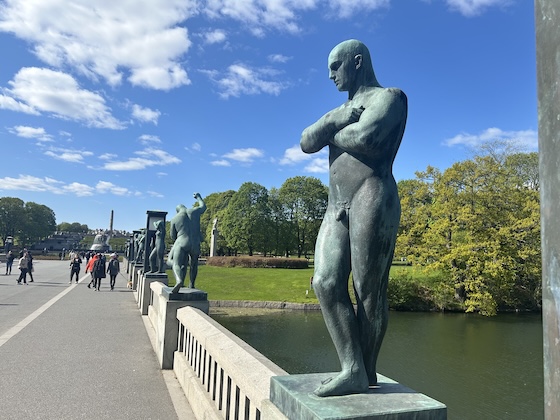
If that wasn’t enough art appreciation for one day, we said goodbye to Sheri and Dan – who were headed the next day to latitudes north – and took advantage of Oslo’s great tram system to ride out to the city’s Frogner Park. And why? Because that’s where we were told we could find the weird sculptures of the late Norwegian artist Gustav Vigeland.
(Let me pause here and say how much I admire Oslo’s public-transit system. Both the buses and trams, all of which are electric, are clean, dependably on time and cover much of the city itself.)
Oslo’s biggest park, Frogner Park dates back to the 18th century and includes the Frogner Manor House, a set of baths, a sports stadium, a café and restaurant and what’s said to be Norway’s largest collection of roses.
Yet it is the 80-acre section that houses some 212 of Vigeland’s bronze and granite sculptures, most aligned alongside a bridge, that most people come to see. Especially noteworthy, though, is the 46-feet-high monolith, consisting of 212 interlocked human figures, that sits atop the park’s highest point.
According to an Oslo University essay, “Vigeland’s goal, according to one of his biographers, was to represent what people have in common, regardless of race and culture. What we are supposed to see are timeless humans, naked in body and mind.” Underline the word naked.
In fact, I can’t imagine such a display in an American park. Not in San Francisco or Portland, but specially not in Spokane. But on the day we visited, hundreds of people of all ages and ethnicities walked by. And many took selfies by the various nude sculptures, particularly the towering monolith.
No one seemed particularly offended, even if I did see a few teenagers giggling at some of the more erotic poses.
Which was hardly surprising. As I’ve noticed in our world travels, teenagers around the world – whether we’re talking about Greek teens at the Oracle of Delphi or Chinese teens in Beijing’s Forbidden City – seem to have many of the same kinds of attitudes.
And they’re almost always busy sharing those attitudes as they stare into their respective iPhones.
Next up: More (and less) Munch and a library for the ages.