London parks, museums, a TARDIS look-alike … and home
(It’s been a long trek, but I’m finally concluding my report about the Norway cruise that my wife, Mary Pat Treuthart, and I took in May.)
Sunday, May 18, 10:25 a.m.(British Summer Time): We’re sitting in a pastry shop across the street from the British Museum. We have an 11 a.m. entry reservation, something that – considering the long line waiting at the front gate – should come in handy.
This will be our first visit in years to the museum and its 8 million objects, which are on revolving display – though the Rosetta Stone seems to be a constant. And while the museum itself, founded in 1853 and opened six years later, has at its heart an admirable goal, how it has achieved that goal over the centuries continues to be the subject of debate.
Here is what the museum says about what drives it (as printed on its website): “an insatiable curiosity for the world, a deep belief in objects as reliable witnesses and documents of human history, sound research, as well as the desire to expand and share knowledge.
That’s all well and good. But then there’s the other side, which the comic James Acaster lampoons in a brilliant routine. Laugh as you learn.
3:57 p.m.: Anyway, we made it through the massive facility in a little over two hours and were surprised at how less crowded it is on the London streets than the day before. We did, of course, bump elbows with the many visitors vying to take photos (some selfies) at the Rosetta Stone exhibit.
Note: On our way back to the hotel, it was hard not to notice the number of panhandlers and, I suspect, those referred to as the “unhoused.” And I note that while there are far more of these people than we saw in Norway, there are far fewer than you’re likely to find in Seattle, Portland or even Spokane.
We walked though Russell Square, which has a storied history that’s emblematic of the UK class (some would say caste) system. I especially like the story, circa 1864, when the place was known as Long Fields and — according to a sign in the park itself — was considered “a place of unruly behaviour.” A pair of sisters were said to cut the strings of kites flown by young boys and take the clothing of boys who would bathe in the area’s ponds.
The borough in which we are in, Camden, is fine for our purposes. Not only is it close to both Russell Square and Tavistock Square (and its gardens), but it is filled with a number of cafes, coffee shops and is within walking distance of the British Museum and even the theater district.
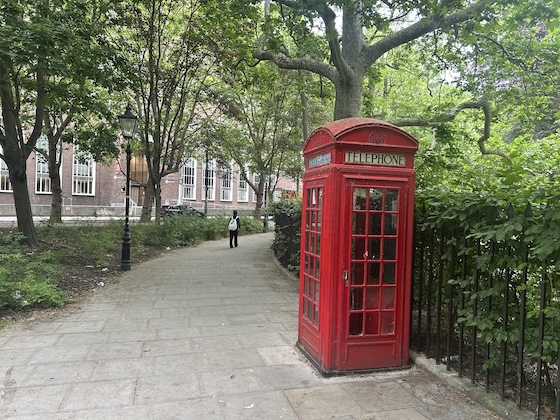
It’s just outside Tavistock Square that I found, to my delight, one of those old-fashioned police call boxes. It reminded me of one of my favorite British television shows, “Doctor Who,” which I first began watching during the 1980s on Spokane Public Television. If you’re not familiar with the show, know this: The Doctor is a Time Lord who travels around in a TARDIS, which is an acronym for “Time and Relative Dimension(s) In Space.”
In short, it’s a time machine that typically is disguised as a standard call box. (BTW, everyone has a favorite Doctor, and I’m no different. I’m a fan of both David Tennant and Matt Smith, the 10th and 11th actors who starred in the long-running series.
Monday, May 19, 1:15 p.m. (British Summer Time): We’re in Heathrow Airport, sitting in a lounge waiting on our flight home. Getting through security wasn’t easy because I apparently can’t follow instructions.
Here’s the problem: I’ve always been sensitive to the metal that I wear, whether it’s a belt buckle, my watch, a pen or even a pair of glasses. But I’ve never had a problem with tissues that I typically carry in my back pocket. Until, that is, just a few minutes ago. “You’re not supposed to have anything in your pockets,” I’m told by an irritated security employee, who makes me go through the screen process a second time.
That was almost enough to ruin the good feeling that I had after rising earlier today and, while searching for pastries and a decent cup of coffee, again found myself walking past the police call box at Tavistock Square. I stood there, wishing that I could just step into it and in an instant be whisked home.
But, no, I find myself here, looking forward to a 9-hour-plus flight to Seattle and then hoping that there will be enough time to make our connection to Spokane.
4:21 p.m.: Finally we’re in the boarding area of Gate 21, and I’m surprised that I’m having trouble understanding the instructions being transmitted over the airport sound system. This is not the first time I’ve experienced this problem, having endured the same situation in China, Italy, Indonesia, Qatar, Hungary, Kosovo, Brazil, Mexico and elsewhere.
But this is occurring in England, the country that invented the language I’ve been speaking for the better part of seven decades. I catch only snippets of what the woman is saying, maybe every fifth word.
As I wrote in my journal, “Her accent is delivered in a high-pitched, sing-songy manner that I would find irritating were it something I had to face on a regular basis.”
No danger of that, though. I manage finally to step into the metal tube that will take me back home, far from the fjords of Norway, the waffles of Bruges and the parks, theaters and museums of London.
And I lose myself in a fantasy that the plane is no mere jet but an actual TARDIS with the good Doctor at the helm.
Life is good. And despite the occasional hardship, travel always makes it better.