This column reflects the opinion of the writer. Learn about the differences between a news story and an opinion column.
Spin Control: Protests in the Northwest: Antifa or anarchists?
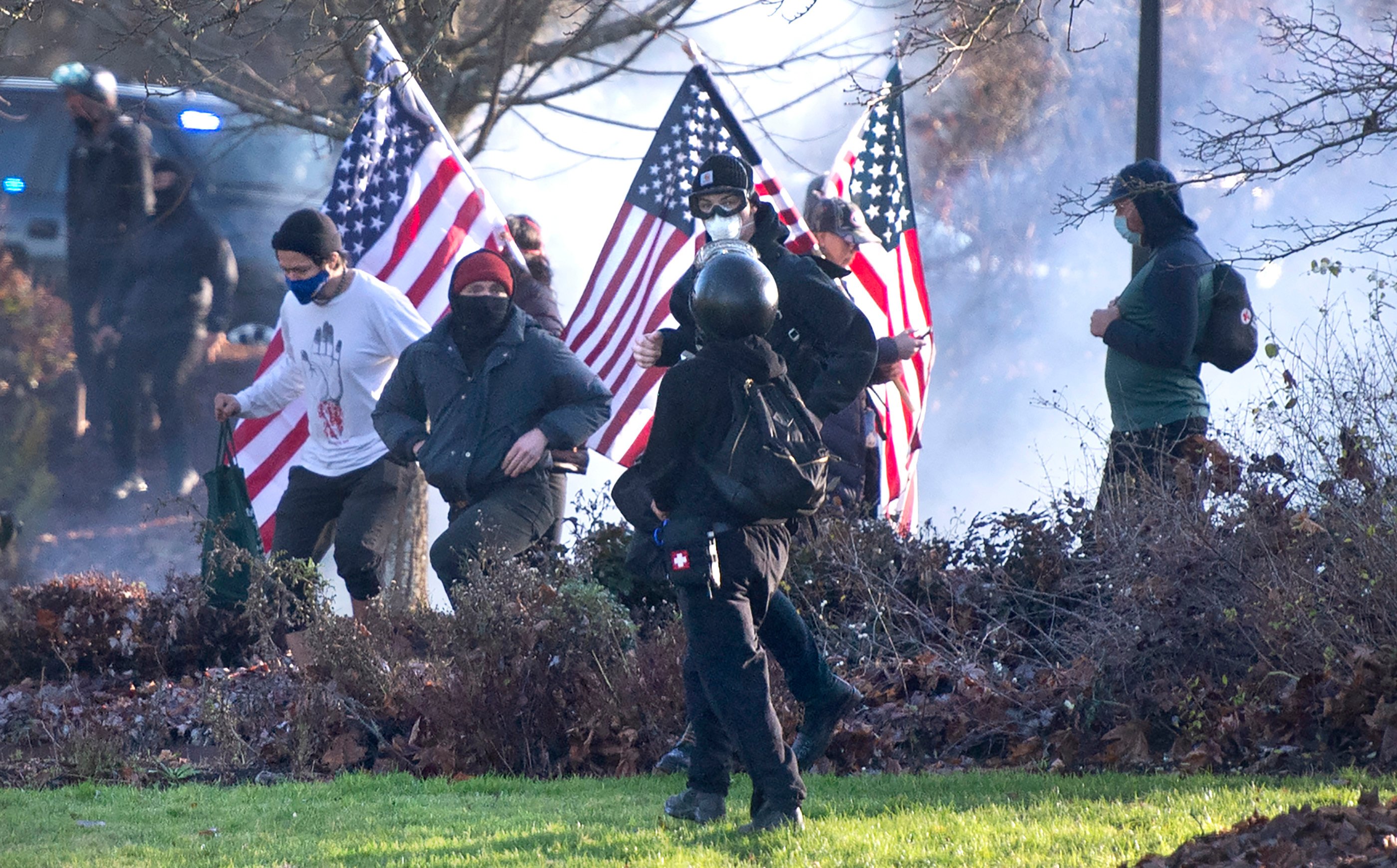
The designation by President Donald Trump of antifa as a “domestic terrorist organization” and his order to deploy federalized National Guard troops to Portland has many people in the Seattle metropolitan area waiting for the next combat boot to drop somewhere in the Puget Sound corridor.
As a prelude to whatever action might be next, it seems important to try to offer a bit of clarity on protest movements on the wet side of the Cascades that has been gained through long exposure.
First, antifa isn’t an organization, it’s an abbreviation for anti-fascist. Most people are opposed to fascism, and have been for about a century. But there is a wide range of views on how to oppose it. The president and many of his supporters tend to label anyone who vocally disagrees with them as antifa, while many of his opponents like to point out that their father or grandfather fought the Nazis during World War II, which means they were antifa.
It has become a term described by Humpty Dumpty in “Through the Looking-Glass” as a word that “means just what I choose it to mean – neither more nor less.”
If you see protesters at some future demonstration dressed all in black, in some cases sporting balaclavas and seeking to create chaos, they might be anti-fascist. But the more important distinction is that they likely refer to themselves as anarchists. They are the people who like to spray paint a capital “A” surrounded by a circle on buildings, fences and sidewalks. Their second favorite thing to spray paint is ACAB, which stands for All Cops Are and a B-word that suggests questions about an officer’s parentage. This no doubt endears them to police everywhere.
Anarchists, by definition, are not an organized group, as they are opposed to any strict organization. Also, by definition, they are opposed to governments run by fascists, communists, socialists, oligarchs and monarchs, as well as to democracies and republics. If they had a theme song – and a sense of humor – it would be Groucho Marx singing “I’m Against It.”
In some ways, they are to the left side of the political spectrum what the members of the sovereign citizen militia movement are to the right side of the spectrum. Neither believes in the power of the government to control their actions. One difference, however, is that while sovereign citizens usually keep to themselves unless they inadvertently run afoul of legal authorities, anarchists are drawn to protest events like ants to a Fudgsicle melting on a hot sidewalk. They usually come spoiling for a fight, and sometimes get their wish after most of the other demonstrators have gone home for the evening.
In recent years, the anarchists on the far-left in the Northwest have sometimes knocked heads (literally) with members of the Patriot movement on the far-right. Some might consider this ironic, because anarchists believe the federal government is illegitimate and tyrannical, while members of the Patriot movement believe the federal government is tyrannical and illegitimate, although somewhat less so since Jan. 20, 2025.
Anarchists have been known to get belligerent when having their pictures taken by news photographers even when they are in very public places, like in front of the state Capitol. Members of the Patriot movement are more accommodating to news cameras, possibly because they bring more colorful banners and flags, including lots of variations on the Stars and Stripes.
Both groups have members who will travel from Oregon to Washington, or vice-versa, to take part in protests. A clash between the two groups can be chaotic, destructive to nearby property and dangerous to anyone in the general vicinity.
That could likely be handled by a combination of city, county, state and federal law enforcement. Calling in the troops and declaring martial law would be exactly what the anarchists want, because it would allow them to tell themselves that they are right about the government. So while – in one sense, anyway – they would win, everyone else would lose.
A correction on recyclable plastic bags
Last week’s column on a legislative hearing over changes to the state’s recycled plastic bag laws had a big mistake on little measurements.
As several alert readers emailed last Sunday, the column incorrectly described the thickness of the bags as between 0.5 and 4 millimeters, which would be relatively small measurements if one is used to, say, lumber.
But the measurement in the law that controls the thickness of bags is actually mils, which is an even smaller measurement, and not metric at all. It is one-thousandth of an inch.
For comparison, there are slightly more than 25 millimeters in an inch; there are just under 40 mils in a millimeter. A dime is slightly more than a millimeter thick and two stacked 50-cent pieces are slightly more than 4 millimeters thick, which would be pretty thick for a bag.
Visualizing a mil is a bit harder. The clear plastic bag around your dry cleaning is probably about 0.75 mils thick, and the bag around a loaf of bread is about 1.5 mils, so it is in between those two. Four mils is about half the thickness of a piece of copy paper.
Exhibits at a hearing on changing the law referred to the thickness in mils. Replacing that with millimeters was my fault.