Returning to Hawaii and fulfilling a dream
During the four years that I lived in Hawaii, my parents made sure to explore much of what the island of Oahu has to offer.
I attended sixth grade in what, at the time, was the small village of Wahiawa (the area, which has grown a lot over the decades, is officially referred to as a “census-defined place” or CDP). And after a year back on the mainland, we returned to Oahu. This time we lived in Ewa Beach where I attended grades eight through 10.
On Sundays, my father would take us on long drives, several of which over time involved a circuit of the entire island (it would take most of the day). I can recall driving through Haleiwa on the North Shore past what, in the day, were giant fields of pineapples. Other days we would go the opposite direction, through Waikiki Beach and on past Diamond Head to view the Hālona Blowhole.
One of my favorite spots to visit was the historic Nu’uanu Pali Lookout, which can be accessed on State Highway 61 and which connects Honolulu with the windward areas of Kailua and Kaneohe. I learned enough Hawaiian history to know that this promontory was where in 1795 King Kamehameha I cemented his campaign to unite all the islands by winning the Battle of Nu’uanu.
I remember standing on the edge of the cliff and imagining what it was like being one of the doomed warriors facing Kamehameha’s forces and having to choose between being killed by them or jumping to my death. Such are the thoughts that run through the mind of teenage boys – or at least they did through mine.
My parents did not do two things that are typical activities for the many tourists that visit Hawaii these days. One was to visit any of the other islands. In those days it was far more difficult, and likely more expensive, than it is now when flights go several times daily from Honolulu to the Big Island, Maui, Molokai, Lanai and Kauai.
I wasn’t able to experience any of the other islands until I honeymooned on Maui. Mary Pat Treuthart and I stayed first in Lahaina, which allowed us to experience the old whaling village long before it was destroyed in 2023 by a flash fire. Afterward, we rented a place in Hana, which gave me the opportunity to drive the infamous Hana Highway with it 600-plus curves. And I drove it twice.
My parents didn’t have a lot of money, so it didn’t surprise me that we never left Oahu. It’s not as if we were poor, but trying to support a wife and four children on a Naval officer’s salary didn’t leave a lot of money for that kind of tourism – thus the many Sunday drives.
The other more surprising thing that my parents – my father in particular – didn’t do was to take us to Pearl Harbor. Four years on the island that my school friends referred to as “the rock” – as in, “One day I’m gonna get off this rock” – and we never visited the site of the infamous attack that pulled the U.S. into World War II. Not once.
I knew of the attack, of course. On those weekends when my father would take my two brothers and me out of the house, largely to give my mother a break, one of the places we would visit was the library at Barbers Point Naval Air Station. That library was full of military histories, and I read as much as I could about both the First and Second World Wars and Korea.
But until last August, the closest I’d come to Pearl Harbor was on those occasions when my father would drive toward Honolulu and I would look toward Ford Island where I knew Battleship Row was located. And again, I would imagine what it might have been like to have been there on the morning of Dec. 7, 1941.
All that changed earlier this year when my wife received an invitation to attend a wedding of two of her former law students. One of the students, now a lawyer, was from Oahu, and the wedding was set to be held in a Waikiki Beach hotel. It was good timing and the perfect opportunity to finally fulfill a childhood desire.
So on one free afternoon, Mary Pat arranged a visit to the Pearl Harbor Visitor Center. And while it wasn’t a particularly pleasant experience getting in – I always forget how irritating military protocol can be – I guess being treated brusquely is to be expected in these trying times.
That aside, there’s a lot to like about what the visitor center has to offer. You can tour the Aviation Museum, the Submarine Museum, take a shuttle to Ford Island and tour the USS Missouri (the battleship on which Japan’s formal surrender was signed), climb the Ford Island Control Tower and, most alluring of all to me, take a boat tour to visit the Arizona Memorial.
That final destination, of course, consists of a structure that sits atop where the battleship Arizona still rests. After departing the shuttle, you can walk through the memorial and take pictures of the ship itself, the hulk of which can be spied through the harbor’s dark waters.
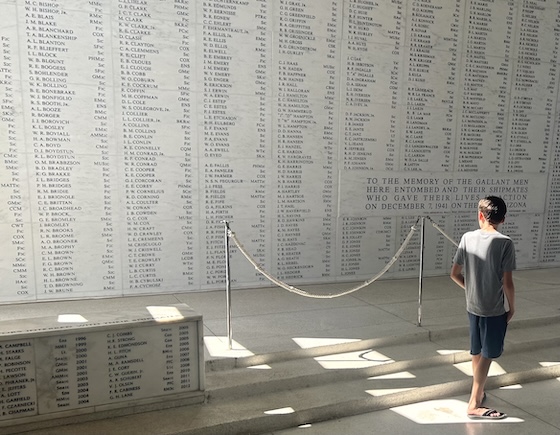
The whole experience is obviously sobering, especially when you walk to the far end of the building and look up at the wall that carries the names of the 1,177 sailors and Marines who died on what President Roosevelt called “a day of infamy.”
Standing there, I think I understood why my father in particular wasn’t interested in visiting the place. As a World War II and Korean War veteran, and a man who’d spent 28 years in service to his country, he’d experienced enough loss and grief to last a lifetime.
Still, as a Vietnam veteran myself, I was glad to have come. I thought of the 58,281 names listed on the Vietnam Veterans Memorial in Washington, D.C. And since we were in Hawaii, I couldn’t help but think of the men on both sides who died just a few miles away at the Battle of Nu’uanu.
It’s never too late to pay tribute to all those who have fallen in war.