Bruges, Belgium: Crowds, canals … and waffles
(And so I continue writing about the Norway cruise that my wife, Mary Pat Treuthart, and I took in May.)
Friday, May 16: We’re standing in the middle of Mart (or Market Square), an open area that sits in the shadow of what one website refers to as the “beating heart of Bruges.” That’s Bruges, as in Belgium.
This is the final full day of our Norwegian Fjord Cruise, though in reality we left Norway the day before yesterday. Following a full day at sea we docked early this morning at the port of Zeebrugge, which is some 14 miles from the city that Rick Steves calls “a heavyweight sightseeing destination.”
It was a struggle to find a ride into Bruges itself since the buses don’t seem to come regularly and the line to board them was already long. So, we opted to call an Uber. Some 20 minutes later, here we are.
BTW, the “beating heart” I referred to up above is the 83-meter-tall Belfort (or Belfry), one of the three towers that this Belgian city is known for. The view from the top is apparently awesome, but neither I nor Mary Pat, not to mention her sister Jean or Jean’s husband Steve, is willing to negotiate the 366 stops we’d need to climb to get up there.
Besides, we wouldn’t have time. We’re standing here, amid the crowds and under a searing sun – thankfully slathered in sun screen – waiting to begin the guided city tour that MP has arranged for us. All we have to do is look for the red umbrella in what is a virtual sea of multi-colored parasols.
My initial reaction is that Bruges, at least this part of it, is far more diverse in its population than I might have imagined. People of all colors mingle, a number of them uniformed teenage students who kick soccer balls (footballs in European parlance) back and forth. As I, too, would have done decades ago, they never miss a chance to glance at the girls who pass by.
My next thought is one of slight disappointment. What I see is charming. But, too, the crowds remind me that much of the world’s most-visited sites – from Shanghai to Tokyo, Stockholm to Rome, Paris to Istanbul, all cities I have visited – seem to have been converted into virtual theme parks for tourism.
When we finally do meet up with our red-umbrella guides, there are too many of us to handle in a single group. So we split up, and our four end up following Celine, a Dutch native who speaks English fluently. It turns out she teaches both English and Spanish, and she once lived in Uruguay with the man who is now her ex (TMI?).
Celine takes us through the city, stopping here and there to lecture us both on Bruges history and the city’s architecture. One interesting story she tells concerns how a bear became the city’s symbol and actually is part of the city’s official coat of arms.
It all dates back to the 9th century when a minor nobleman named Baldwin fell in love with the teenage Princess Judith (already married twice before, Judith was just 17 and the daughter of King Charles II of West Francia, while Baldwin may have been around 33).
As with so many other tales based on legend – even though Baldwin and Judith were actual historical figures – Baldwin was to become Count Baldwin 1, the Margrave of Flanders. And his strength and courage, which proved enough to ward off succeeding hordes of Vikings over the years, was initially proven when enroute to Bruges he is said to have killed a marauding bear. Based on the story, he came to be known as Baldwin Iron Arm.
Note: To watch a YouTube video explaining the story, click here.
Over our two-hour tour, Celine tells us any number of stories about Bruges history. Among them are her version of the only battle the city ever won, how the city became a trading center because the sea once came right up to the city walls, and how various European wars caused so many changes in both government and trade patterns that Bruges fell on hard times and. Ultimately, she explains, it was tourism that brought it back to life.
Sources for some of these stories are easily found online, while others are likely Celine’s simplified view – shaped to entertain those she guides – of a much more complicated web of historical interconnections.
Whatever, after we bid Celine farewell we end up having lunch at an outdoor café, sitting by chance next to a group of fellow Americans. And as is the fashion of many U.S. residents abroad when they meet, we commiserate about the difficult situation at home, which boasts its own maze of societal complexities.
Then, of course, we have to stand in line to eat one of the few things Belgian that most Americans can easily recognize: waffles. Among the many waffle-making choices the city offers, a place called Chez Albert is considered the best. (Fun fact: Belgian waffles were introduced to the U.S. in 1962 during the Century 21 Exposition, otherwise known as the Seattle World’s Fair.)
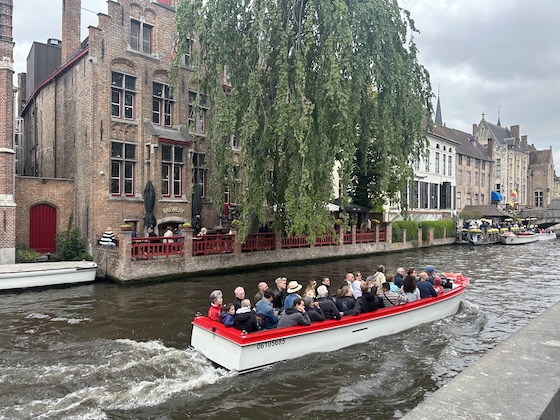
While digesting the blend of flour, yeast, confectioners’ sugar and strawberries (drowned in chocolate sauce) that we’d ordered, we stand by one of the several canals that make Bruges feel somewhat similar both to Venice and Amsterdam. We watch as several motor boats cruise by full of other visitors.
I’m reminded of two things: One, how much the view feels as if I were decades younger and about to get on Disneyland’s Pirates of the Caribbean ride. (Remember what I said about tourist sites becoming theme parks?)
Two, that we have just a couple of hours to get back to our ship, the Celebrity Apex. The final night on board promises to be a busy time, packing before our early departure the following morning.
Our cruise is coming to an end. But before we return home, we’re going to take a couple of days to see what London has to offer.
I just hope we don’t run into Micky Mouse or his pals. E-tickets are too expensive these days.
Next up: Back to the U.K., London calling.