Vibrant London: A mix of crowds and fine acting
(And so I work toward a conclusion to my report about the Norway cruise that my wife, Mary Pat Treuthart, and I took in May.)
Saturday, May 17, 10:07 a.m. (British Summer Time): I’m sitting on a crowded train that departed a few minutes ago from the Southampton Central Railway Station. We’re headed for London’s Waterloo Station.
After enjoying our visits to Oslo and Bergen, the cross-Norway train trek, then boarding the Celebrity Apex to hit a number of Norway’s famous fjords before making a final stop in Bruges, Belgium, we’re now planning to spend a couple of days in England’s capital city.
Leaving the Celebrity Apex posed no real problem as we’d packed everything the night before. We had little time to bid the liner farewell before we met up with Mary Pat’s sister Jean and her husband Steve and caught a cab to the station.
Turns out we arrived more than an hour early. I mention this only because when it came time to board the train, we got caught up in a last-minute rush. And when we found seats, we discovered that we couldn’t sit together and that there was no place convenient to stow our suitcases. Heavy as they are, I had to squeeze them as well as I could in the overhead racks.
What I find interesting is that our car is full of all different sorts of people – old, young, native Brits and foreign travelers … which, of course, is what we are.
(As it turns out, that aura of diversity will be representative of our entire London visit … but more on that later.)
7:23 p.m.: We arrived at Waterloo station just before noon and cabbed to the Morton Hotel, which sits just across from historic Russell Square Gardens. After checking in, we bought tickets online for London’s National Gallery. We’d planned to take the city’s subway, The Tube, to get there but, oops!, the stops nearest to our hotel were closed for “maintenance.”
So, again, we took a cab. The gallery was showing a special exhibit, “Siena: The Rise of Painting 1300-1350.” My main interest in seeing Italian paintings, though, is seeking out works by Caravaggio, a master who came along a couple of centuries later than the art in this exhibit. So away I walked. (FYI, the gallery has three Caravaggios in its permanent collection: “Boy Bitten by a Lizard,” “Salome Receives the Head of John the Baptist” and “Supper at Emmaus.”)
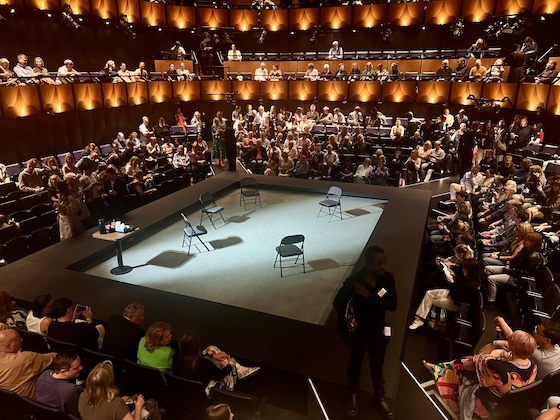
We’re now sitting in the Soho Place Theatre, ready to see a play titled “The Fifth Step,” which features two well-known actors, Martin Freeman and Jack Lowden. We have good seats, thanks to Mary Pat, but then the benefit of this theater-in-the-round setup is that all the seats offer a good view of the stage.
10:22 p.m.: The play proved to be just 90 minutes long, and it is one of those topical studies that involves two characters – one (Lowden) a man battling alcoholism and the other (Freeman) his Alcoholics Anonymous sponsor (thus the significance of the play’s title).
As the story progresses, the sponsor – who starts off the stronger of the two – gradually switches places with the other character. As I wrote in my journal, “It’s clever and hits some serious points but is too much a comedy to take seriously. The two actors are good, though, with Lowden showing more than he does in the series ‘Slow Horses,’ and Freeman being as solid as ever.”
Not to mention that, with tickets costing only 100 English pounds, we paid maybe a third or less of what would have for an equivalent play in New York.
As entertaining as attending the play was, two events leading up to it proved to be more interesting. One involved the dinner Mary Pat and I experienced at Pierre Victoire Restaurant, a French bistro that congratulates itself for “its fantastically priced, high quality contemporary French menu and its warm and inviting ambience.”
I’d say a definite yes to the former but not so much on the latter. We initially were shown to a table on the ground floor level, but when we informed the staff that two of our party weren’t coming, we were told we’d be more comfortable sitting downstairs (in the basement).
No problem, we thought, except that downstairs is where the kitchen is, and we could hardly hear ourselves speak with all the clanging of pots and pans. We, and the parties sitting at two other tables nearby, finally complained … and things slowly quieted down.
But our walk to the restaurant, and then on to the theater, should have given us an idea of what to expect. I’d been to London twice before, though not for decades, and I wasn’t prepared for how crowded it was. Again, I wrote in my journal: “The streets of central London are packed. People jostling on the sidewalks, and everywhere such a diverse crowd, all colors and nationalities. I’ve never seen such a scene even in New York.”
Our ride to the National Gallery earlier in the day had been affected just as much by the crowd streets. Our cab got held up because of a flag-and-banner-waving parade of Manchester United football (soccer) fans in town for a match with Crystal Palace, forcing us to get out and make our way forward on foot.
“Then,” I wrote, “near the gallery we saw another march, this one composed of supporters for a Free Palestine. And, finally, in front of the gallery itself a booth was situated, complete with flags and loudspeakers, that supported a Free Iran movement.”
I summed up my reaction this way: “Overall, it feels like a vibrant, exotic circus … energetic and exhausting all at once. And it’s just mid-May, in what used to be pre-tourist season.”
Times clearly have changed. As has London.
Next up: Artistic treasures and signs of Doctor Who.