This column reflects the opinion of the writer. Learn about the differences between a news story and an opinion column.
Faith and Values: Longing for a future defined by words of peace and well-being
Hard as a person tries, some things stick – things that we never stop caring about – things we tend so hard they tune our senses, earn a peek of an eye, a perk of the ear, the soft settle of recognition in a mind.
I’m stuck on words. I cannot abandon caring for them. I miss old words like yesternight, giglet and scoundrel. I listen for new words and make a point to use shero, awfulize, enoughness and sadfishing. Forgive the obvious word drop – it’s unsurprising and unsubtle. Nearly insufferable.
A person stuck on words like me waits for November-ish when the definitive authority at Oxford announce the official word of the year. There’s a sticky process to words that stick hard enough in a year’s time to get to be the official word of the year, but it’s seldom such a surprise.
The Oxford word of the year for 2025 is “rage bait,” and the year before? The Oxford word of the year for 2024 is “brain rot.” What horrors have we Oxfordized here? They sound like the common names for serious diseases like cranium gangrene or cerebrovascular aneurysm.
Both “rage bait” and “brain rot” are internet-related, and the internet – that brilliant library of genius that was supposed to be shared enlightenment for all – somehow turned into a Babel of bits and bytes and diseases for human hearts and minds.
Today’s internet is a minefield of flatscreened fakery, baiting for rage and slopful rot, post-truthed, algorithmic echo chambers, doomscrolling and trolls. It should come with a warning from the surgeon general for the ills it causes, and a guide for the good it can be used for – a “how-to” for avoiding the rage and being baited only by brilliance.
The best I can do is use the internet deliberately and avoid all social media in favor of real-life social experiences. I can’t avoid using AI, and in the absence of media literacy (who can tell what’s what anymore?), I gravitate toward websites where local people do local people things. My bookmarked websites are mostly hobbies, bookish things, gardening and recipes. But (very revealing) the first thing auto-filled in my Google search field is favs.news.
The habit is to check for local religious news. I like the FāVS mix of journalism and personal commentary. Local religious news is surprisingly always different, which I find infinitely interesting. It’s a gift to myself to know what is meaningful in another’s life. It reminds me to reflect on what is meaningful to me. Understanding only happens when meaning is shared.
Philosopher and religious historian Mircea Eliade believed that religion is how a person orients themselves in the cosmos. He did not bother to make a case for nonreligious people like me who also share the cosmos, but I do. Religious or not, how we experience life and how we make meaning in our hearts and minds through space and time stuck on me. Like words.
For me, favs.news is a place where religious pluralism and nonreligious values such as mine is verbed and verbalized. It is the local religious landscape. Good theology and in my case, atheology, is pluralistic; it is the study of gods and spiritual experience, past, present and future. Human beings are rich with valuable, transformative experiences, and I’m rather fond of discovering that epiphanies and sweet understandings are universal. Our sacredness is what is the same in our diversity.
I wish I didn’t care so much about words. It’s a year of dread for Oxfordized word -of -the -year lovers. A year of wishing the future to be defined by words that mean peace or human wonder and well-being. Anything but another internet-caused disease.
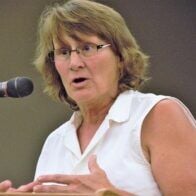
Janet Marugg, of Clarkston, Washington, is a nature lover, a lifelong learner and a secular humanist.