This column reflects the opinion of the writer. Learn about the differences between a news story and an opinion column.
Spin Control: A $250 bill seems like a strange idea, but there have been stranger
When I was a 16-year-old french-fry cooker and register ringer at McDonald’s, the store had a policy that any $20 bill we took in payment had to be checked by a manager.
It was designed to keep the store from accepting counterfeit $20s. It didn’t apply to other bills, but management apparently decided that fast-food workers earning minimum wage – at the time $1.60 an hour – would be so unfamiliar with $20 bills that we’d be easy to fool. When verified and accepted, the $20 went under the tray that held change, singles, $5s and $10s in the register draw, lest an unscrupulous customer grab it when the draw was open and our back turned.
There was no such rule for $50 or $100 bills, as we never saw them. Not many $20s had to be checked, as this was also a time when McDonald’s touted the “All-American Meal,’’ consisting of a hamburger, fries and a Coke and change back from your dollar.
Yes, it was a long time ago.
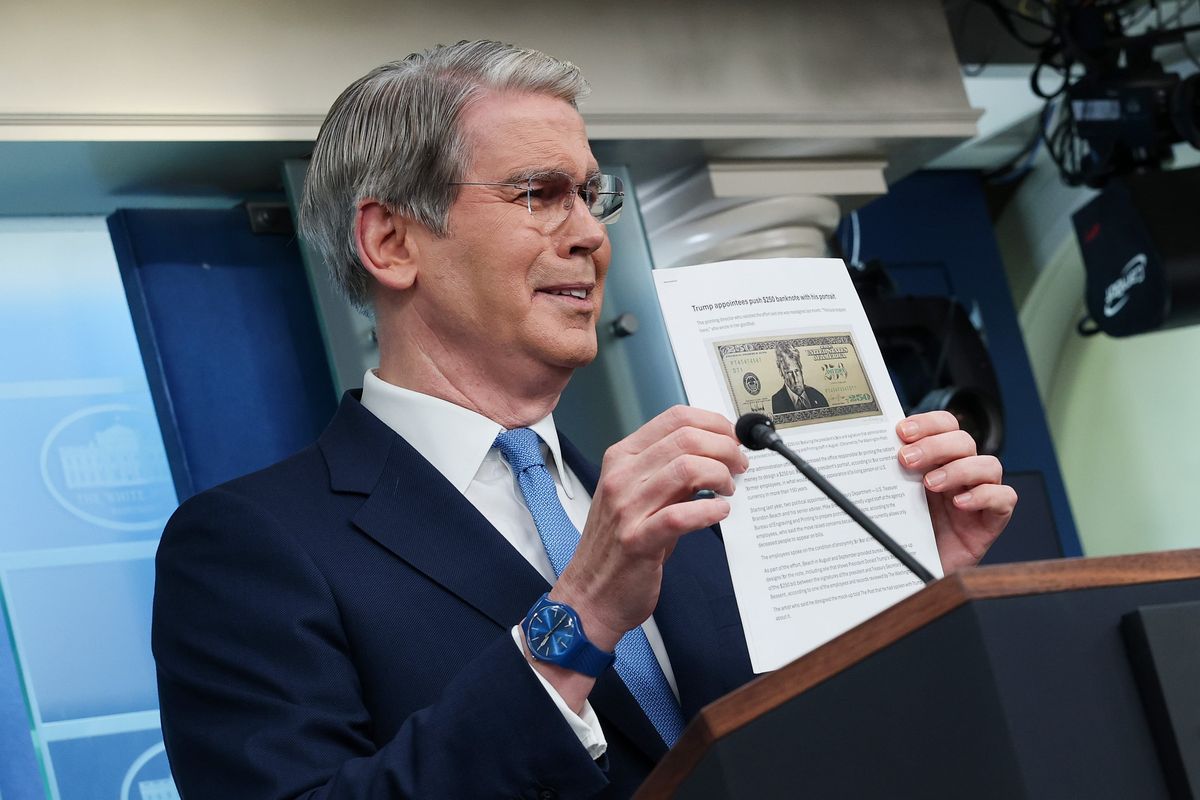
I thought about this bill-checking policy lately as controversy continued to swirl around a proposal for the federal government to start printing $250 bills, featuring the image of a somewhat glowering President Donald Trump.
Allowing for inflation, a $250 bill might be slightly less useful for every day transactions than a $20 bill was in 1969, when I wore a white shirt, silly hat and apron at the golden arches. Its use at fast-food restaurants, mini-marts and gas stations would likely empty their register of their smaller bills on a regular basis, forcing runs to the bank for more change.
It might, however, be a boon for drug cartels, if all the movies about such operations are to be believed. All such films have at least one scene in which large stacks of Benjamins, as $100 bills are apparently known on the streets, are run through a machine that counts and wraps them in more easily recorded stacks before being placed in brief cases or duffel bags for delivery to banks or warehouses. By shifting the largest circulating bill to $250, the volume of cash to be carried or stacked could be reduced 2.5 times.
The denomination of the bill is a bit odd by U.S. currency standards – we have a $2 bill and a $20, but not a $2.5 or $25 bill – but is reportedly tied to commemorating the 250th anniversary of the adoption of the Declaration of Independence.
At that denomination, it’s pretty far outside the realm of most other U.S. commemoratives. Those are usually coins in the quarter, half-dollar or dollar denominations. Although collectors typically pay a bit above face value and hold onto those commemoratives, it’s unlikely that anyone short of a billionaire would be willing to tie up $250 for this bill then put it aside in a plastic case.
There’s also the small problem of the law, which since 1866 has made it illegal for a living person to have their picture on U.S. currency. Treasury Secretary Scott Bessent told Congress last week that his office wasn’t planning to break the law to print a Trump $250 but was just making preparations in case the law changes.
At the pace Congress moves, it seems unlikely the law will be repealed before the July 4 anniversary rolls around.
Another face
on another denomination
Talk of the Trump $250 also reminded me of another person who liked having his face on an unusual denomination of greenbacks.
In my first summer as a reporter in Spokane, I bumped into Love 22, a bearded man in an Uncle Sam outfit in Riverfront Park, where he was distributing $22 bills. They were 22 cents apiece, or five for a dollar.
That was his legal name – he’d changed it five years earlier – because he had a fixation with that number, which he believed was the master vibration for the universe. He believed each letter of the alphabet had a numeric value, and words that added up to 22 tapped into that.
He was running for president, of course.
The bills were on good paper, the same size and shape as other U.S. currency with a back almost the same shade of green. That resulted in 22 being arrested by federal agents after my story about him ran. He initially faced charges of possessing something that looks like a replica of federal currency with the intent to use or sell.
But because the U.S. does not print a $22 bill, and because a federal judge in New Orleans had ruled a month earlier that the bills were not enough like actual currency to sustain a counterfeiting charge, the judge and U.S. attorney in Spokane cut him loose just 22 days after his arrest and 22 days before his trial was scheduled. So maybe there was some magic to that number.
While 22 went on his way, he continued to mount what was his third write-in campaign for president. He ran at least eight more times, all as a write-in, with the same success. At last report in the Providence Journal, he was in a senior living center in Rhode Island, and still had his Uncle Sam outfit.