This column reflects the opinion of the writer. Learn about the differences between a news story and an opinion column.
Spin Control: Ted Turner brought the Goodwill Games to Spokane in the summer of ‘90
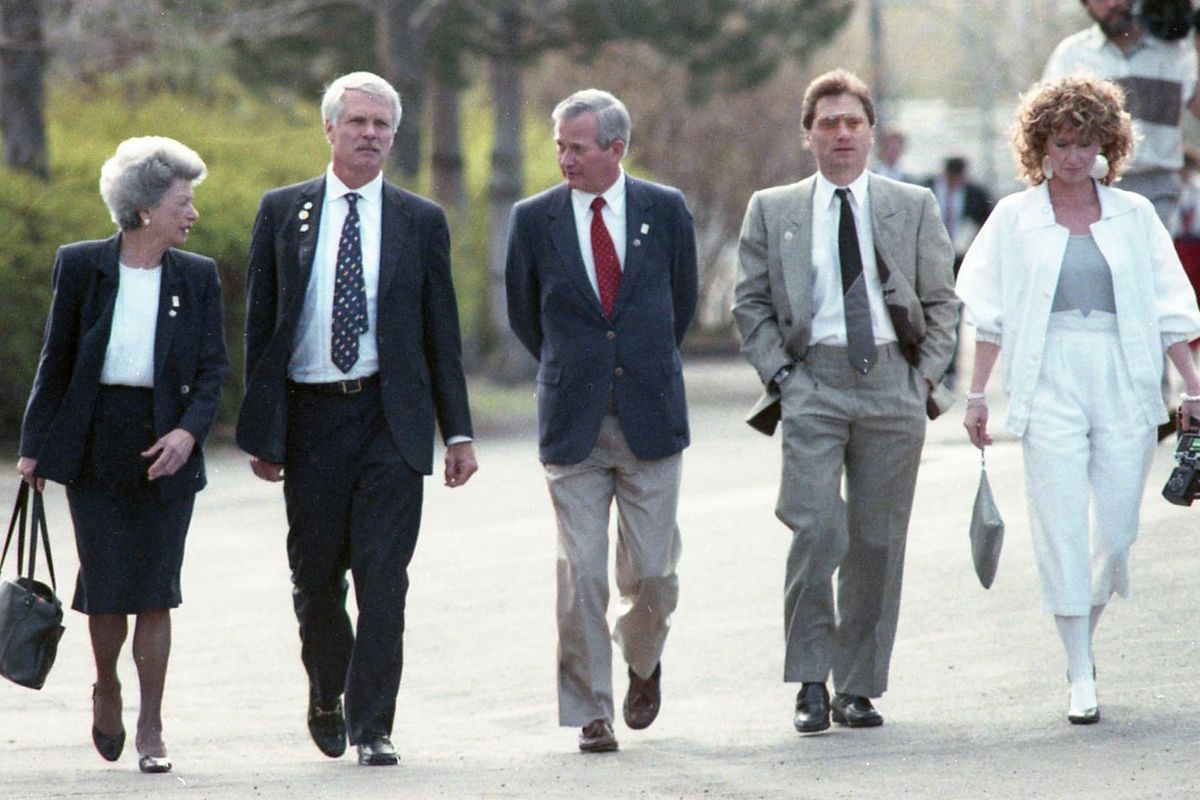
The death of billionaire Ted Turner last week brought to mind the way the former media mogul affected the Pacific Northwest other than by allowing people to watch round-the-clock news or Atlanta Braves baseball most summer nights.
Turner was the creator and chief evangelist of the Goodwill Games, which he described as a way to get the United States and the Soviet Union to compete in sports rather than nuclear stockpiles.
He started the Goodwill Games in 1986, after the United States boycotted the 1980 Olympics in Moscow and the Soviets did the same for the 1984 Olympics in Los Angeles. It wasn’t pure altruism. His cable television network, Turner Broadcast System, had the television rights. But he did lose money on the enterprise.
Not so much that Turner dropped the idea. He scheduled a new round of games for 1990 and picked the Pacific Northwest as the venue.
Most of the events were scheduled for the Seattle-Tacoma area. But in an effort to spread around the largesse, or perhaps the headaches, three events were scheduled for Spokane: rhythmic gymnastics, weight-lifting and volleyball. Another – ice hockey – was set for Kennewick.
Even though it was in the desert and the games were in July.
Promoters talked of big economic impacts at hotels, restaurants and bars, as well as healthy ticket sales to help with the summer doldrums when half of Spokane is “at the lake.”
To help boost the games, Turner did a fly-around of the three locations in April. With local games executives including former Spokane Mayor Vicki McNeill he walked through Riverfront Park to the old Coliseum. (It managed to pass muster with Turner even though its days were numbered.) He returned with them to the Ag Trade Center to address a luncheon of about 1,000 of the city’s movers and shakers.
He opined that such international sporting events can forestall wars. As proof, he noted that Hitler didn’t start World War II until after the 1936 Olympics in Berlin. (It’s possible rearming and rebuilding the German military machine, and a secret deal with Joseph Stalin, had a bit more to do with that timing, but Turner wasn’t giving a history lecture.)
Although the Berlin Wall had come down and the Soviet Union was starting to crumble, Turner warned of the continued danger of nuclear proliferation. He joked about his fears when Ronald Reagan was in the White House that the president would suffer a heart attack and fall over “The Button.”
Then, seemingly oblivious to the fact that there were several blue-suited officers from Fairchild Air Force Base in the audience, Turner cited the movie “Dr. Strangelove” as an example of what could happen.
“Kentucky Fried Planet,” was his description of that post-Armageddon landscape.
Apparently no one bothered to inform Turner that a dozen B-52s, the type of plane carrying the bombs and Slim Pickens in that movie, were parked at the base not far from Spokane. Or that the sign over the main base gate read “Peace is Our Profession.” Or that the nuclear launch system does not have a “button” on which one can fall to start a nuclear war by accident.
On the plus side, Turner was not traveling with his then-girlfriend, Jane Fonda, who folks in the military held in less esteem than anyone except perhaps Ho Chi Minh as a result of her visit to Hanoi in the 1960s. Fonda had skipped the Eastern Washington stops to go to Turner’s Montana ranch, so it’s possible she knew a bit more about Spokane.
The day earlier when he stopped in the Tri-Cities, no one had bothered to tell Turner before he got off the plane that he was visiting the place where nuclear warheads were being made. He said he’d heard of Hanford but didn’t know it was in Washington. That didn’t stop him from talking about nuclear disarmament at a dinner that night.
“I am not real high on nuclear weapons,” Turner was quoted in the Tri-City Herald the next day. “I mean, who wants to fry the world?”
Except for a single heckler, members in the audience mainly shrugged it off, the Herald reported. No one called the local Goodwill Games office to complain, a spokeswoman told the paper.
As it turned out, the Goodwill Games were not the economic boost some had predicted. The hotel industry didn’t see much of a bump in summertime reservations and ticket sales were lower than projected, this newspaper reported.
Team USA also suffered some embarrassing defeats, including a 10-1 pounding by the Soviet team in hockey, a 16-2 loss in baseball to Cuba and a 85-79 loss to Yugoslavia in the men’s basketball final. On the plus side, the weightlifting championship at the Spokane Coliseum was a sellout, although the venue’s seating was shrunk for the event.
Television viewership was also less than expected. Turner again lost money on the games, but he committed to a third round for 1994 in Moscow.
New York hosted the 1998 games and the 2001 games were in Brisbane, despite waning interest. But by then, Turner had sold his cable network to Time Warner, and it pulled the plug on the Goodwill Games for financial reasons. Also by then, the Olympics had recovered from the bad feelings over boycotts of the 1980s and the Soviet Union had broken up, so the political tension between the two super powers had gone away.
For Spokane, the Goodwill Games were the fourth in a series of highly touted summer events that failed to live up to expectations. The city had tried Grand Prix racing in downtown in the summers of 1987 and 1988, which drew less than half the expected attendance and was $1 million in debt when the plug was pulled. The Festival of Four Cultures in 1989, which brought music, art and cultural exchanges from what were then Spokane’s four Sister Cities had about half the projected attendance and also finished in the red.
Just weeks before the Goodwill Games came to town, however, Spokane got a glimpse of the event that would become the premier boost to the summer economy when local organizers of the first Hoopfest persuaded local officials to block off five downtown blocks for 3-on-3 basketball tournaments.
It succeeded and grew with a formula the others lacked: A local event by local organizers featuring mostly local participants.