Granada’s Alhambra: A majestic relic of Spanish history
History always has intrigued me. It was only when I discovered just how much original research the discipline involved, much of it in foreign languages, that I changed my college major from history to literature.
But my interest in the past has never wavered. That’s how I knew that Islam was a force in Spain for some eight centuries. I just didn’t know how much of an influence. That is, I didn’t know until I read about – and then visited – Granada’s most-visited site, the Alhambra.
Continuing my narrative concerning the recent trek through Spain and Portugal that my wife and I made, we awoke on our second morning in Granada to cool and rainy weather. Jet lag still hitting me hard, our day didn’t start until after 11.
When we did set out, our first visit was to the Royal Chapel of Granada , which is where the remains of Queen Isabella and King Ferdinand – yes, they of Christopher Columbus fame – are interred. I wish that I could say I was awed by being so close to the burial place of historical figures that I’d first learned about in grade school, but … no.
First, I was still feeling exhausted and overwhelmed – not to be repetitive, but jet lag can be debilitating. Second, I always feel a bit funny when I see gold displayed so prominently in churches, especially when you are confronted by people standing at the entrances begging for help.
Anyway, we left the church – after spending a euro to light a candle in honor of my wife’s late mother and then placing a couple of euros in the hat of the old, bearded guy standing outside – and headed for someplace to eat lunch. We decided on a café called La Vinoteca , where we sat outside and ate huevos estrellados con jamon (eggs and ham over fried potatoes).
Returning to the hotel, we cleaned up and then headed uphill to the Alhambra. And when I say uphill, I mean exactly that. The Alhambra, whose origins date back to the year 889, sits atop Sabika Hill . And for those with mobility issues, the best way to get there would be by taxi or Uber.
Since the weather was cool, with only a slight threat of rain, and we’re still ambulatory, we chose to walk. And we made it, coursing first through both city streets and then ambling the lengthy trek up the tree-lined sidewalks, pausing occasionally to catch our breath.
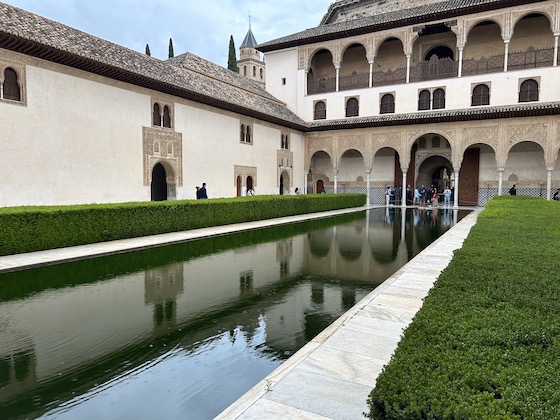
To say the least, it was worth the effort. From those humble beginnings, the Alhambra over the centuries grew into what is now a massive outlay of some 26 acres that boasts Islamic roots, it being the last vestiges of Islamic power on the whole of the Iberian Peninsula. From the early efforts of the Emirate Mohammed ben Al-Ahmar through a succession of others, including Ferdinand and Isabella, the place is now a designated UNESCO World Heritage Site.
It’s such a popular tourist destination that you’re required to make reservations to tour the vaunted Palacios Nazaries , which one website describes as “the stunning centerpiece of the Alhambra.” Because we arrived a few hours before our assigned time, we took the opportunity to tour the Alcabazá (the original “red castle,” from which the name Alhambra is derived), the palace of Charles V and the spread-out Generalife Palace and Gardens.
When it came time for our 6:30 p.m. reservation, we joined a long line of others and ever so slowly made our way toward the Palacio Nazaries. The wait was worth it, though, as the palace is a maze of rooms boasting walls of carved wood, molded plaster and intricate ceramic tiles – so many visually rich rooms, halls and courtyards, in fact, that I began to feel the kind of Stendahl Syndrome that Florence, Italy, is famous for – so much beauty that its effect is stupefying.
One travel website describes the overall impact of the Alhambra far better than I can: “As a whole, the Alhambra palace is a reflection of the culture of the last centuries of Islamic rule in the Al-Andalus or the Iberian Peninsula. It has accumulated the skills of Muslim, Christian, and Jewish craftsmen, architects, and artisans over the years, and it stands as a true testament to their multi-cultural appeal.”
Afterward, we emerged to a light rain. So, we opted to take a cab back to our hotel. And when it came time to eat dinner, we were fortunate to snare the last street-side table at the popular Bodegas Castañeda , where a supremely competent and amiable server helped us order just the right amount of food, both for our appetites and our budget.
And with a glass of Alhambra cerveza in hand, I gave a toast to the last night that we would spend in my favorite Spanish city: Granada.
Next up : Nerja and the Costa del Sol.
* This story was originally published as a post from the blog "Going Mobile." Read all stories from this blog