Las Vegas offers outdoors pleasures, too
When someone mentions Las Vegas, a number of expressions – clichés, actually – come to mind.
One of the most familiar is “What happen in Vegas stays in Vegas.” I saw a sign in the city’s Harry Reid International Airport, though, that gives that tired platitude a new twist: “What happens in Vegas … happens in Vegas.”
Hard to argue that Chamber-of-Commerce type of message, especially because it tends to temper the city’s taboo-heavy image. Which is funny because, according to Wikipedia, “Reid is one of two airports in the United States with slot machines.”
You simply can’t get away from gaming opportunities in Las Vegas wherever you go.
I bring up Las Vegas because in my previous post I talked about a visit that my wife Mary Pat and I made last week to Nevada’s desert gaming oasis. I explained how we were exploring the ways a visitor can enjoy what the city has to offer without once placing a bet, tossing dice or pulling the handle on a slot machine.
Most of the gambling in Las Vegas occurs indoors, even if several of the hotel/casinos these days offer pool-side gaming opportunities. The fact is, though, Nevada boasts a number of state parks that are well worth checking out. And that includes the area around the famous Sin City.
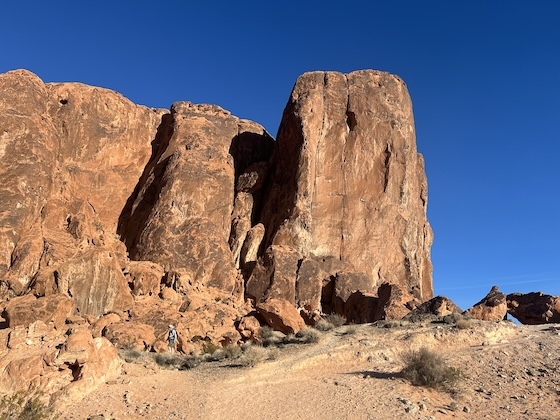
So we jumped in our rental car and investigated. Our first stop was Valley of Fire State Park , which sits some 55 miles northeast of downtown Las Vegas. It’s an easy day trip, with paid admission costing just $15 for out-of-state vehicles (National Park passes are not accepted).
Nevada’s largest state park at some 40,000 acres, Valley of Fire was inhabited for millennia by various Native American tribes, mainly the Ancestral Puebloans. They relocated as the environment became too harsh, drought combining with summertime temperatures that can reach as high as 120 degrees Fahrenheit.
But over time the aura of the place attracted visitors, lured by the red sandstone cliffs that – according to state park literature – “seem to glow as if they are on fire in the hour just before sunset.” The park earned its state designation in 1935.
Even if you don’t stick around until sunset, you can see some majestic geological sights in just a couple of hours. In fact if you just drive without any intention of getting out, you could experience much of the valley in less than an hour – though you’d be missing some of the best things the park has to offer.
The route we drove began at the west entrance, proceeded to the visitor’s center where we picked up a map that details all the important stops, from the Beehives Rock Formation to the Arch Rock and Atlatl loop, on to the scenic drive that grants access to Mouse’s Tank, the Pink Pastel Canyon and White Domes Loop.
Not for the first time, I realize that any photo that I took (especially with my iPhone) couldn’t begin to capture the magnificence of such natural beauty – even on a cloudless day.
One caveat: While we didn’t hike much more than a kilometer along any of the several trails, we had to be careful because most of the footing was in soft sand. Anyone with weak ankles needs to take special care.
That wasn’t a problem at Red Rock Canyon National Conservation Area , which we visited two days later. Far closer to downtown Las Vegas, only 17 miles from The Strip, Red Rock offers a 13-mile scenic drive with as many as 26 different hikes and trails, as well as opportunities for climbers and campers.
You can spend as much time as you want exploring the various trails. And the footing there is more rocky than sandy, which as long as you manage to dodge the occasional baseball-sized rock should pose no problem.
Admission for a single car is $20, which we paid gladly – though as a veteran I could have qualified for a waiver.
And did I mention the petroglyphs? You can find some at both parks. At Red Rock Canyon , the short walk is rated as “easy” and will bring you close to rock art estimated to be 800 years old. Those in the Valley of Fire , which can be found in two different locations, are estimated to be between 2,000 and 4,000 years old.
As an added treat, after leaving Red Rock we continued down the highway for two and a half miles and stopped by Spring Mountain Ranch State Park . Said to be the area’s first working ranch, and dating back to the late 19th century, it’s been owned by several notable celebrities, including the German actress Vera Krupp and the famous rich guy/recluse Howard Hughes.
The volunteer docent, David, was happy to show us around, even taking us through a secret door to what was Krupp’s back-room lair.
Little that we saw over the two days, however, matched the views of the petroglyphs. I have to admit, though, that I wondered if the markings, some of which are set some 20 or so feet above the valley floor, were really the work of ancient peoples. Couldn’t someone interested in getting tourists to pay to ooh and ah over what they think are some sort of direct communication from the past have carved them into the sandstone cliffs?
But experts have checked them out, people much more qualified to judge such things than I am. In one study from the University of Nevada, Las Vegas , the concern wasn’t so much the authenticity of the markings but whether they’ll survive the attention from visitors.
As the study reports, “With thousands of tourists visiting the park annually there has been slow but steady damage to this irreplaceable resource.”
Being good and responsible citizens, we made sure to remain at a safe distance from all of them, at both parks.
Even farther, I’ll emphasize, than we did from Las Vegas’ ubiquitous gaming tables.
* This story was originally published as a post from the blog "Going Mobile." Read all stories from this blog