Even a short stay can give you a feel for a place
Common sense tells you that it’s impossible to get more than a feel for a city in just a couple of days. Much less so in just one. So, I can’t write comprehensively about any of the cities that my wife and I visited on our recent trip to Spain and Portugal.
But I can write about what we experienced. And I can give you a taste of what each city has to offer.
As I wrote in a previous post, I met up with my wife in Madrid. I was flying from Spokane (through Seattle and Amsterdam), while she was coming from Athens (having spent 10 days exploring the Greek islands with her sister).
We’d spent some time exploring Madrid several years ago and so were OK with spending just a single night there, all of it at the Madrid Airport Hilton. The next morning, we caught a train south to Córdoba .
We’d heard that Córdoba was referred to as “the oven of Spain.” And indeed, the guidebooks will tell you that it’s typically sunny and hot, especially in high summer. As our visit was in late May, we found the weather to be sunny but cool.
We arrived in the early afternoon and caught a cab to our hotel, La Llave de Judería (which could be translated as “key to the Jewish quarter”). The woman who greeted us, Yolanda, was as friendly as anyone we met on the entire trip. Not only did she speak perfect English, but she tutored me in my attempts to speak basic Spanish.
The benefits of staying in this particular boutique hotel, besides the friendliness of the staff, was its location – barely a short walk from the Córdoba Synagogue in one direction, and the world-famous Mezquita-Catedral de Córdoba in the other.
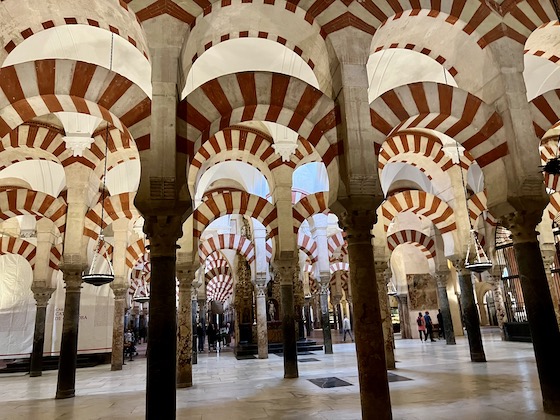
A brief bit of history here: The Mezquita dates back to the year 785, a time when Córdoba was designated the Muslim-controlled capital of the region then known as Al-Andalus. As a mosque, it was gradually expanded until 1236 when Christian forces drove the Muslims from Spain and converted the massive structure into what today is officially referred to as the Cathedral of Our Lady of Assumption.
Some of this we learned later that very afternoon when we joined a tour, led by an English-speaking guide named Ruben, and were herded through the place. At least I think that’s what he said because even though we were handed radio receivers with headphones, Ruben’s accent was so thick the only word I can be sure that I heard was “impressive.” Which he must have said a couple of dozen times.
But not without reason. From its original outlay of 70-some square meters, the last expansion increased that size to some 8,600 square meters, making it the world’s then-second biggest mosque. And it is, as Ruben insisted, “impressive.” Just imagine an indoor area big enough for, say, three or four football fields, its low roof held up by a succession of colorful double-arch pillars.
We’d embarked on the tour in the late afternoon, jet lag requiring me first to take a nap, after which we enjoyed a late lunch at the nearby Casa Pepe de la Judería , which the Michelin Guide describes this way: “It has an interior that comes as a pleasant surprise, replete with a typical Andalucian patio, pleasant dining rooms and a charming rooftop terrace. Southern Spanish cuisine with a modern touch.”
Full of tasty tapas, we walked to the city’s Roman Bridge . Dating back nearly two millennia, the bridge has been rebuilt a number of times but still retains an ancient look and attracts – at least on the day we visited – hundreds of walkers at a time. We stopped halfway across, took a long look at the distant Calahorra Tower (which sits on the southern bank of the Guadalquivir River and houses what the guidebooks say is a pretty great museum) before hurrying back to the Mezquita to meet Ruben.
Afterward, we walked around the narrow, cobblestoned streets of the Jewish quarter, which reminded us both of Morocco. Then as darkness closed in around us, we headed back to the hotel for a fitful night’s sleep. We ate snacks for our dinner.
Yes, we’d planned only a single day for Córdoba, which means we left much of it unseen. The Royal Baths of Doña Leonor , for example, and the Museo Arqueológico, etc. All that means, though, is that one day we’ll have to return.
Or not. It’s a big world and there’s still a lot to take in.
Next up : Granada.
* This story was originally published as a post from the blog "Going Mobile." Read all stories from this blog