Zinke on why he suspended all Resource Advisory Councils…
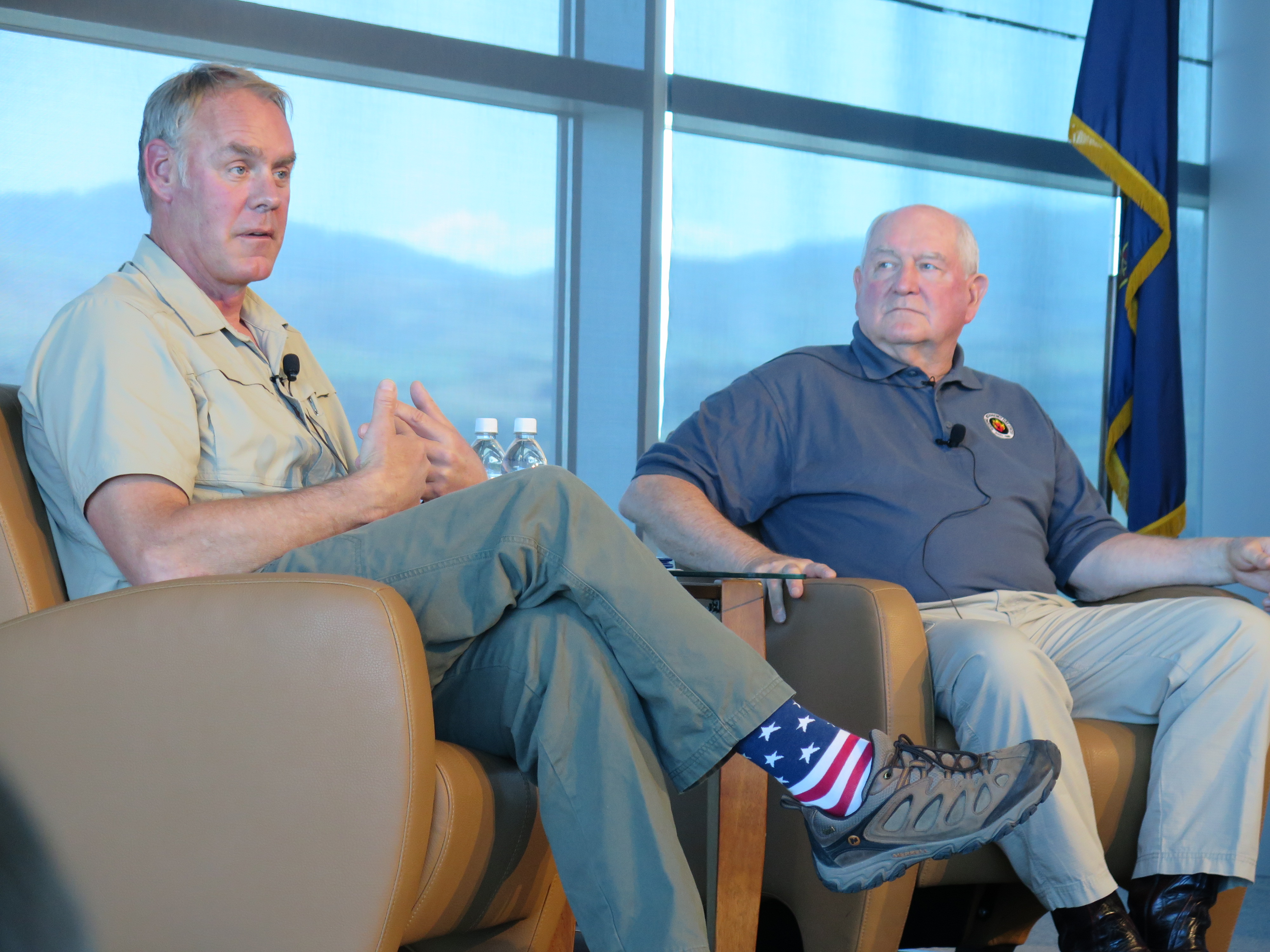
The new U.S. secretaries of Interior and Agriculture rolled into Boise today with a strong message of support for collaboration in efforts to solve the nation’s public lands issues – even as the Trump Administration has suspended all meetings of local Resource Advisory Councils through September.
“I hope we have more, not less,” new Agriculture Secretary Sonny Perdue told a crowd of about 300 at Boise State University. “Frankly, the better collaboration we have and the better we do from inviting the local communities in, the better we’ll do with decision making and learning one another’s viewpoints, and how we can resolve that rather than resolving it in court.”
New Interior Secretary Ryan Zinke – who suspended the RACs that have been the conduit for the past two decades for collaboration and local input on issues that arise on Bureau of Land Management lands – said, “We have to reward collaboration. … We have to reward efforts of everyone trying to work together.”
He said his frustration when he was a congressman from Montana was that collaborative efforts would “take a lot of time, a lot of enthusiasm, a lot of moving back and forth, a lot of compromise, a lot of resources,” and then after as much as two years of work, the resulting plans could be halted in court by an outsider’s lawsuit. “There’s no progress made,” he said. “It’s hard to get people motivated to participate in the next series of collaborative efforts.”
Asked later, at the National Interagency Fire Center, why the RACs have been suspended, Zinke said, “I have 225 different councils and boards, so I suspended them all, so I could ask: What do you do? Who’s on your board? What have you done in the last year? What have you done in the last two years?”
He said the Department of Interior is spending $15 million a year on the various boards and councils, and he didn’t want to “pick and choose” which to keep or cut. “So I did it blanket across,” he said. “And alls I asked was two pages. … I just want to know what you do, who’s on the board, what you’ve done the last year, what you’ve done the last five years, so I have a degree, and then as they deliver it, we’ll look at it, and then I give ‘em the thumbs up to continue mission. But that’s why. Rather than me going through a list of 220, I just said … look, if you guys can’t deliver a two-page document and tell me who you are, what you do, how much it costs, and give me your milestones, then maybe we should look at redoing the boards. Most people complied.”
He added, “Some of the boards are super about it, and some of ‘em aren’t. Some of the boards don’t even know what they’re supposed to be doing.”
BSU public policy professor John Freemuth, who studies public lands, said collaborative approaches have begun to pay off throughout the public lands arena, with courts even beginning to give some deference to collaborative projects against challenges from outsiders who didn’t participate. Numerous collaborative efforts are under way involving Forest Service lands; the Forest Service falls under the U.S. Department of Agriculture, while the BLM is under Interior.
The Department of the Interior established the RACs in 1995; the BLM’s website says they’re “sounding boards” for everything from regulatory proposals to policy changes. Each citizen-based council consists of 10 to 15 members “from diverse interests in local communities, including ranchers, environmental groups, tribes, state and local government officials, academics, and other public land users.”
* This story was originally published as a post from the blog "Eye On Boise." Read all stories from this blog