
On The Air: The spread of home radio
“A complete receiving set, capable of catching messages within a radius of 1,000 miles of Pittsburgh, has been set up in a section of the basement” of Horne’s department store, an advertisement in the Pittsburgh Sun announced on Sept. 29, 1920 — 105 years ago Monday.
Amateur wireless sets were selling there for $10, the ad said. For the first time, radio listeners could buy a plug-and-play radio without having to buy electronic parts and assemble their own sets.
The Birth of Radio Broadcasting
In the 1890s, Guglielmo Marconi invented the vertical antenna, capable of transmitting signals over great distances. By 1901, Marconi could send messages from England across the Atlantic to Newfoundland.
In December 1906, Canadian inventor Reginald Fessenden transmitted a holiday broadcast to operators along the Atlantic seaboard, singing and playing violin to listeners aboard ships from New England to Virginia.
But listening to radio at home was practically unheard of. Radio enthusiasts — typically, those who had operated radio in the military — built homemade sets with wire coils and spark plugs in wooden breadboxes or on sheet metal platforms.
These early radios required constant fiddling with a tuning dial to stay with a broadcast signal. Until the 1930s, more families would listen on homemade sets than with sets purchased commercially.
Frank Conrad was assistant chief engineer of the Westinghouse Electric Company in Pittsburgh. He had become interested in radio in 1912, when he built a set to check the accuracy of his new $12 watch. He could use the receiver to pick up time signals transmitted by the U.S. Naval Observatory.
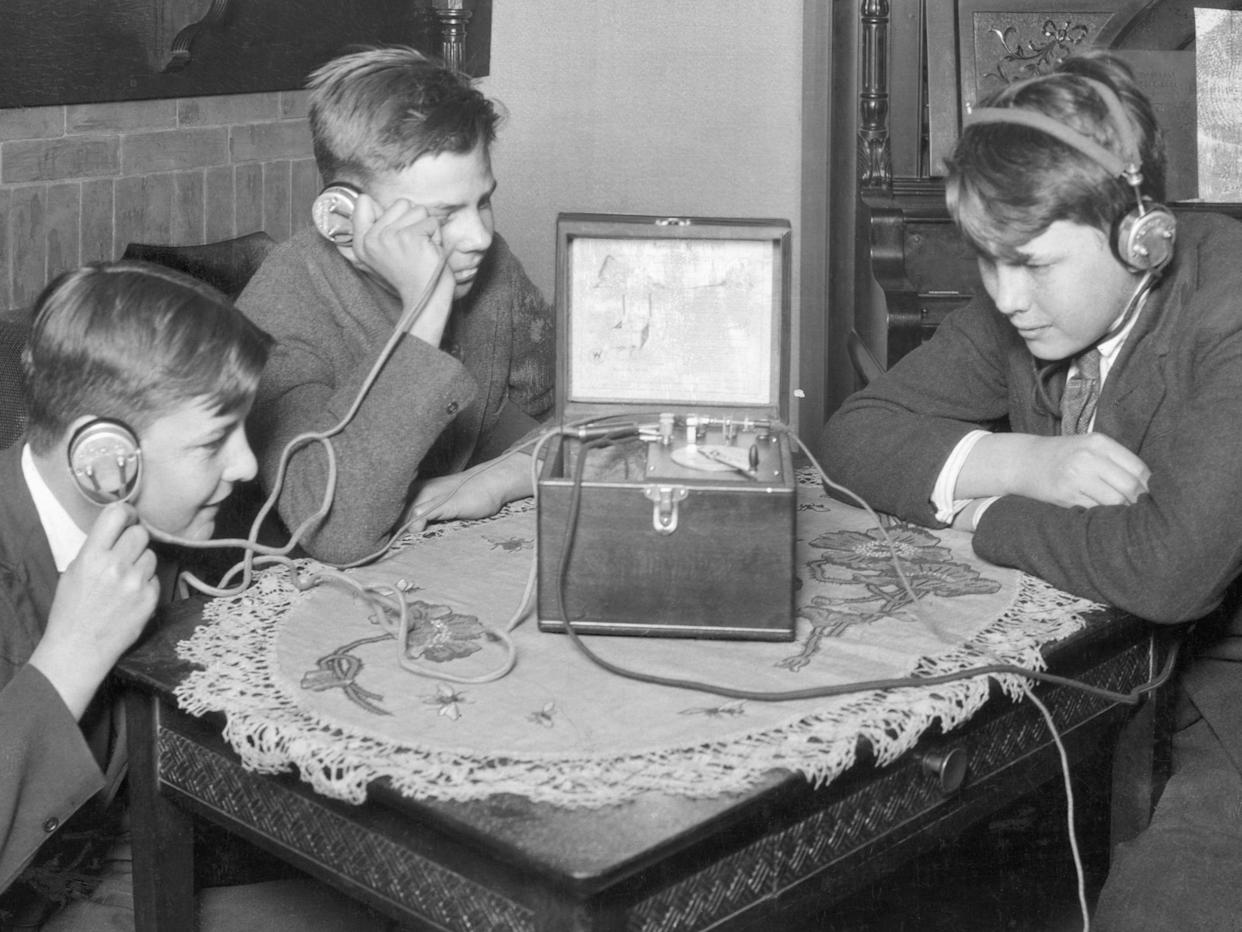
Notice these boys listening to their crystal set with headphones. It wasn’t until radios built with vacuum tubes came along later in the 1920s that sets were powerful enough to run loudspeakers.
Excited by the possibilities in this new medium, Conrad built a transmitter in the room over his garage and, using license 8XK, began broadcasting in 1916. As he tested his equipment, his voice began to give out from the constant announcements of his call letters. To give his voice a rest, he hit upon the idea of playing and broadcasting gramophone records.
Other radio enthusiasts tuned into Conrad’s transmissions and began requesting particular musical selections. Conrad had evolved into radio’s first disc jockey.
With the release of ready-to-
play sets in a downtown Pittsburgh department store, Conrad’s boss at Westinghouse recognized the commercial possibilties in Conrad’s hobby. With Conrad’s consent, Westinghouse applied for a commercial broadcast license for a new 100-watt transmitter and, in October 1920, was assigned the arbitrary call letters KDKA.
The new station began broadcasting on Nov. 2, delivering the results of that year’s presidential election between Warren G. Harding and James Cox. KDKA began regular commercial broadcasts the next year.
Not surprisingly, given how new radio technology was and how mysterious it must have seemed, some people were afraid of the new medium. Were these new electromagnetic waves transmitted through the air responsible for droughts? The vibrations of bed springs? The creaking of floorboards? Cows that stopped producing milk? Illnesses in their children?
The radios offered by Horne’s in 1920 cost “$10 and up.” Adjusted for inflation, that would be $162 today. There were only 30 radio stations operating in the U.S. in 1922 and retailers sold 100,000 sets. The next year, 556 stations were broadcasting and retailers sold a half-million sets.
Radio Spread Quickly Across The U.S.
In 1923, only 1% of U.S. households owned a radio set. By 1931, the majority of households were equipped with radios. By 1937, 75% of U.S. households owned radios.
