
Making Tracks On The Moon: Apollo 14
Apollo 13 in April, 1970, was a near-disaster. An oxygen tank aboard the spacecraft exploded, taking away the opportunity to make NASA’s third lunar landing and very nearly killing the three astronauts aboard. How would the space agency follow a debacle like that?
NASA sent another crew to the moon, commanded by America’s first astronaut in space and sent them to gather an amazing amount of geological and scientific data.
Apollo 14 landed on the moon on Feb. 5, 1971 — 55 years ago today.
A Successful - But Trouble-Filled - Mission to the moon
NASA’s third crewed lunar landing, Apollo 14, collected quite a bit of scientific and geological data for hungry scientists back on Earth.
Alan Shepard — who had been America’s first man in space in May 1961 — and Edgar Mitchell set up a series of small “thumper” explosions and measured their effects, which gave geologists an idea of the composition and depth of the loose lunar soil known as regolith.
Shepard and Mitchell collected more than 93 pounds of moon rocks that would be distributed to 187 geological teams in the U.S. and in 14 other countries. One rock turned out to be the third largest collected during Project Apollo and has been nicknamed “Big Bertha.” Geologists suspect it originated from Earth and was slung to the moon by a comet or meteorite strike.
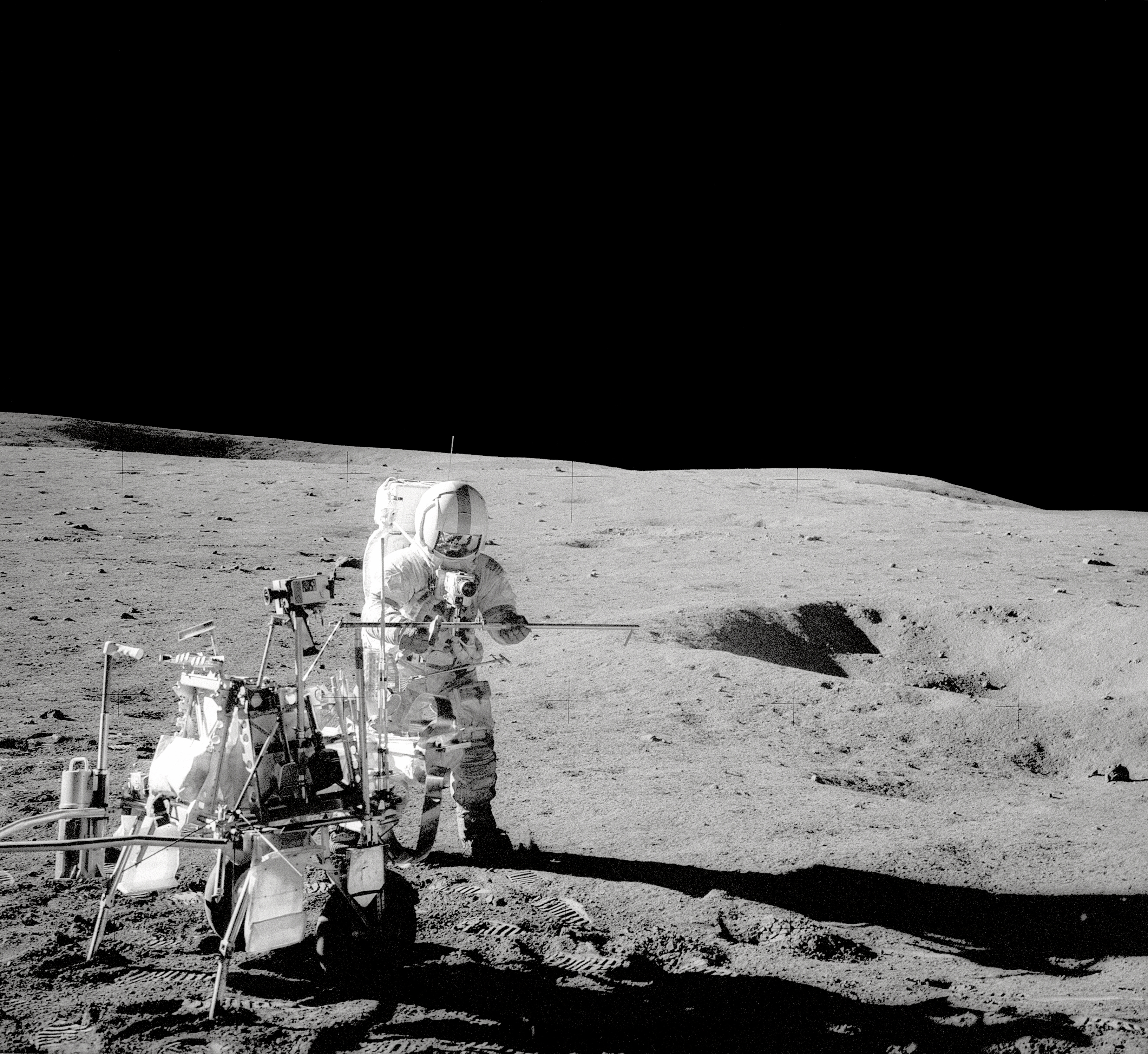
Mission Commander Alan Shepard extracts equipment from a two-wheeled wheelbarrow-like cart used on Apollo 14, the Modular Equipment Transporter, or MET. Shepard and Mitchell called it “the rickshaw.”
While Shepard and Mitchell were on the surface, their crewmate still in orbit around the moon, Stuart Roosa, also performed a number of experiments and made a thorough photographic survey of the moon, including proposed future Apollo landing spots.
That’s not to say the mission went smoothly. A major problem popped up shortly after launch when the Apollo 14 command and service modules separated from the rest of the spacecraft and turned around to dock with and extract the lunar module from the upper stage of the Saturn V rocket.
The docking mechanism failed to engage. It took six tries before the two craft were firmly linked up for their voyage to the moon.
Then, on landing day, as Shepard and Mitchell separated their landing craft from the command module, an alarm went off, indicating a procedure had been triggered to abort the landing and return to lunar orbit.
But the procedure had not been triggered. The problem turned out to be faulty software. A NASA engineer in Massachusetts was hauled out of bed at 2 a.m. and told he had 90 minutes to fix the problem. He did.
Shepard and Mitchell made two excursions onto the lunar surface over two days. On the second day, their task was to haul their new equipment caddy cart to Cone Crater, a mile or so away with a rim 1,000 feet high. The more they walked, however, the further away the crater seemed to be.
As the day wore on, the two kept walking. When the terrain grew too steep for their cart, they simply picked it up and carried it. Eventually, though, NASA controllers could hear the 47-year-old Shepard struggling to catch his breath. Telemetry from his suit showed Shepard’s heart was beating more than 140 times a minute.
Over the objections of both moonwalkers, NASA ordered the two to abandon their walk to Cone Crater and return to base. It would later be determined they gave up just 100 feet from the edge of the crater.
Despite their exertion that day, Shepard gained a pound during his mission — the first NASA astronaut to gain weight in space. Even Roosa had lost 10 pounds.
One Final Surprise: Golf on The Moon
As the astronauts of Apollo 14 were wrapping up their second and final day of exploring the surface of the moon, Shepard staged a little surprise for mission control and viewers watching on live TV.
He had made a special six iron golf club head that attached to the handle of a tool used to take lunar soil samples. As he explained what he was doing, he affixed the club head and pulled out of a pocket of his spacesuit what he called “a little white pellet that’s familiar to millions of Americans”: Shepard had brought two golf balls with him.
Shepard’s suit limited his mobility, so he was forced to use his makeshift golf club with only one hand. It took him two tries to hit the first ball — while mission controllers laughed.
Shepard got a better piece of the second, however. He told folks back on Earth that the ball had sailed “miles and miles and miles.”
Some folks scoffed at that. But in 2010, Gizmodo consulted with a theoretical physicist who said that an experienced golfer could easily hit a ball 2.5 miles or further on the moon, where gravity is only 1/6th that of Earth. The ball could possibly stay aloft in the moon’s airless sky for 70 seconds.

Shepard hits a golf ball on the moon using a makeshift club.
NASA's Six Crewed Moon Landings
