
That's What Christmas Is All About: Charlie Brown Christmas Special
One of the most beloved animated holiday TV specials, “A Charlie Brown Christmas,” made its debut on CBS-TV on Dec. 9, 1965 — 60 years ago today.
But as much as we love the special, it almost didn’t make it onto the air. And even when it did, the initial reaction was that it wouldn’t be shown again.
'I Never Thought It Was Such A Bad Little Tree'
In 1963, television producer Lee Mendelson produced a documentary on Willie Mays that was shown on NBC.
A few weeks later, he was reading the comics page of his newspaper and saw Charlie Brown was losing yet another baseball game. “Peanuts” creator Charles Schulz’s book, “Happiness Is a Warm Puppy” was No. 1 on the national bestseller lists. An idea for another documentary popped into Mendelson’s head.
Mendelson was delighted — but not surprised — to learn Schulz was a baseball fan and had seen the Willie Mays documentary. They ended up collaborating on a documentary about Schulz’s work that featured a few minutes of his characters animated by Bill Melendez and original music by jazz musician Vince Guaraldi.
Once Mendelson finished work on the documentary, however, he couldn’t find a buyer — all the TV networks turned him down. The project was dead until April 1965, when Time magazine ran a cover story about “Peanuts.” Shortly afterwards, an advertising executive called to compliment the documentary and to ask if they had considered making a Christmas TV special.

Producer Lee Mendelson, “Peanuts” creator Charles Schulz and animator Bill Melendez with their first Emmy award. Photo from Bill Melendez Productions.
The caller’s client, Coca-Cola, was interested, but by the time the necessary arrangements had been made, Mendelson, Melendez, Schulz and Guaraldi had only six months to have the special ready to broadcast.
Schulz wrote a script and drew model sheets for his characters. Melendez storyboarded the show. They were paid only $76,000 to produce the 30-minute show, which would require about 10,000 animation drawings.
There were things that Schulz insisted on putting in the special. He was originally from Minnesota, so he wanted scenes of the characters ice skating in the snow. He wanted a Christmas school play.
And he wanted there to be a moment where the true meaning of Christmas was explained. To Schulz, that would be the story of the Nativity from the Bible.
Mendelson worried how this might go over with CBS and the sponsor. “We can’t avoid it — we have to get the passage of St. Luke in there somehow,” Schulz said. “If we don’t do it, who will?”
“The show was finished a week before the broadcast date,” Mendelson would write later. “The exhausted staff watched the entire program for the first time. We all felt an uneasiness after the screening. We thought that perhaps we had somehow missed the boat.”
“When I flew to New York to present the show to the top two executives at CBS, I was very apprehensive,” he wrote. They watched the show. The lights came up.
“ ‘Well, you gave it a good shot,’ said one,” Mendelson wrote. “ ‘It seems a little flat ... a little slow,’ said the other. I was crushed. “ ‘Well,’ said the first, ‘we will, of course, air it next week, but I’m afraid we won’t be ordering any more. We’re sorry; and believe me, we’re big “Peanuts” fans. But maybe it’s better suited to the comic page.’ ”
“A Charlie Brown Christmas” was broadcast at 7:30 Eastern Time on Thursday, Dec. 9, pre-empting “The Munsters.” Nielsen reported that 15.5 million households tuned it, making the special the secondmost-watched TV show of the week.
Critics raved over the show. That spring, the special won an Emmy Award for Outstanding Children’s Program and a Peabody Award.
'Didn't You Know Sarcasm When You Hear It?'
The voice of Charlie Brown was provided by 8-year-old actor Peter Robbins, who had appeared in episodes of “Rawhide,” “The Donna Reed Show” and “The Munsters.” He’d play Charlie Brown in five more Peanuts specials and in the film “A Boy Named Charlie Brown” and would also appear in “F Troop” and “Get Smart.”

With the exception of Robbins and Christopher Shea, who played Linus, the rest of the child voices were supplied by children Mendelson recruited from his neighborhood. The girl who played Sally couldn’t yet read, so her lines had to be fed to her sentence by sentence. None of the children received on-screen credit for their work on the special.
“A Charlie Brown Christmas” has been credited for helping bring an end to aluminum Christmas trees. About 150,000 aluminum trees of various colors and sizes had been sold in 1964. The special showed the metal trees in a negative light, as examples of over-commercialization of the holiday. By 1969, aluminum trees were pretty much extinct.

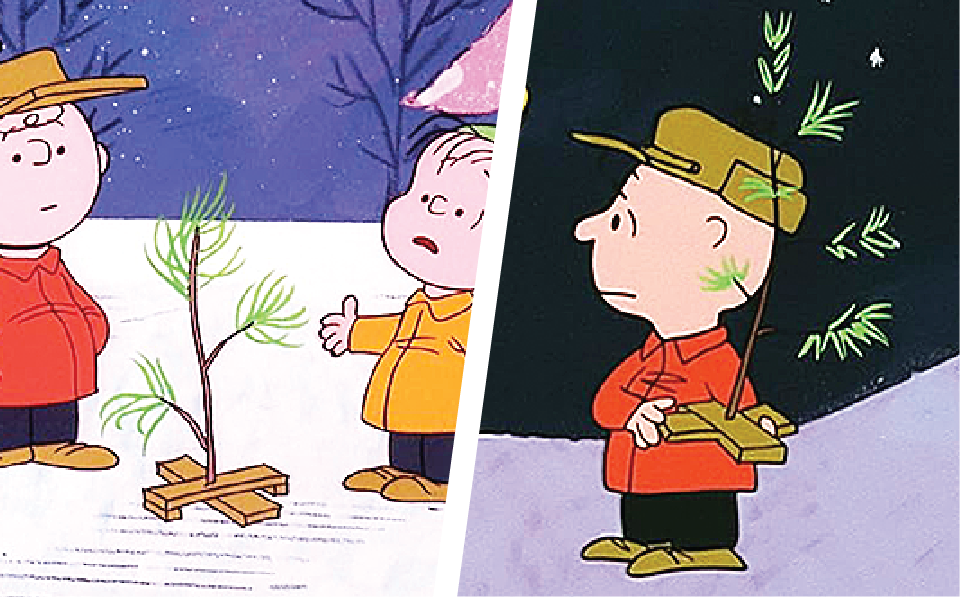
Schulz was disappointed with the animation in the special — in particular, the poor little Christmas tree Charlie Brown buys for the stage production seems to gain more branches as the evening goes on. That’s not including the big reveal when the decorated tree is totally full. Schulz blamed the continuity error on two animators who weren’t communicating.
The original televised version of “A Charlie Brown Christmas” contained references to the sponsor, Coca-Cola: Once during the ice skating scene at the beginning, when Linus crashes into a billboard and once at the end, during the closing carol. Over time, those visuals were cut out and other cuts were made to make time for more commercials.

CBS executives were disappointed with the completed special, but it was too late to cancel the show. When the ratings came in for that night, showing 50% of the households with TV sets had watched “A Charlie Brown Christmas,” CBS immediately signed on for more like it. CBS would show 34 Peanuts specials through 1991.
