On Nov. 6, 1965 — 60 years ago today — the Cuban and U.S. governments agreed to arrange regular emigration airplane flights aimed at reunifying Cuban families with their loved ones already in the U.S.
What would become the largest and longest refugee resettlement effort in U.S. history — the Freedom Flights — would begin on Dec. 1 and would allow more than a quarter-million Cubans to enjoy freedom and the hope for economic success.
The Origin of Cuban Freedom Flights
After the spectacular failure of the U.S.-planned and backed Bay of Pigs invasion in April 1961 and then the Cuban missile crisis of October 1962, it was clear the island nation of Cuba — just 93 miles off the coast of Florida — was going to remain a communist-controlled country.
This wasn’t necessarily a popular thing in Cuba. Anti-government protests broke out throughout the country. The population of Cuba fell into poverty — thanks in part to a U.S. embargo of all trade with Cuba.
Those with means to travel made plans to leave — affluent Cubans and those who had been part of the previous government. Those not so economically fortunate had to scrounge for ways to escape.
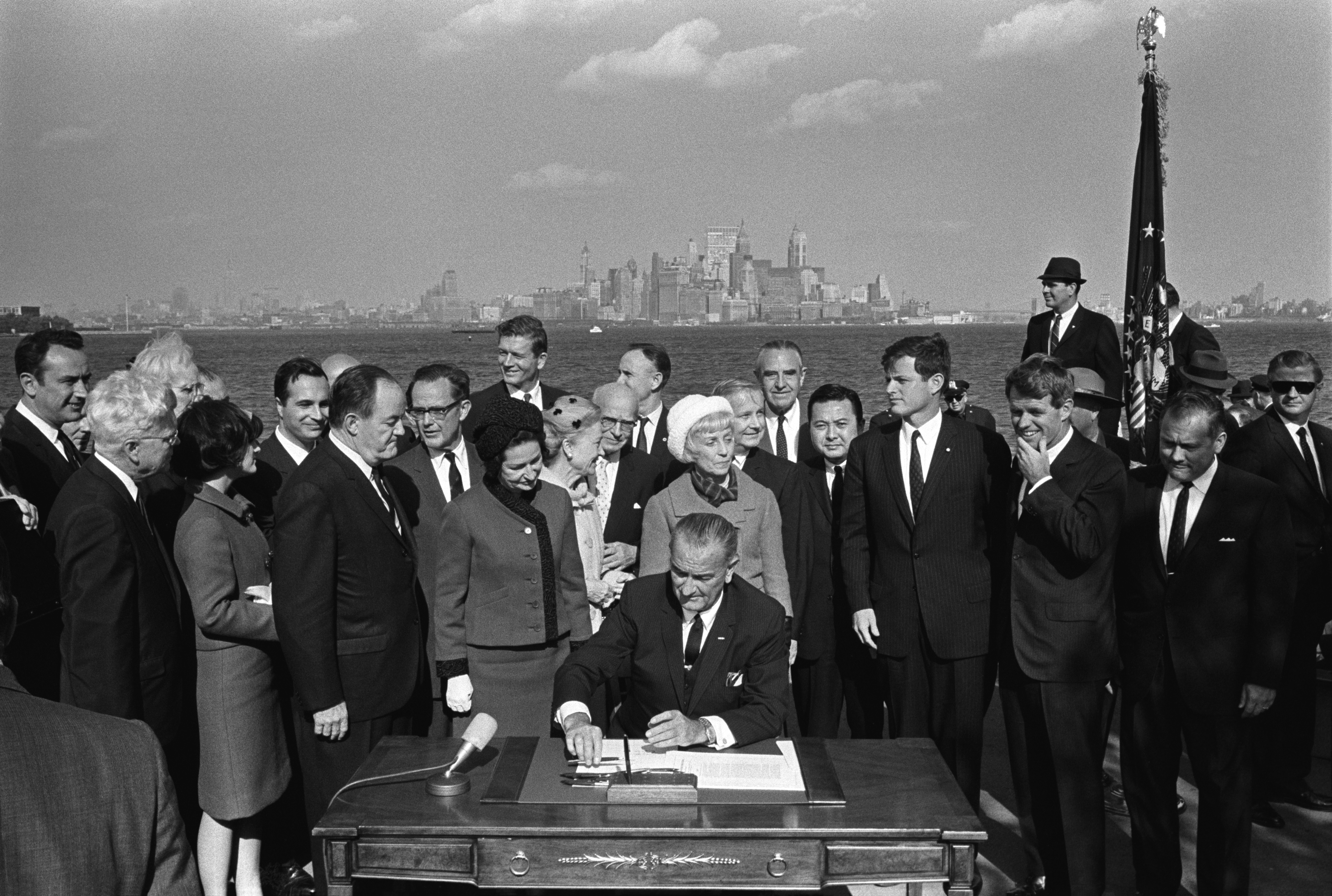
In the fall of 1965, this migration was aided by passage of the Immigration and Nationality Act, which President Lyndon Johnson signed into law on Oct. 3, 1965 and became effective on Dec. 1.
The act was a major update of U.S. immigration guidelines, prioritizing things like reunification of families. This resulted in a significant increase in immigration from Asia and Latin America.
Right away, Castro opened the Cuban port of Camarioca, where 3,000 Cubans boarded about 160 boats to travel to Key West. The influx there threatened to swamp the U.S. Coast Guard and immigration authorities.
While not sanctioned by the U.S. government, President Johnson chose to not enforce restrictions on this boat traffic. With little notice, Castro closed the port on Nov. 3, stranding thousands of hopeful immigrants.
“I declare this afternoon to the people of Cuba that those who seek refuge here in America will find it,” President Lyndon Johnson told the crowd who watched him sign the Immigration and Nationality Act. “Our tradition as an asylum for the oppressed is going to be upheld.”
Just three days later, the Cuban and U.S. governments agreed to launch an emigration airlift, limiting participation to those whose immediate relatives were already in the United States. The U.S. budgeted more than $12 million to the project.
What came to be called “Freedom Flights” began on Dec. 1, 1965. For the next eight years, 10 flights a week left Varadero, Cuba, carrying an average of 85 people — typically families with young children — for Miami.
The airlifts were extremely popular in Cuba — some waited up to two years before their names came up. Over time, Castro became alarmed at how the airlifts were creating a brain drain in his country. He began a campaign of harassment and shaming those who signed up for the airlifts.
By 1972, Castro had had enough. He suspended flights for six months before halting the program for good the next year. The final Freedom Flight touched down in Miami on April 6, 1973. By then, more than a quarter-million Cubans had escaped to the United States.
The Cuban refugee community in the United States — and especially in Florida — grew to several hundred thousand and, for the most part prospered; which hadn’t been possible in Cuba.
Notable Waves of Cuban Refugees to The U.S.
Over the last century, there have been several major waves of Cuban refugees to the United States. Below are some of the most notable ones:
Golden Path
1959-1962
Consisted mostly of wealthy Cubans and those who worked in the previous government. Many felt their relocation would be temporary — the Castro government would fail. In 1960 President Dwight D. Eisenhower established the Cuban Refugee Emergency Center to aid emigrants.
Operation Peter Pan
Novemeber 1960 to October 1962
The CIA spread rumors that Castro planned to seize Cuban children and indoctrinate them with communist beliefs. Some Cuban parents made the agonizing decision to put their kids on airplanes to Florida in hopes they might be able to find a better life.
Camarioca Boatlift
Oct 10 to Nov. 15, 1965
Castro announced that Cubans wishing to emigrate the country could do so from Camarioca. While U.S. and Cuban officials worked on an agreement for an airlift project, Cuban Americans traveled from Florida to Camarioca in small leisure boats to begin ferrying friends and family members back to the U.S.
Freedom Flights
Dec. 1, 1965 to April 6, 1973
The largest resettlement effort in U.S. history brought in mainly skilled and blue-collar workers at a rate of up to 4,000 people per month. The 1966 Cuban Adjustment Act allowed Cuban citizens who had been physically present in the U.S. for at least a year to apply for permanent residency.
Mariel Boatlift
April 26 to Oct. 1, 1980
Sparked by a political crisis in Havana between working-class and African-Cuban communities. Thousands traveled to Florida on pleasure boats and shrimping vessels. Castro then opened his prisons mental hospitals and allowed them to join the improvised flotillas.
The Balsero Crisis
April 15 to Oct. 31, 1994
Up to 35,000 Cubans attempted to make the journey to Florida on makeshift rafts. The Clinton administration attempted to lessen the number of those who tried by announcing that all Cuban refugees captured at sea would be detained at the Guantanamo Bay Naval Base.
Wet Foot, Dry Foot
Sept. 4 1994 to Jan. 12, 2017
The Clinton Administration settled on a policy that stipulated that Cuban nationals who reached U.S. soil (“dry foot”) would be allowed to remain, while those intercepted at sea (“wet foot”) would be repatriated. President Barack Obama would end this policy days before he left office. Thousands of Cubans found themselves stranded in countries like Mexico, Panama, and Costa Rica and seeking alternative — and often more dangerous — routes to the U.S. Cubans began traveling through Nicaragua to the Mexican border. By 2022, the number of Cubans arriving at the U.S.-Mexico border had skyrocketed
The Walking Generation
2022 to present
Cuban journalist Rachel Pereda called the recent surge in migration the “Walking Generation,” given the 514,255 Cubans that have traveled from South and Central America to the Southwester U.S. border by foot between fiscal years 2022 and 2024.
Major Waves of Cuban Refugees to The U.S. By The Numbers
Sources:
“LBJ’s Neglected Legacy: How Lyndon Johnson Reshaped Domestic Policy & Government” edited by Robert H. Wilson, Norman J. Glickman and Laurence E. Lynn Jr., U.S. Naval Institute, U.S. Department of State Archive, Digital Public Library of America, the Center for Engagement and Advocacy in the Americas, Migration Policy Institute, PBS’ “American Experience,” the Miami Herald, Miami-Dade Public Library Digital Collections, EBSCO Information Services, FamousDaily.com, HistoryNet.com, History.com. Photo from LBJ Presidential Library.