
It's All Relative: Einstein's Theory of Relativity
110 years ago today, Albert Einstein published his General Theory of Relativity, which redefined the relationship between matter and gravity. Suddenly, our mysterious universe made a little more sense.
There Were Two Theories of Relativity
The first thing you need to know about Einstein’s Theory of Relativity is that there are actually two separate theories.
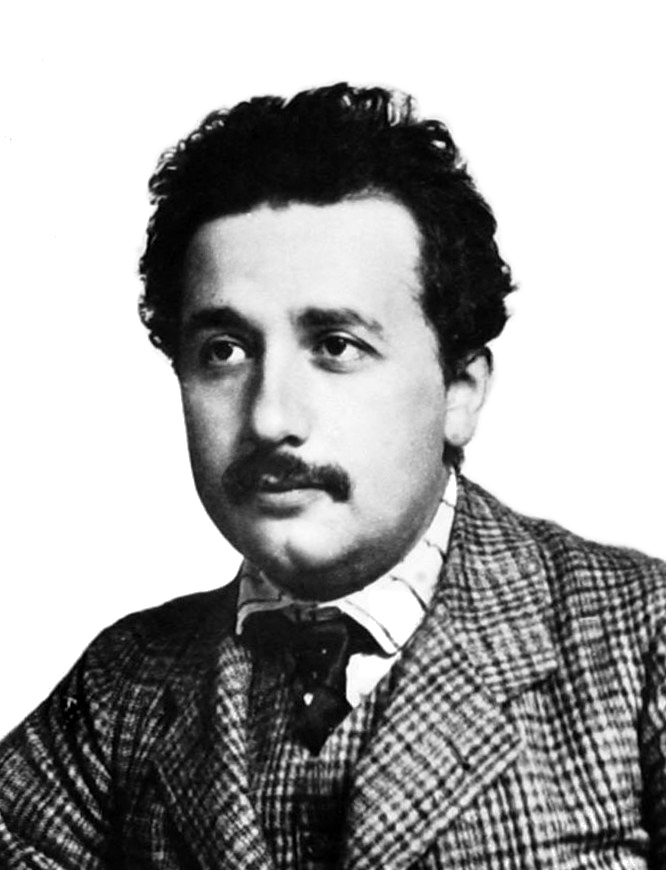
Einstein in 1904.
The first, which came to be known as his Special Theory of Relativity, was published on Sept. 26, 1905. Einstein was a relatively unknown clerk toiling in the Zurich patent office. His paper — which helped describe the nature of the relationship between motion and time — was a game changer for physicists. It made him world-famous.
Einstein continued to work, however, issuing papers on topics like Brownian motion — the motion of molecules — and photons, which are elementary particles of light. Ten years after he first rocked the scientific world, he came out with this second major work: What came to be known as his General Theory of Relativity, which dealt with the relationship between mass and motion.
Einstein had developed the theory and presented it earlier that year. Yet, Einstein struggled to make the math work out. Other theoreticians raced to beat him to the punch.
In November 1915, Einstein made four presentations to the Prussian Academy of Science. It wasn’t until the final one — Nov. 25, 1915 — that he was able to reveal what are now called the Einstein field equations: The mathematical basis for his General Theory of Relativity.
Special Theory of Relativity
Scientists knew already that light moved at a constant speed — 186,000 miles per second — whether the source is moving toward or away from an observer.
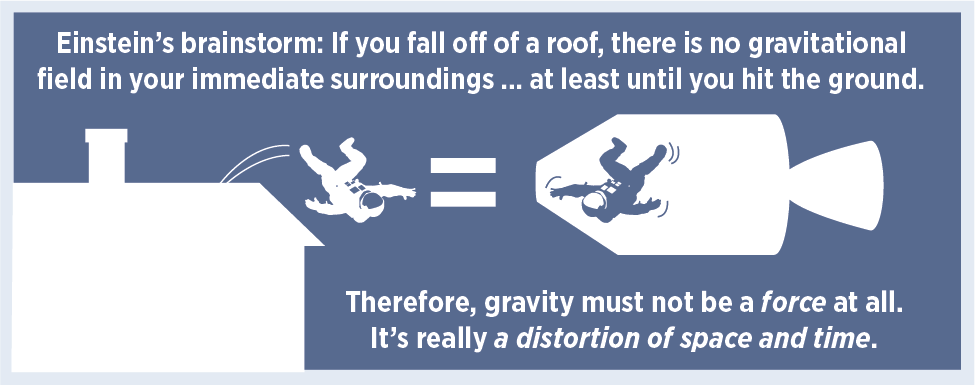
The young Einstein turned the problem on its ear: Instead of asking why is the speed of light constant, let’s assume this is one of nature’s fundamental facts. Once we do that, what may we deduce?
What Einstein came up with: Velocity is never constant. Motion is relative to one’s perspective.

When one applies a force to an object to accelerate it, the object doesn’t just go faster, it also gains mass. The faster it goes, the heavier it becomes. If it were to achieve the speed of light, its mass would become infinite.
Since this is impossible, then the speed of life is essentially nature’s ultimate built-in speed limit.
The upshot: Energy and mass are manifestations of the same thing.
This is where Einstein came up with a formula showing the proportions of that mix: Energy equals mass times the speed of light squared, or:
E=mc²
General Theory of Relativity
For more than two centuries physicists had accepted Sir Isaac Newton’s concept as gravity as a “force” that objects exert on each other. But how would such a force be transmitted across empty space?
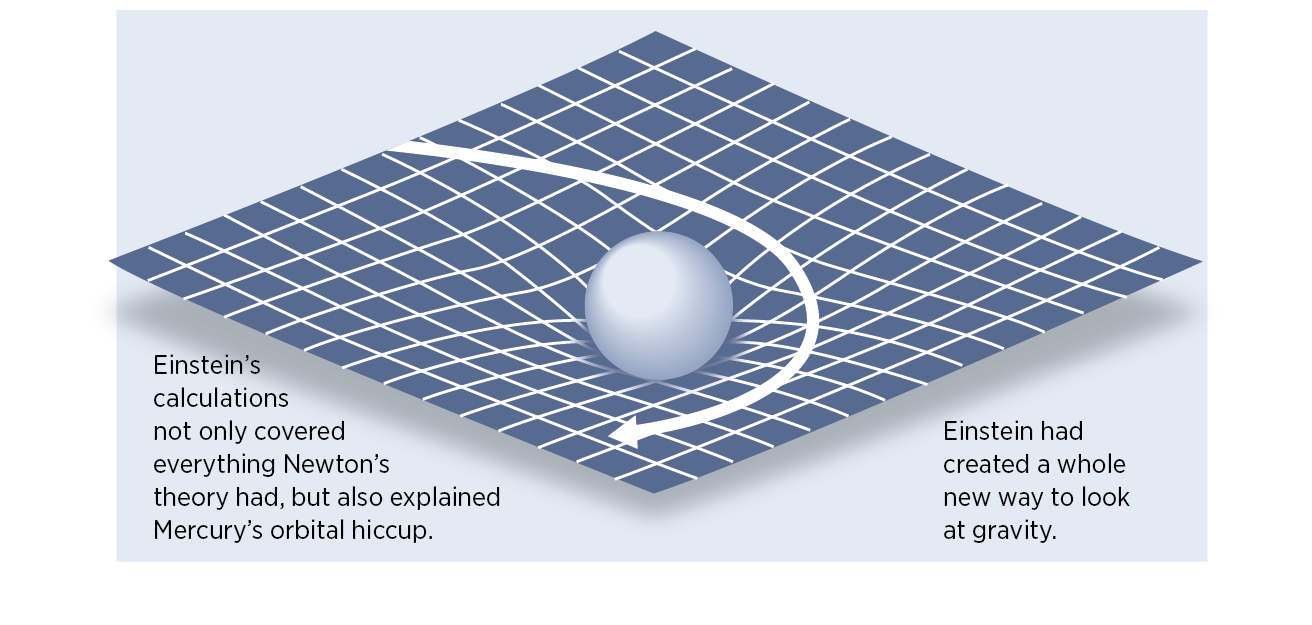
Einstein was intrigued by the fact that the planet Mercury had a slight “hitch” in its orbit — it simply didn’t follow the path Newton’s laws predicted for it.
Think of a planet or star like a bowling ball dropped onto a trampoline. The surface of the trampoline sags under the weight of the ball.
A marble rolled past the bowling ball will curve around it — not because of some unseen force, but because the surface is distorted.
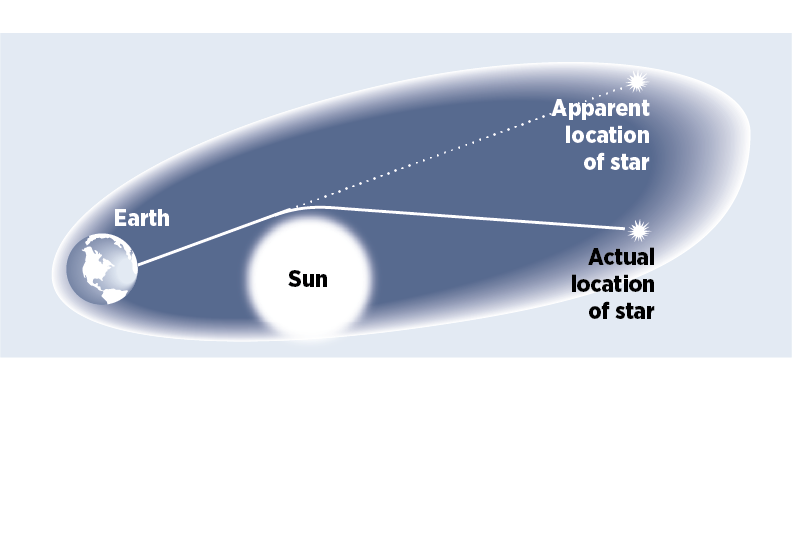
Even the path of light will bend around a massive object.
But Where's The Proof?
Einstein himself thought that the bending of light around a massive object — as predicted by his General Theory — would be too slight to be observable.
But it was observable. Astronomers carefully watched during a solar eclipse in 1919 to see if they could observe stars near a blotted-out sun appear in places other than where they should be. They did, proving the theory.
Today, our GPS technology takes into account the fact that satellites tracking our devices are orbiting the Earth at tremendous speeds and further away from the Earth’s center of gravity.
Even what Einstein called the biggest blunder of his career turned out to have a brilliance of its own. When he worked out his famous Field Equation, he found the math didn’t quite come out the way he expected. So he added what we might today call “a fudge factor” — something he referred to a “cosmological constant.”
But Einstein was operating under a mistaken assumption: The universe is not static. As we know now, the universe is constantly expanding, thanks to “the Big Bang,” nearly 14 billion years ago.
What Einstein himself considered a mathematical cheat has turned out to be a compensation factor for what scientists now consider the energy that keeps the universe expanding — perhaps indefinitely.
What It All Means
- Gravity is the curving of space by massive objects.
- There is no real difference between accelerated motion and gravity.
- Time will slow down for a person traveling at great speeds. The greater the speed, the more the effect. The catch: The traveler won’t notice until she returns home to find herself younger than she’s supposed to be.
- There is an enormous amount of energy stored in even tiny amounts of matter — if one can only figure out how to get at it.
Einstein spent the final years of his life working on a theory that might prove the two forces of nature known at the time — gravity and electromagnetism — were related. Or, perhaps, even the same.
However, during this time, two more natural forces were discovered: The strong and weak forces that bind together the nuclei of atoms. As a result, the task of unifying the theories became too great.
Today, 70 years after Einstein’s death, physicists have a pretty good idea that strong, weak and electromagnetic forces are strongly related in the field of quantum mechanics.
They can’t quite figure out how gravity is part of the mix. A grand “Theory of Everything” could shed more light on the nature of nature itself. But, alas, it still eludes the world’s biggest brains.