It’s been brought up a lot recently — especially after the controversial ruling the court made in June 2022 reversing Roe v. Wade: Why can’t a Democratically controlled Congress and President Joe Biden simply add seats to the Supreme Court to give the nonconservative justices a majority of votes?
President Franklin Delano Roosevelt had the same idea in 1937. Frustrated by a conservative court blocking his plans to pull the country out of the Great Depression, he proposed to “pack” the court with justices friendly to his programs.
How Many Justices Are Supposed To Be On The Supreme Court?
Article III of the Constitution — which establishes the Supreme Court —
doesn't say. The number of justices changed quite a bit over the court's
first 80 years of existence, and sometimes for partisan reasons. Over the
last 155 years, however, the court has remained at nine justices.
1789
Congress initially sets up the court with a chief justice and five associate justices.
1801-02
Congress passes legislation to reduce the size of the court to five, but changes its mind a year later to restore the number to six before any change actually takes place.
1807
Congress adds another justice, setting the court at seven.
1837
Congress adds two more seats, boosting the court to nine justices.
1863
Congress adds a 10th justice to the Supreme Court.
1866
The Republican-controlled Congress passes the Judicial Circuits Act, intending to gradually shrink the court down to seven seats by not filling vacancies. This denies Democratic President Andrew Johnson a chance to fill the positions. The death of Justice John Catron the year before means the court is now down to nine.
1867
The court falls to eight in 1867, when Justice James Wayne dies from typhoid fever.
1869
After Republican President Ulysses S. Grant takes office, Congress returns the number of justices to nine.
Roosevelt's Issue With The Court
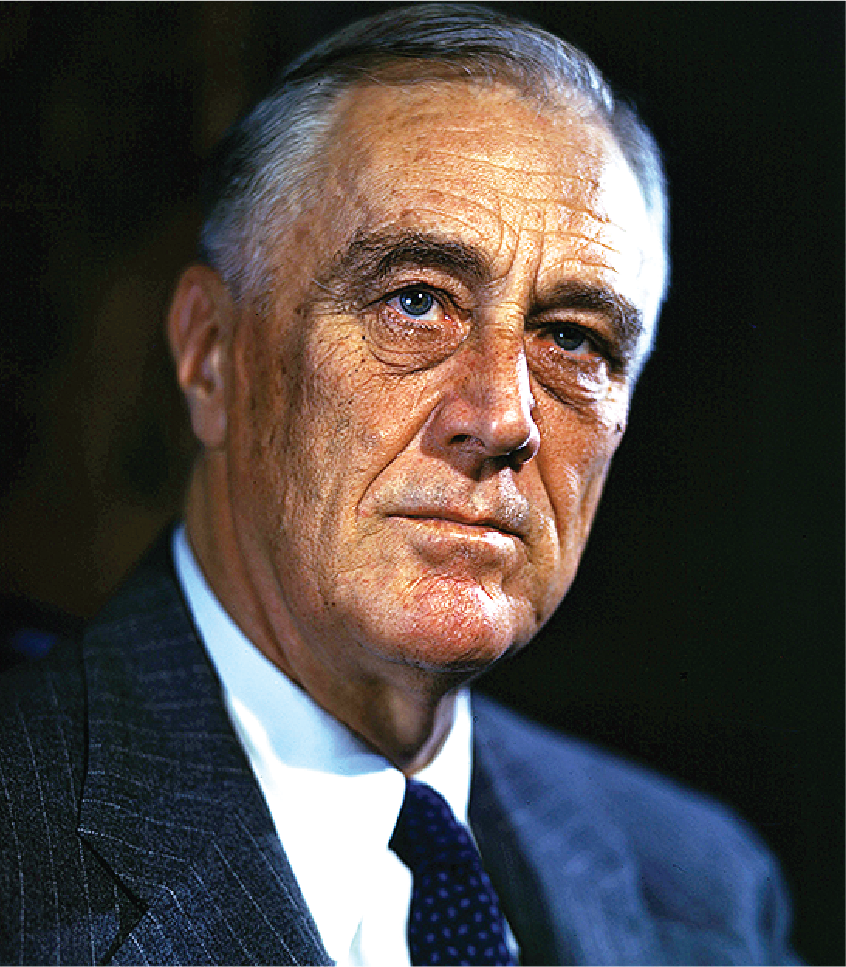
Franklin Delanor Roosevelt as pictured form his FDR Presidental Library.
Franklin Delano Roosevelt was elected in 1932 with the expectation the “New
Deal” programs he would propose would aid the country’s recovery from the
Great Depression.
And much of what he proposed was passed by a sympathetic Congress and did indeed put millions of Americans back to work.
But a number of key parts of his New Deal — the National Recovery Administration and the Agricultural Adjustment Act — were struck down by the Supreme Court, much to FDR's frustration.
Even as he was reelected by a landslide in 1936, Roosevelt was plotting a workaround. Rather than attack the court's conservative leaning, he would play upon its collective age.
In February 1937, Roosevelt proposed providing full pay to all justices over age 70 years and six months and who had served 10 or more years. For any justice who refused to retire, Roosevelt would appoint a new "assistant" justice — who would have full voting rights.
This had the potential of "packing" six additional justices onto the Supreme Court — justices whom Roosevelt would be able to nominate and whom the Senate would likely sign off on. It would essentially guarantee Roosevelt and his agenda a liberal-voting majority.
The "court-packing" proposal didn't go over well. News commentators hated it. The public disliked what was a rather naked grab for power. Members of the court were appalled. Congressional Republicans howled. Even Democrats — who outnumbered Republicans 4-1 in the Senate — voiced their opposition.
After sitting on the legislation for 167 days, the Senate Judiciary Committee recommended the bill not be passed. It was voted down 70-22 on July 22, 1937.
The Supreme Court in 1937
The 1937 Supreme Court, from the archives of the Supreme Court.
How FDR Lost The Battle But Won The War
As Roosevelt’s proposed legislation was debated, critiqued and criticized over the spring of 1937, there was one group that was watching the issue very closely: The Supreme Court itself. It knew very well that there is nothing in the Constitution that would prevent FDR from packing the court with New Deal-friendly justices.
But something interesting happened: The Supreme Court surprised everyone by validating, by a 5-4 ruling, a minimum wage law in Washington state that was similar to one it had struck down just months before in New York. Two weeks later, the court sustained the National Labor Relations Act — legislation that had previously been deemed too broad. On May 24, it found Roosevelt’s Social Security program constitutional.
What changed? Justice Owen Roberts, who previously had voted with the court’s conservative justices, suddenly began voting in favor of Roosevelt’s programs.
The perception at the time was that Roberts — perhaps working in concert with Chief Justice Charles Evans Hughes — intentionally began voting more liberally in order to take the wind out of FDR’s court-packing effort. Humorist Cal Tinney even referred to the change in Roberts’ voting pattern as “the switch in time that saved nine.” But, in fact, historians point to evidence that Roberts had shifted his point of view long before Roosevelt had declared war on the court. Roberts would also deny that court packing had anything to do with his voting pattern.
Not long after, Justice Willis Van Devanter — one of the court’s more conservative members — announced he would retire at the end of the spring 1937 session. This would give Roosevelt an opportunity to appoint a more liberal-leaning justice in his place. FDR would pick Hugo Black, who would go on to spend 37 years on the Supreme Court, retiring in 1971.
So while Roosevelt’s Judicial Procedures Reform Bill of 1937 died in committee, he would arguably win his war against the Supreme Court: Never again would the court strike down any of his New Deal legislation or programs.
Roosevelt would go on to serve three full terms as president, dying less than three months into his fourth term. Over those 12 years, he would appoint eight new members of the Supreme Court — one seat he would fill twice — and elevate Associate Justice Harlan Fiske Stone to chief justice.
Sources:
“FDR v. The Constitution” by Burt Solomon, “Man of Destiny: FDR and the Making of the American Century” by Alonzo Hamby, “Franklin D. Roosevelt: His Life and Times, an Encyclopedia View” by Otis L. Graham Jr. and Meghan Robinson Wander, Smithsonian magazine, National Constitution Center, Supreme Court Historical Society, History.com, Rutgers Today