
When Flight 19 Disappeared: The birth of the Bermuda Triangle mythos
On Dec. 5, 1945 — 80 years ago Friday — five TBM Avenger torpedo bombers took off from a Naval Air Station in Fort Lauderdale, Florida, on what was to be a three-hour training mission.
The planes and the 14 aviators aboard them were lost, as was a search plane the Navy sent after them.
Never mind the fact that investigators learned what happened to the planes and the men. The incident became part of the lore of the mysterious Bermuda Triangle.
A Routine Training Flight
The country was demobilizing from World War II, which had ended just three months before.
At 2:10 p.m. on Dec. 5, 1945, a routine training flight of five TBM Avenger torpedo bombers took off from a Navy air base in Fort Lauderdale, Florida. One of the planes carried two men. Each of the other four carried three. Most were trainees. In command was Lt. Charles Taylor, who had flown combat missions in the Pacific and who had taught flying to young trainees.
The mission was to drop practice bombs at Hens and Chickens Shoals in the Bahamas and then return to base.
The planes carried out their mission but then became lost. Taylor radioed that his compasses were out. He said he was over the Florida Keys, but that would have been a long way from the Bahamas, and in the opposite direction.
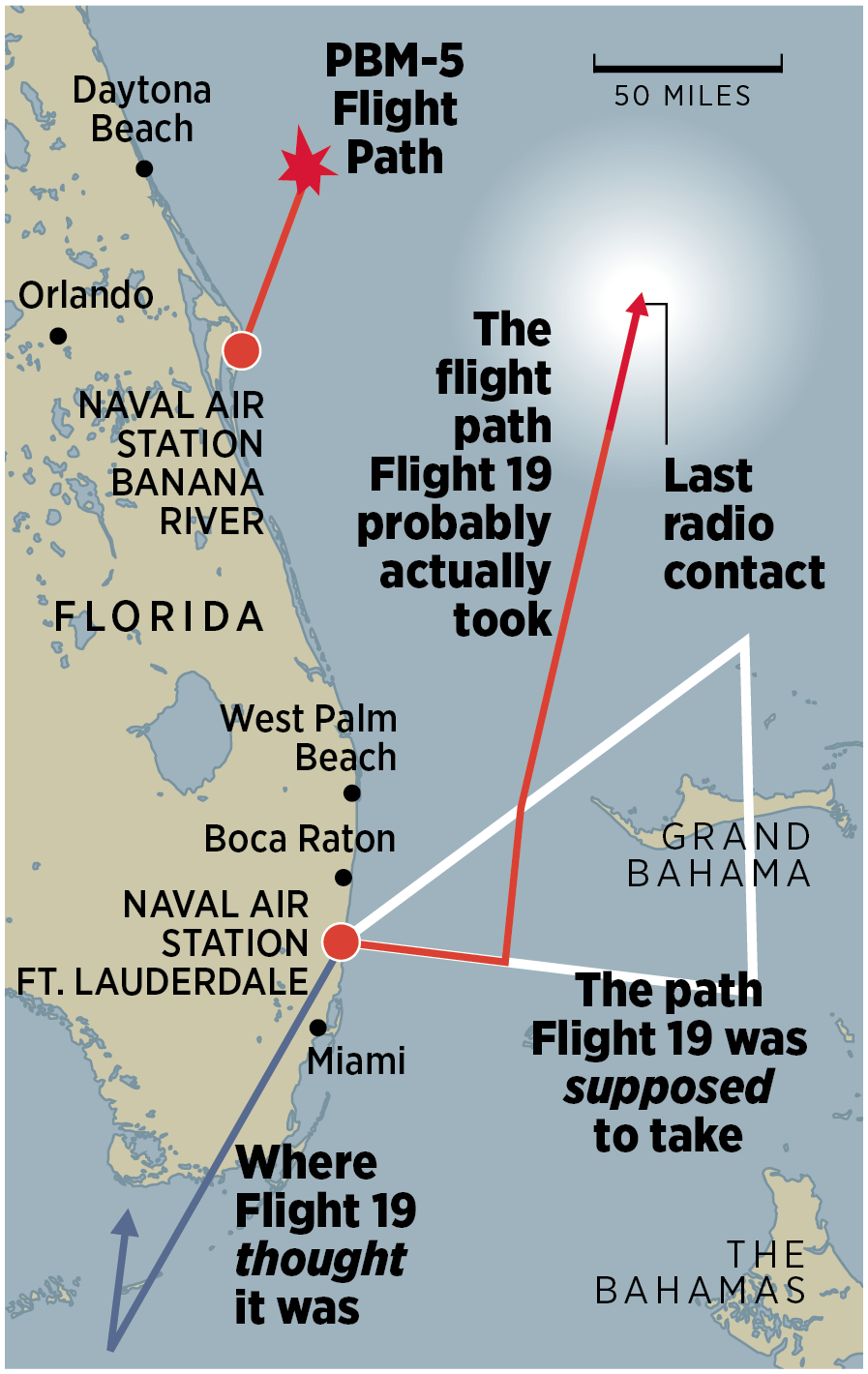
Normal procedure on a sunny afternoon might be to fly into the Sun — in other words, to the west — to reach the mainland. But Taylor, thinking he was southwest of base, turned Flight 19 to the northeast. Even some of his pilots realized they were headed the wrong way. “Dammit,” one man griped over the radio. “If we would just fly west, we would get home.” At one point, he was persuaded to turn west but then changed his mind and headed east again.
Eventually, Flight 19 began to run out of fuel. “All planes close up tight,” Taylor radioed his men. “We’ll have to ditch unless landfall … when the first plane drops below ten gallons, we all go down together.”
Moments later, radio contact was lost. Flight 19 was about 150 miles east of Cape Canaveral.
Baffled personnel back on shore scrambled three flying boats to search for Flight 19. But then one of those planes — carrying 13 rescue personnel — also disappeared about 20 minutes after takeoff.
At daybreak the next day, the Navy launched more search-and-rescue planes. Over the next five days, operations would comb 300,000 square miles. No trace of Flight 19 would ever be found.
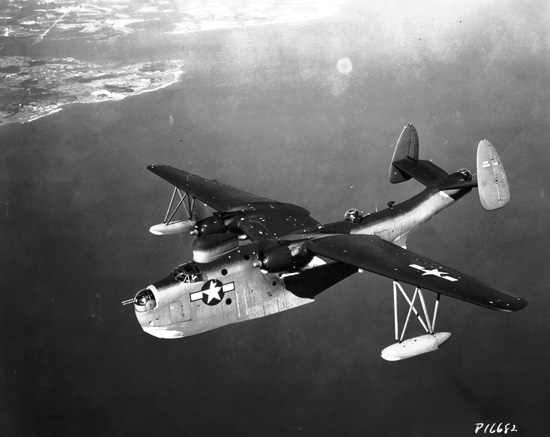
A Navy PBM-5 Mariner flying boat, like the type that disappeared searching for Flight 19. Photo from the U.S. Naval Institute.
The disappearance of the PBM-5 search plane is easy to explain. That particular model was notoriously accident-prone. Naval airmen called them “flying gas tanks” because of their tendency to catch fire. A passing merchant ship reported spotting a fireball and seeing an oil slick in the water after the plane had disappeared.
It’s clear that Lt. Taylor lost his bearings, failed to listen to wise advice and Flight 19 eventually ditched or crashed into the Atlantic.
What’s not clear is why an experienced mission leader and instructor like Taylor would become so disoriented in the first place. Witnesses later said that Taylor had shown up late for the training mission and had remarked he didn’t want to take the mission out that day. It’s been speculated that perhaps he wasn’t feeling well. A Navy board of investigation attributed the loss of Flight 19 to “causes or reasons unknown.”
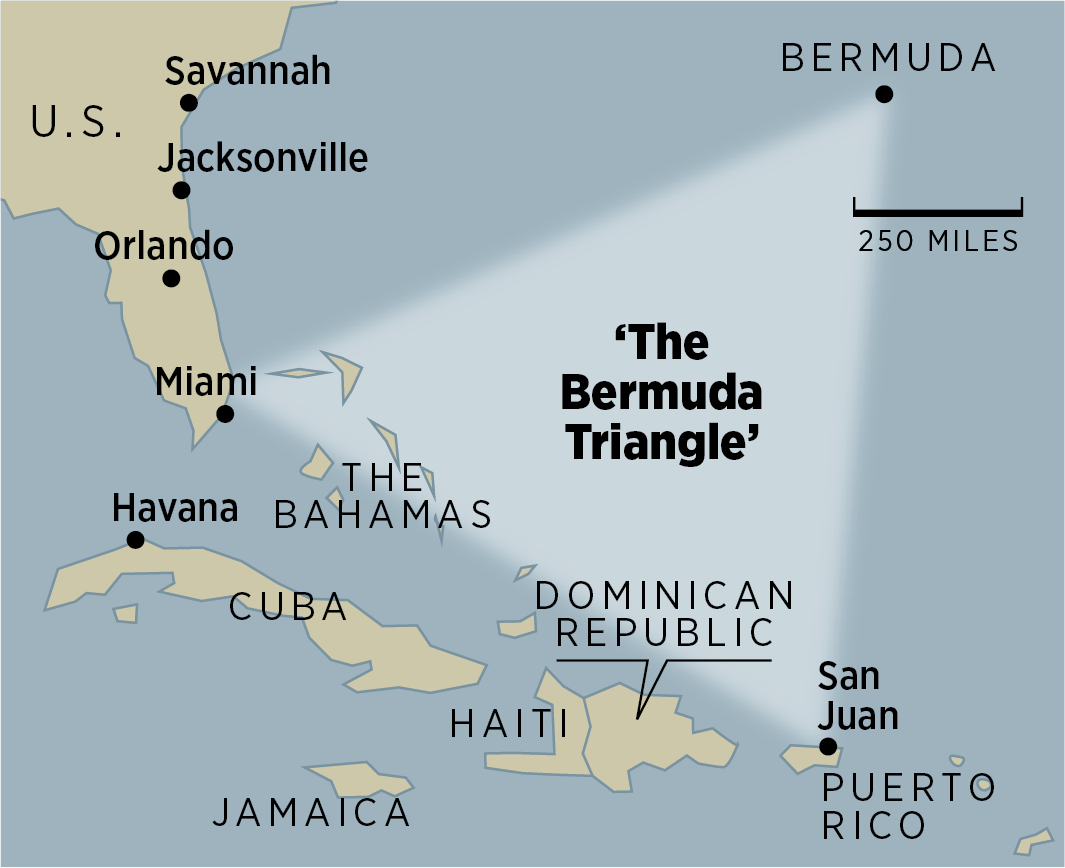
The events of Dec. 5, 1945 have become part of the myth of the “Bermuda Triangle,” a section of the Atlantic where a large number of disappearances and other oddities have occurred over the years.
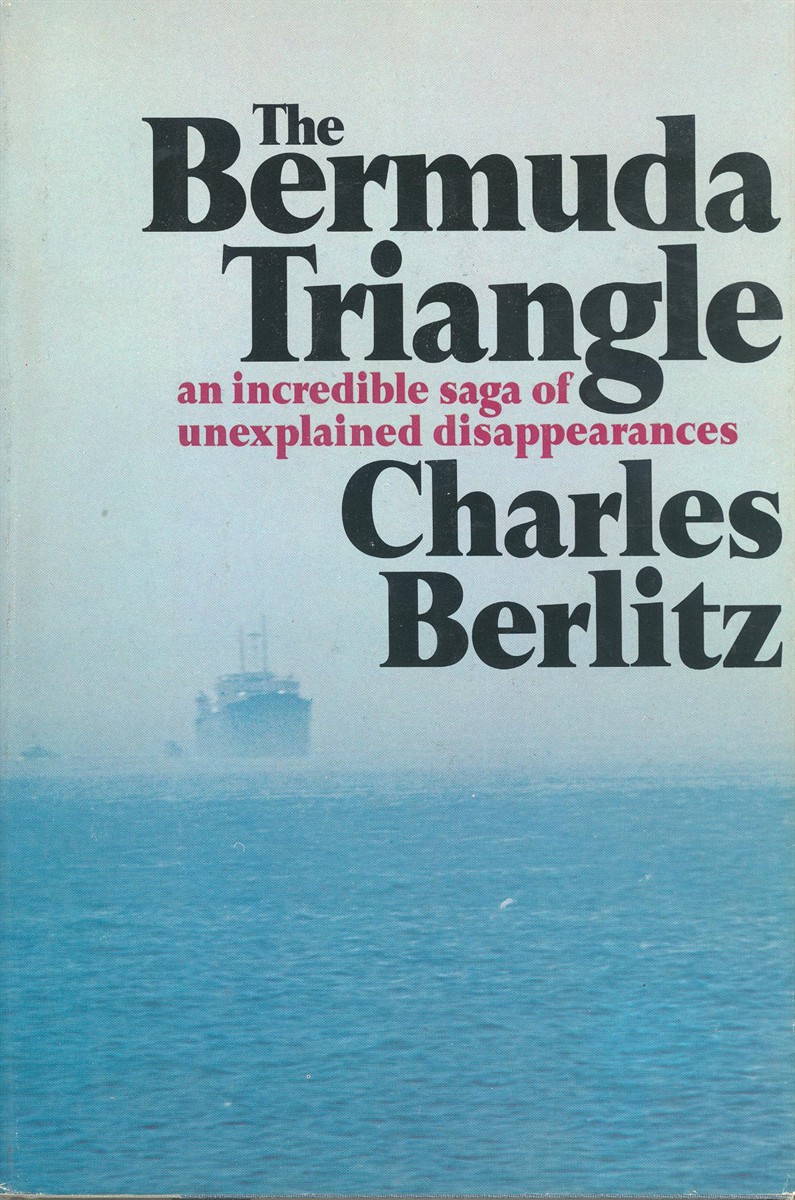
Photo from Doubleday and Company.
The mysterious happenings there are the cause of magnetic anomalies, parallel dimensions or even alien abductions, conspiracy theorists say.
Charles Berlitz’ 1974 book about Bermuda Triangle theories sold nearly 30 million copies.
Despite The Hype, There Is No Supernatural Mystery
One doesn’t hear quite so much about the Bermuda Triangle any more, but that topic was huge in the 1970s and early 1980s.
Steven Spielberg even gave Triangle mythology a little tweak on the nose in his 1977 film “Close Encounters of the Third Kind,” when an alien spacecraft wishing to make contact with Earthlings returns the Flight 19 aircraft — in pristine condition — in the middle of a desert.
Australian scientist Karl Kruszelnicki says the sheer volume of traffic in that region shows the number of ships and planes “that go missing in the Bermuda Triangle is the same as anywhere in the world on a percentage basis.”
“There is no evidence that mysterious disappearances occur with any greater frequency in the Bermuda Triangle than in any other large, well-traveled area of the ocean,” declared the National Oceanic and Atmospheric Association in 2010. “The U.S. Navy and U.S. Coast Guard contend that there are no supernatural explanations for disasters at sea,” the NOAA says. “Their experience suggests that the combined forces of nature and human fallibility outdo even the most incredulous science fiction.”
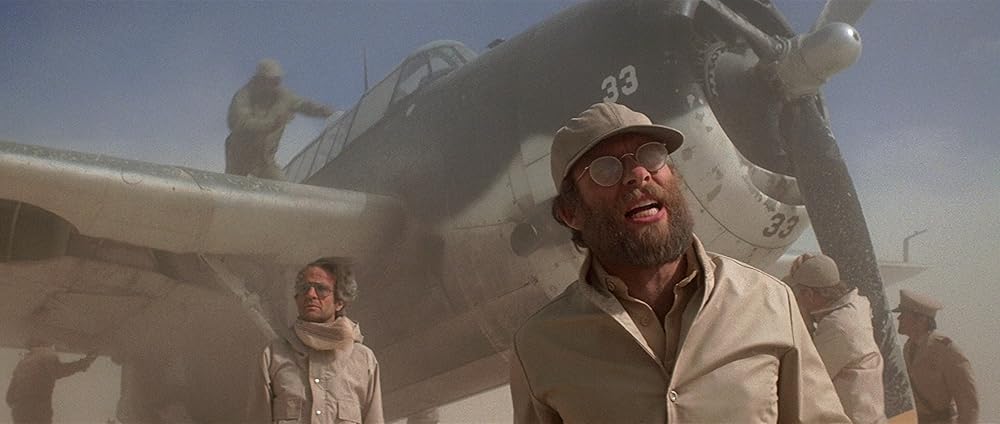
Flight 19’s cameo appearance in “Close Encounters of the Third Kind.” Photo from Columbia Pictures.