The London Blitz
On Sept. 7, 1940 — 80 years ago tonight — the German air force launched a massive series of attacks on London that would go on for 56 of the next 57 days and nights.
The plan was to destroy the Royal Air Force, leaving England undefended for an invasion. But it didn’t turn out that way.
The Timeline of The Blitz
JUNE 14, 1940
German troops march into Paris. Führer Adolf Hitler and his war machine next set sights on Great Britain.
JULY 10
The Battle of Britain begins as Hermann Göering, the head of the German Luftwaffe, orders attacks on shipping and on British port facilities.
AUG. 1
Hitler issues orders for plans to be drawn up for Operation Sea Lion: The invasion of Britain. He wants to begin making landings in late September.
AUG. 13
The Luftwaffe launches “Eagle Attack”: A four-day effort to destroy Britain’s air force and gain air superiority for the Germans. Two days later, Germany sends 1,300 bombers and 900 fighters for day and night attacks on British airfields. The Royal Air Force is hit hard but manages to hold together and intercept many of the attacking planes.
AUG. 18
Both sides take their biggest losses in what will become known as “The Hardest Day.” The Luftwaffe loses so many Junkers “Stuka” bombers that Göering would pull them from further service over Britain.
AUG. 20
In an address before the House of Commons, British Prime Minister Winston Churchill praises the pilots of the Royal Air Force. “Never in the field of human conflict,” he says, “has so much been owed by so many to so few.”
AUG. 24-25
The Luftwaffe concentrates its attacks on Royal Air Force air bases in southeast England. A few bombers veer off course and hit residential areas of London. Churchill retaliates by ordering the bombing of Berlin, Düsseldorf and other cities the next night — which, in turn, enrages Hitler. This changes the tone of the battle as attention shifts from military to civilian targets.
SEPT. 3
The plan for the invasion — set to begin Sept. 15 — is to drop two German airborne divisions on the south coast of England, establish three bridgeheads and invade with nine divisions and 250 tanks. With the air campaign not going quite as well as he had hoped, however, Hitler pushes Operation Sea Lion back at least a week.
SEPT. 7
The Blitz begins: Full-scale regular bombardments of London. That first day, 300 German aircraft drop more than 300 tons of bombs, killing 430 civilians and injuring 1,600 more. The bombings will continue over 56 of the next 57 days and nights.

Firemen at work in bomb damaged street in London, after a Saturday night raid in 1941. Photo from the National Archives.
SEPT. 14
Royal Air Force bombers take out a tenth of the invasion barges Germany had amassed along the coast of France.
SEPT. 15
An enormous daylight attack on London results in the biggest German losses since Aug 18. Göering is forced to scale back his attacks: Germany is running short of planes and pilots.
SEPT. 17
Since his Luftwaffe has failed to destroy the Royal Air Force, Hitler reluctantly cancels Operation Sea Lion. His General Staff suggests he attack the Soviet Union instead — despite the fact that Hitler had signed a nonaggression pact with the USSR in August 1939.
SEPT. 20
German U-boats begin using “wolf pack” groups of 15 to 20 subs at a time, sinking 12 Allied supply ships in the first two days of using that tactic.
OCT. 14
During a heavy night attack, a bomb falls on Balham High Road, above the intersection of two subway tunnels. The blast kills 68 civilians who are sheltering there from the raid. That night, 200 are killed and 2,000 more injured.
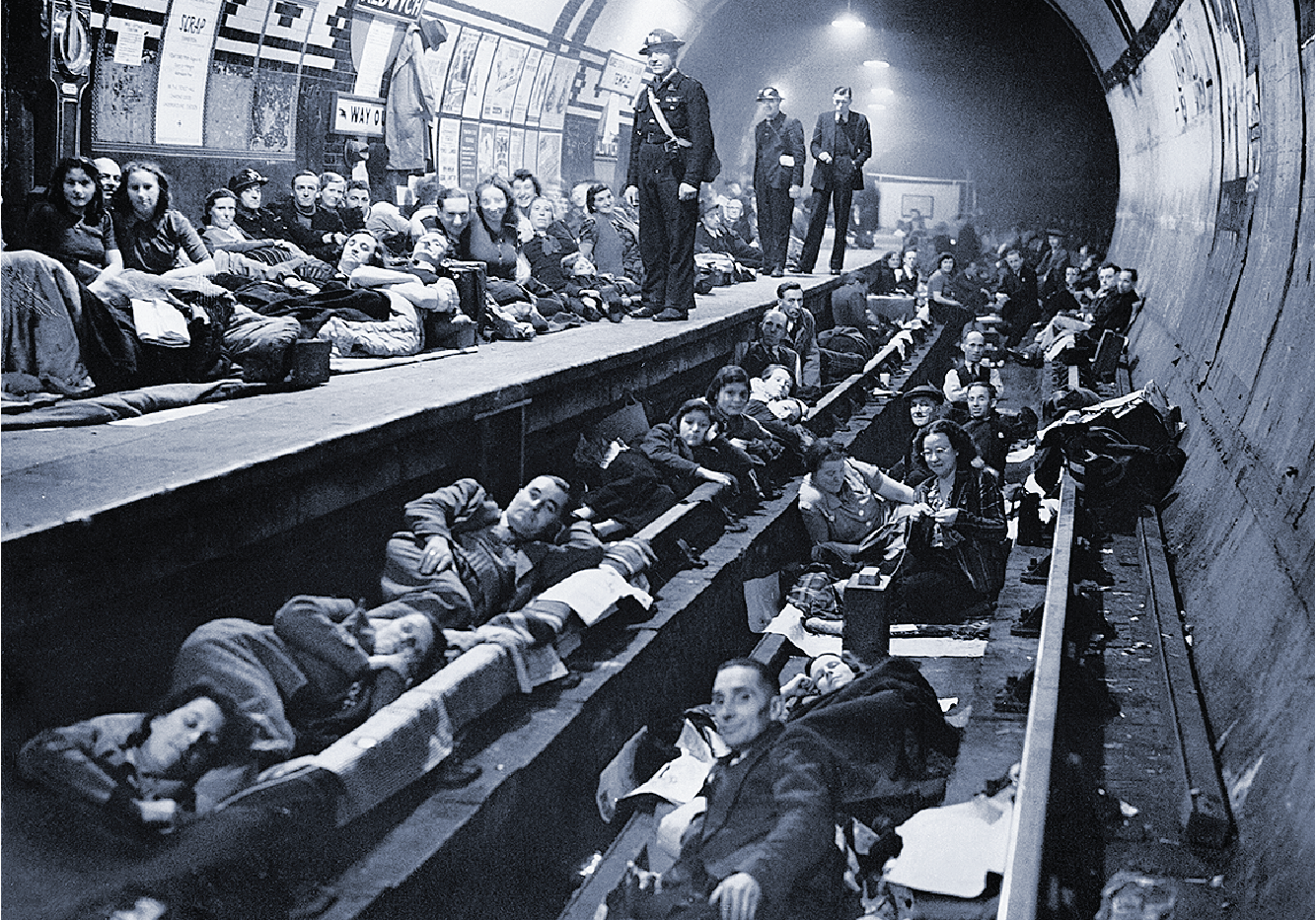
Civilians take refuge in the Aldwich subway “tube” in October 1940. Seventy nine “tube” stations were used as air raid shelters during the Blitz. Photo from the Imperial War Museum.
OCT. 31
England’s famously poor weather comes to the rescue, causing the Luftwaffe to pause its attacks.
NOV. 14
The Luftwaffe sends 449 bombers to strike the city of Coventry in central Britain. The raid kills 500 civilians and leaves thousands homeless.
DEC. 29
Another attack on London results in more than 300 incendiary bombs dropped around St. Paul’s Cathedral within the span of one minute — “like apples falling from a tree,” one witness says. With the River Thames at low ebb, firefighters have trouble putting out the flames. Wooden buildings collapse in flames, further blocking streets to firefighting efforts.
DEC. 29
In a “fireside chat” radio address, President Franklin D. Roosevelt urges Americans to support providing more military aid to Britain. He tells the country that the U.S. must become the “arsenal of democracy” against the Axis powers.
APRIL 21-30, 1941
A series of concentrated attacks on the British port city of Plymouth kills 750 and leaves 30,000 homeless.
MAY 10
Deputy German leader Rudolph Hess flies to Scotland to meet with the Duke of Hamilton to propose a truce: If Britain would allow Germany a “free hand” in England, Germany will promise to leave the British Empire intact. Neither Germany nor Britain had authorized the meeting, however, so British authorities arrest and detain Hess.
MAY 11
London, Liverpool, Bristol, Belfast and other cities are attacked by 507 German bombers. A total of 711 tons of bombs and 2,387 incendiary devices are dropped, killing 1,436 civilians. This would be the final major German air attack on Britain for three years. The final toll of the Blitz: 43,500 dead, 140,000 injured and more than a million homes damaged or destroyed.
JUNE 22
Germany launches Operation Barbarossa, the invasion of the Soviet Union, along a front 2,000 miles wide. Hitler expects his blitzkrieg tactics to defeat the USSR by the end of summer.
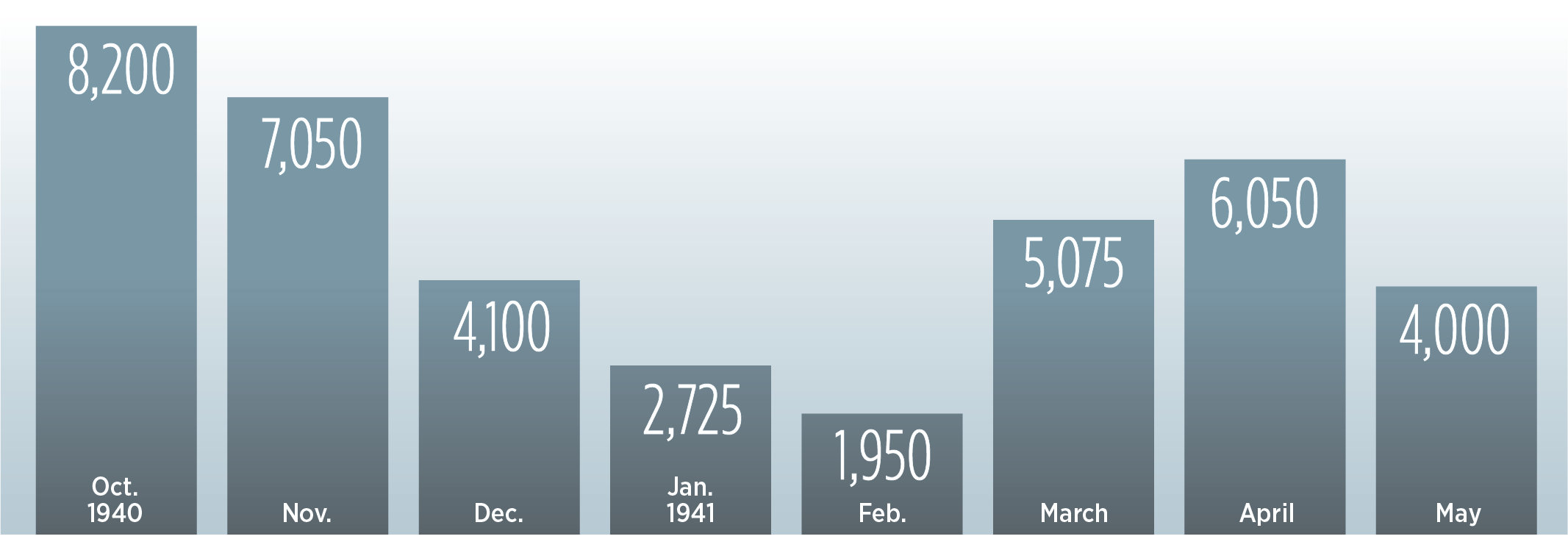
Luftwaffe Sorties During The Blitz
Sortie: One combat mission by one aircraft