
Nadia's Perfect Performance!
On July 18, 1976 — a half-century ago Saturday — a 14-year-old Romanian gymnast earned the first perfect scores in the history of her sport at the Summer Olympics in Montreal.
Great Gymnast. Great Performance. Bad Scoreboard.
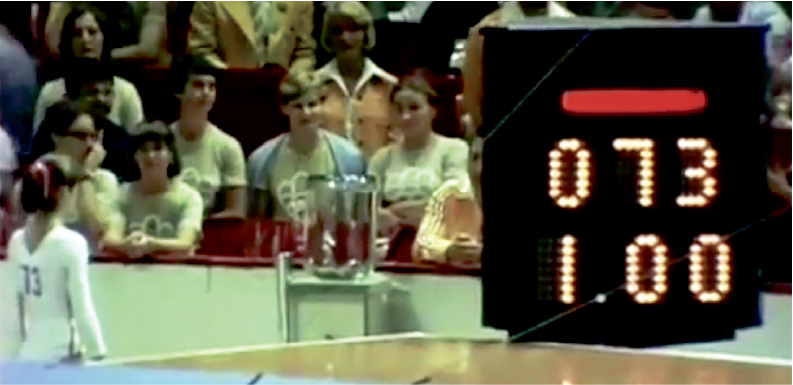
Nadia Comăneci and the audience in the Montreal Forum on July 18, 1976 all stare in disbelief at Nadia’s score of 1.00 for her opening performance on the uneven bars.
You could see the confusion, the hurt in Nadia Comăneci’s eyes.
The 14-year-old Romanian gymnast had just completed what appeared to be a world-class performance on the uneven bars. But when the judges’ scores popped onto the venue’s electronic signs, she saw she had been given a trash score of 1.00.
Nadia was stunned. The crowd murmured in confusion. The commentators for ABC Sports didn’t quite understand.
The scoreboards used at the time hadn’t been designed with two digits to the left of the decimal point. No one thought two digits would ever be needed there.
Slowly, finally, it dawned on everyone: Nadia had accomplished a first in competitive gymnastics: The judges had awarded her a perfect 10.
The crowd leapt to its feet and roared its approval.
The date was July 18, 1976. The place: The world’s biggest sports stage, the Summer Olympics in Montreal.
Nadia’s superheroics didn’t stop with the uneven bars. She went on to match her accomplishment with six more perfect scores over the next four days: Three times on the uneven bars and three times on her best apparatus, the balance beam.
There were six events in women’s gymnastics at the Montreal Games. Nadia took home three gold medals, one silver medal and one bronze.
Nadia became the youngest all-around Olympic gymnastics champion. That record likely will never be broken: Since then, age restrictions for international gymnastics competition have been raised: Starting in 1981 Olympic gymnasts had to be at least 15 years old. In 1997, that was changed again to 16 years old.
At the 1980 Summer Olympics in Moscow, Nadia would win two more gold medals on balance beam and floor exercise and a silver in all-around.
Nadia retired from competition in 1984 and coached the Romanian national team after her mentor, Bela Karolyi, defected to the United States.
Nadia defected in November 1989, just a few weeks before that country’s revolution. In the U.S., she promoted gymnastics apparel, aerobic equipment and even modeled for a controversial series of ads for Jockey brand underwear.
In 1996, she married American gymnast Bart Connor — who had won two gold medals in the 1984 Los Angeles Olympics — and became a U.S. citizen in 2001.
Nadia and Bart run a gymnastics studio in Norman, Oklahoma and publish “International Gymnast” magazine. In 2003, Nadia published a memoir, “Letters to a Young Gymnast.”
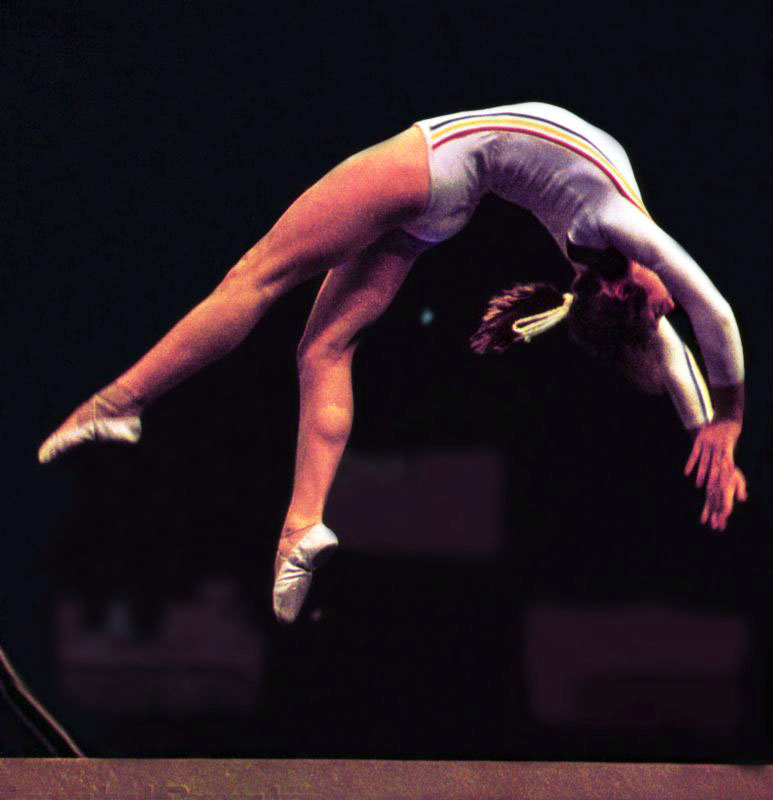
Nadia would earn three of her seven perfect 10 scores in Montreal on the balance beam, which she considered her best apparatus.
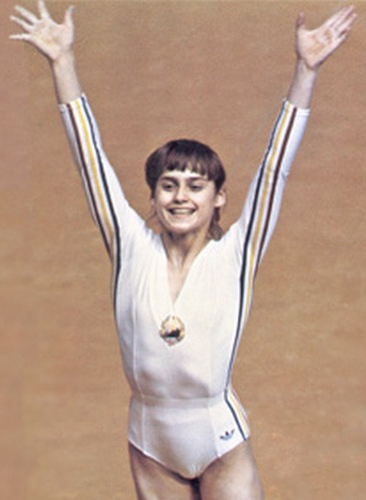
Nadia earned three gold medals, one silver medal and one bronze in Montreal.
Nadia Comaneci's Gymnastic Medals At The 1976 Olympics

The World Reacts To Nadia's Achievements
Nadia became a media darling, appearing on the covers of Time, Newsweek and Sports Illustrated, all in the same week in August 1976.
ABC Sports used a song called “Cotton’s Dream” — which was also the theme song for the soap opera “The Young and the Restless” — as background music for a montage of slow-motion clips of Nadia’s performances.
Although the song came to be known as “Nadia’s Theme,” she never actually used the music in her routines. Instead, Nadia had used a piano medley of “Yes Sir, That’s My Baby” and “Jump in the Line” for her floor exercise music.