
Nixon's Tapes: Notetaking for a trial
Installation of President Richard Nixon’s infamous secret White House recording system was completed on Feb. 16, 1971 — 55 years ago next Monday.
Some of the conversations captured on tape over the next 29 months were ones that Nixon would regret when the world learned about the system during the Watergate investigation in 1973.
Nixon Changes His Mind
Richard Nixon wasn’t the first president to record private conversations in the White House. Presidents Franklin D. Roosevelt, Harry Truman and Dwight D. Eisenhower experimented with recording certain meetings and press briefings.
John F. Kennedy was the first president to expand that to recording many private conversations. Lyndon B. Johnson continued that when he took over after Kennedy’s assassination.
Nixon was stunned by Johnson’s recording system. He ordered the system to be removed — and it was, shortly after his inauguration in January 1970.
Nixon replaced the recorders, at first, with a series of stenographers who would be summoned into the Oval Office to take notes. But keeping staffers like this on constant standby proved difficult. Remembering to call one in proved difficult. Nixon found himself constantly frustrated by visitors who’d attend a meeting and then make inaccurate reports of what they saw and heard in the Oval Office.
A couple of years into his first administration, Nixon was chatting with Johnson when Johnson told him how helpful his tapes had been while writing his autobiography. That sold Nixon on the idea of a tape system.
The System Goes Live ...
Nixon’s top advisors wanted to install a taping system in the Oval Office that would activate whenever anyone within range of one of the seven microphones spoke. After 20 or 30 seconds of silence, the recording would pause.
This low-tech, hands-free approach was a vital part of the plan. “If you think there was any way of having Nixon hit a button, you didn’t know Nixon,” Alexander Butterfield, the staffer who oversaw installation of the system, said in 2003. Butterfield was the chief assistant to Nixon’s Chief of Staff, H.R. Haldeman.
The signals picked up by the microphones would be relayed to a secret recording station in the basement of the White House, equipped with two Sony 800B reel-to-reel recorders loaded with extremely thin, 0.5 mm tape.
Each unit could record up to six and a half hours. Secret Service personnel would change out the reels once every 24 hours.
Once it was determined the system was providing the desired coverage, it was expanded to an auxiliary office Nixon used in the Old Executive Building next door, to the Lincoln Sitting Room, to the Cabinet room and to certain White House telephones. In 1972, the president’s office and two telephones at Camp David were hooked up to recorders.
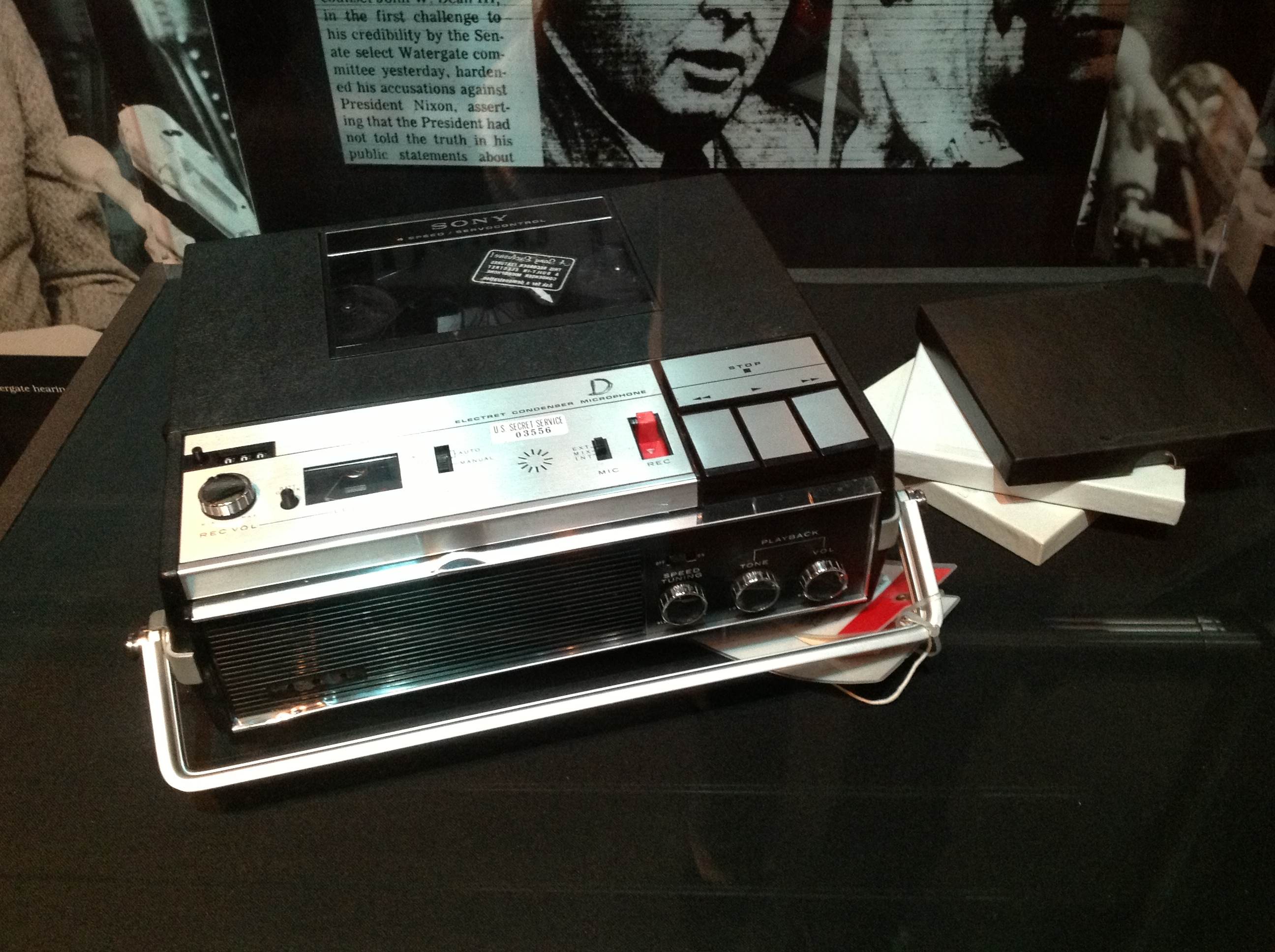
One of the recorders that was used to tape Oval Office conversations is now on display at the Gerald R. Ford Presidential Museum. Photo from the National Archives.
The existence of the system was deliberately kept quiet. Besides Nixon, Haldeman and Butterfield, only a small handful of Secret Service technicians knew of the system and changed the tape reels.
Butterfield was instructed to make the system good, but not so elaborate that the military would have to be called in to set it up.
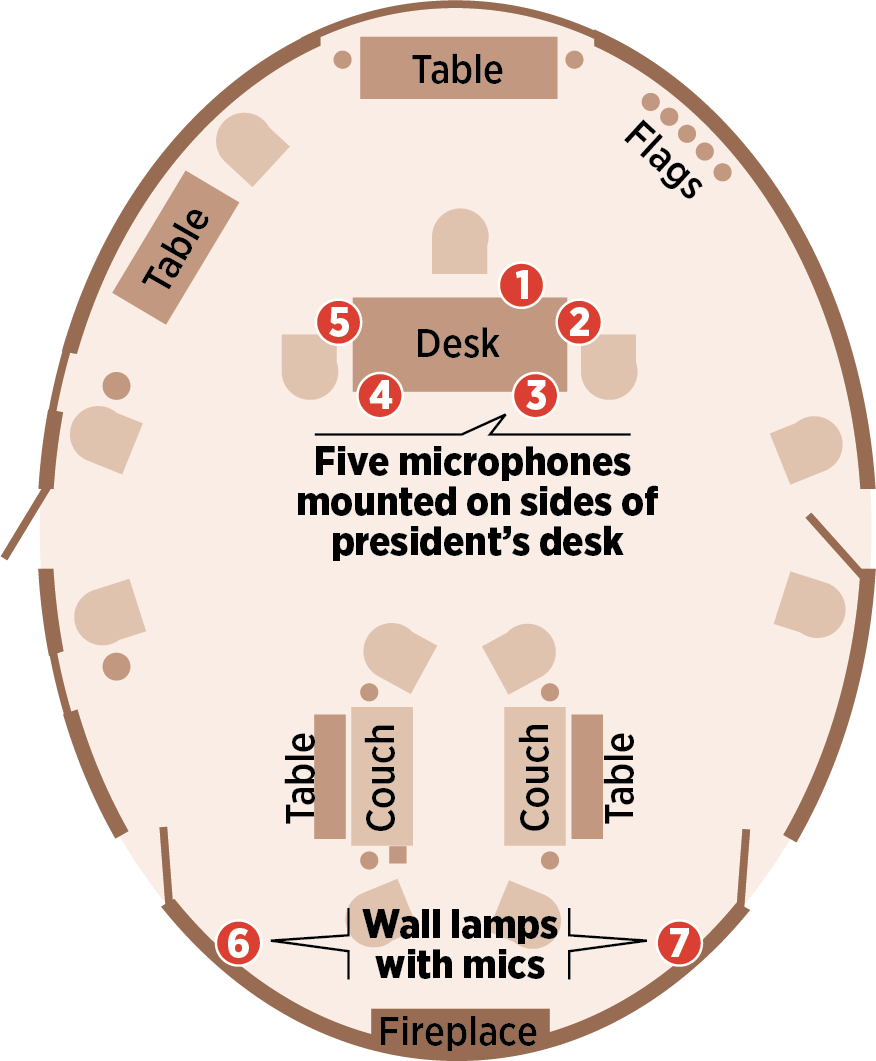
“They put the initial microphones in the president’s desk,” Butterfield explained. “That came back to bite us because, when coffee was served at the desk — which was the normal routine — you could hear the coffee cups rattle, and the president’s knee would kick the desk, or he would put his feet up now and then, probably right on a microphone.”
The taping system was completed by Feb. 16, 1971, and went live that day.
In 1988, Haldeman explained that after the system had been up and running for about a year, “Butterfield came to see me and said our taping system had made quite a pile of full reel. He assumed, he said, that I wanted them transcribed.
“I took this rather thoughtless suggestion to Nixon. He would not have it, and restated his insistence that the tapes should remain absolutely private. I argued briefly for transcribing the tapes, but slowly gave the matter up. I realize now how naive my argument was.”
... But Eventually Leads To Nixon's Downfall
Over the next 29 months, Nixon’s recording system captured about 3,700 hours of conversations, phone calls and meetings.
Everything worked the way it was supposed to. Even when the White House didn’t really want it to work.
“We marveled at his ability to, uh, seemingly be oblivious to the tapes,” Butterfield said. “I mean, even I was sitting there uncomfortably sometimes saying, ‘He’s not really going say this, is he?’ ”
This came into play during the Watergate scandal. On July 16, 1973, Butterfield was called before the Senate Watergate committee, which was surveying Nixon’s inner circle to see what Nixon might have known about the break in at the Democratic National Committee headquarters.
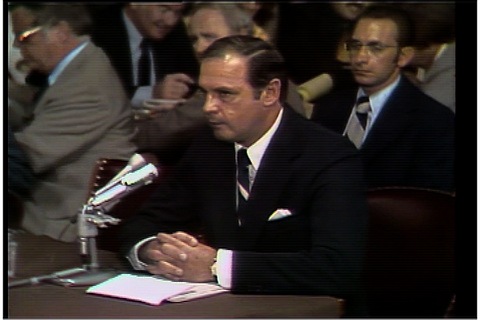
Butterfield testifies on national TV. Photo from PBS.
Committee members — and much of the nation — was stunned when Butterfield answered a question about why Nixon might take his attorney, John Dean, to a certain corner of the Oval Office to have a sensitive conversation.
“I was hoping you fellows wouldn’t ask me that,” Butterfield said in the nationally televised hearing. “... Yes, there’s a recording system in the White House.”
That was a game changer. No longer would the committee and the nation be forced to rely on conflicting reports by Nixon’s staff and former staffers. There were tapes that might reveal what Nixon knew and when he knew it.
Nixon’s new lawyer, Fred J. Buzhardt, advised Nixon to “destroy the tapes.” Other advisers realized the recordings Nixon had hoped to use to write his memoirs had now become evidence in a federal prosecution.
The special prosecutor for the Watergate investigation requested the tapes. Nixon refused, citing executive privilege and claiming that content on the tapes were vital to national security.
In October, Nixon proposed a compromise in which he’d release transcripts of most of the tapes. When the special prosecutor declined that offer, Nixon had him fired in what came to be called “the Saturday Night Massacre.”
In November, it became known that one of the tapes — a recording of a key conversation between Nixon and Haldeman about the Watergate break-in — was marred by a mysterious 18½-minute gap. At first, Nixon’s secretary tried to accept the blame, saying she had accidentally erased the tape while transcribing it.
It wasn’t until April 1974 that the House Judiciary Committee subpoenaed tapes of 42 specific White House conversations. Nixon released edited transcripts.
On July 24, 1974, the Supreme Court ordered Nixon to turn over the tapes. One tape contained a conversation between Nixon and Haldeman constructing a plan to block a Watergate investigation by the FBI.
This became known as the “Smoking Gun” tape. What support Nixon still had on Capitol Hill quickly evaporated. Republicans on the House Judiciary Committee signaled they were now in favor of impeaching Nixon.
Nixon resigned on Aug. 8, 1974. The nation’s first president to step down from office resigned because of a tape recorder.
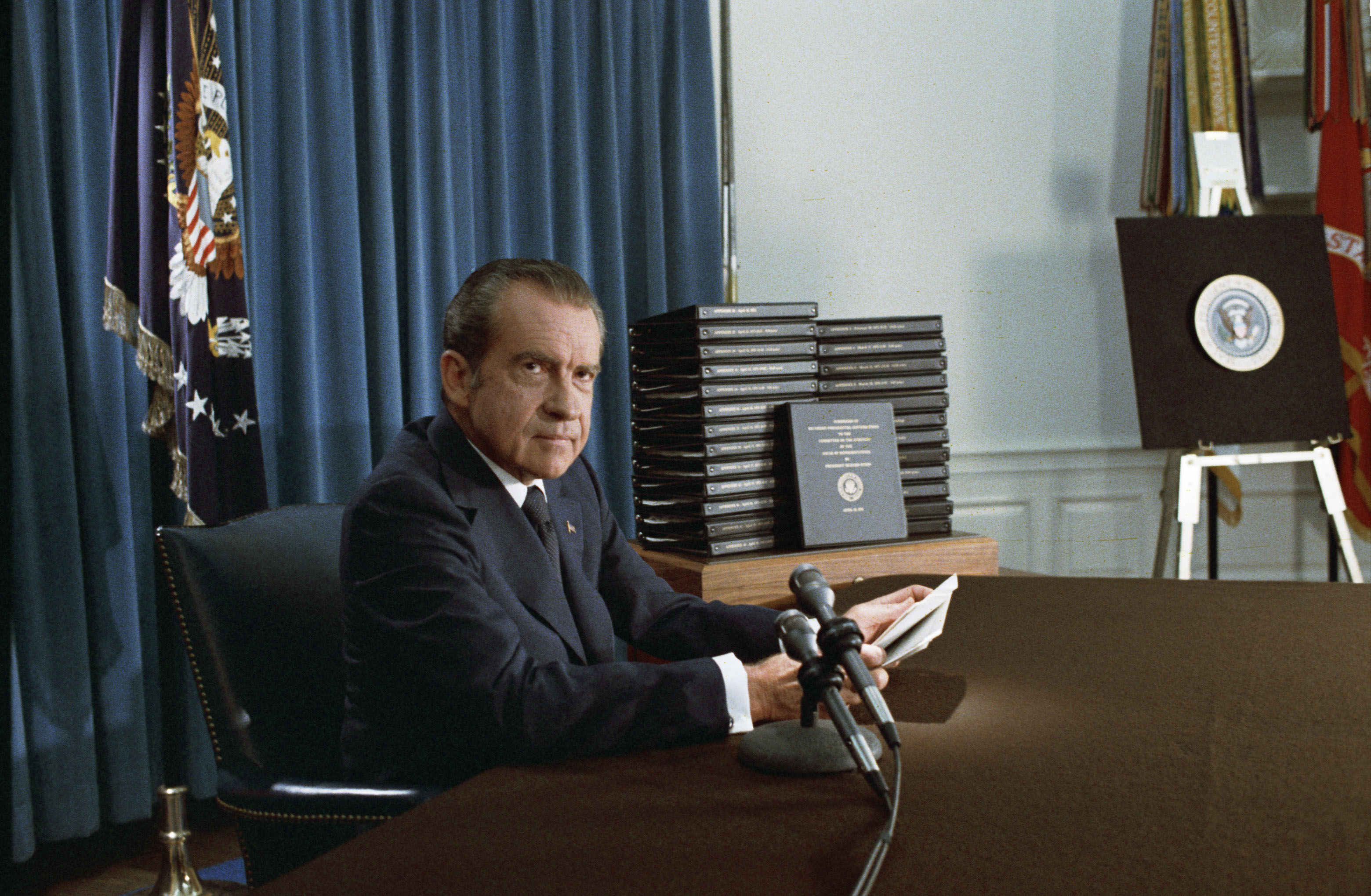
Nixon and his transcripts on April 29, 1974. Photo from National Archives.