
Once upon a time, newspapers were the first, best source of news for the public.
In many cities, people had a choice of newspapers. Some arrived first thing in the morning. Some were delivered in the afternoon — just in time for dad to get home from work, plop into his easy chair and peruse the previous day’s box scores.
That’s not the case any more. Newspapers have seen an alarming shrinkage of their revenue, their resources, their staff and their readership.
And while smaller, local papers are hit especially hard by this, it is by no means limited to certain areas. This is a nationwide problem.
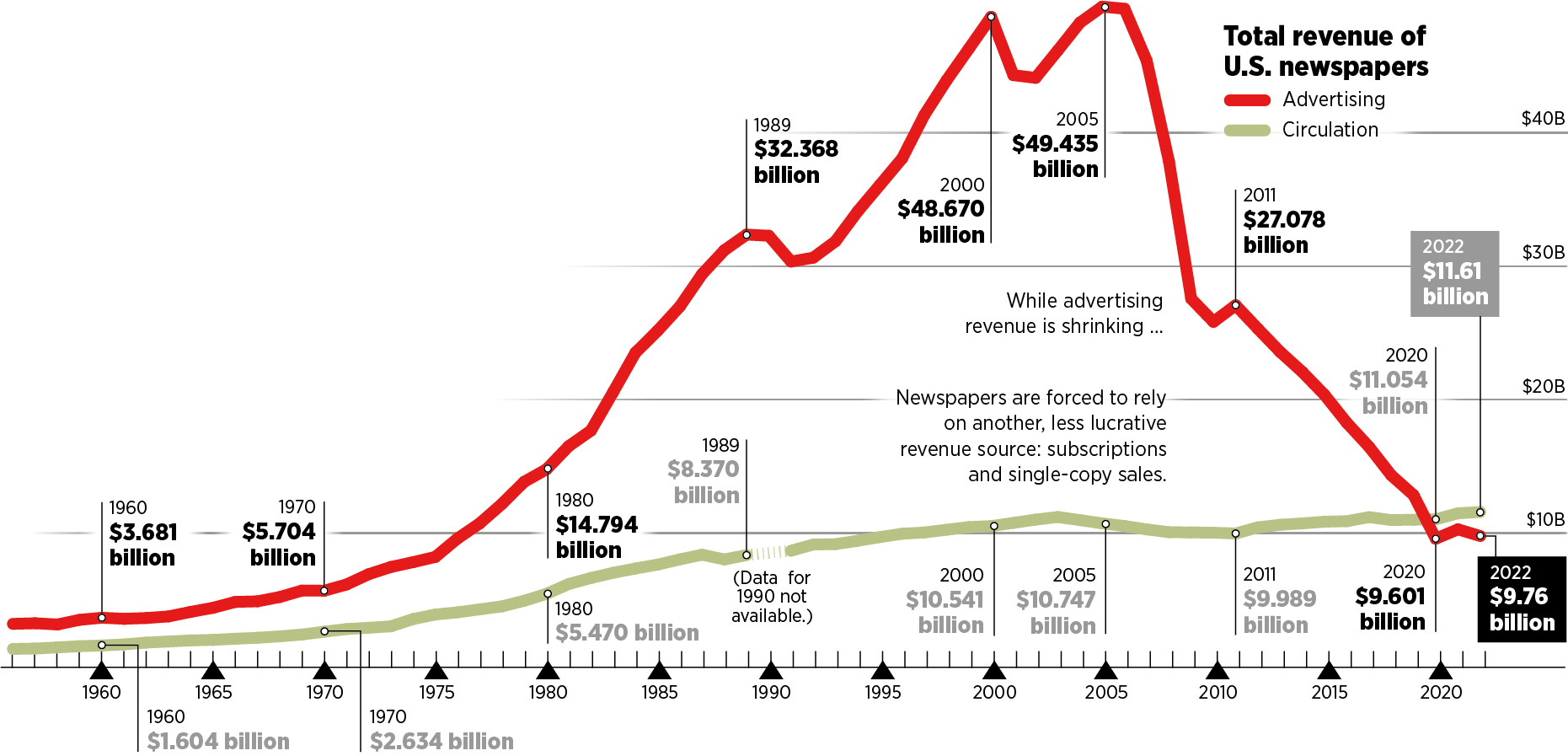
Shrinking Newspaper Revenue ...
It would be easy to blame shrinking newspaper revenues on the movement of readers and advertisers to online platforms. But in truth, it’s a lot more complicated than that.
Newspapers made a lot of their money on classified advertising — think help-wanted ads, real estate ads and so on — and on the multiple full pages of ads retail outlets would buy. These paid the salaries for many reporters and editors — and, yes, in some cases made wealthy people out of publishers and owners.
Newspapers have succeeded in gaining a larger share of the digital ad market. But digital ads pay a fraction of what print ads used to bring in. Advertising revenue — upon which the industry was built — has dropped by more than 80% since its peak in 2005.
The result has been a total collapse of newspapers as a business and the companies that own them.
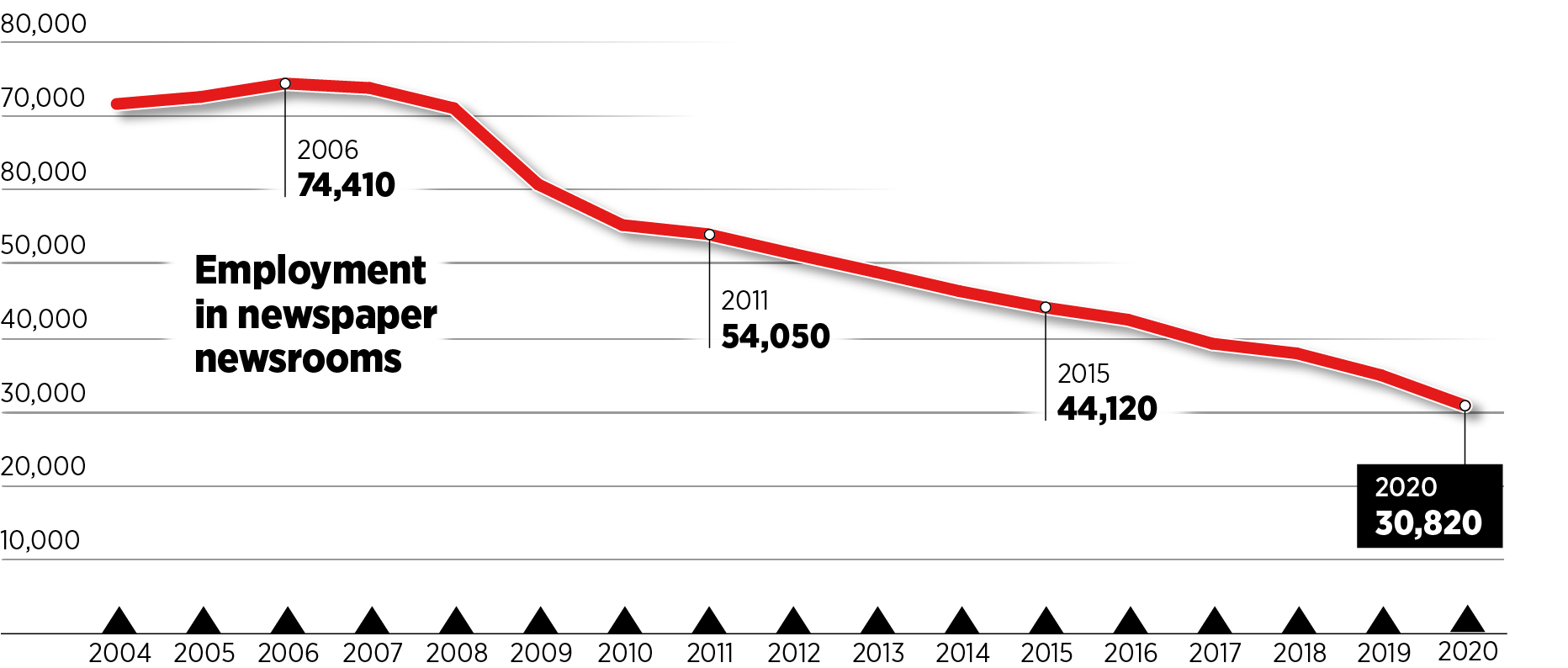
... Means Fewer Employees To Gather News
The number of people employed in newspaper newsrooms has shrunk nearly 60% over the past 17 years. This means fewer reporters, fewer photographers and fewer editors. This means less coverage of local issues, businesses and sports. In some cases, it means a paper might reduce its print schedule to only three or four issues a week.
In some cases, newspaper groups have laid off editors and designers and sent news production duties to regional centers or “hubs,” where papers are assembled by staffers who don’t live or work in the communities where their papers are located. Some newspapers have even outsourced this work to centers outside the U.S.
The Decline of Newspapers By The Numbers
- 10M
- Combined circulation of the 500 largest U.S. newspapers in 2024. In 2005, it was 50 million.
- 2.5
- Newspapers that shut down per week in the U.S. over the past three years.
- 310
- Number of papers owned in 2024 by the nation’s largest newspaper publisher, Gannett. In 2020, it was 613.
- 2/3
- Portion of daily newspapers in the U.S. still printing seven days a week.
- 3.5M
- People in 206 U.S. counties who no longer have a local source for news.
- 62
- Percent decrease in circulation of Gannett’s USA Today since 2020.
- 42
- Median age of a full-time journalist in the U.S. in 2022. It was 32 in 1982.
- 62
- Percentage of readers who prefer print say physical newspapers allow them to read more easily.
- 19
- Percentage of news readers in the U.S. who pay for digital access to newspapers.
Is There A Solution?
“There’s one obvious lesson to be drawn from the collapse” of the newspaper industry: “that a public service industry can be lost when subjected to overwhelming financial pressures,” writes Radford University journalism professor Bill Kovarik in his textbook, “Revolutions in Communication.”
“At some point, people will pay for the content they love,” continues Kovarik. “But then, what does that say about journalism? The popularity of the profession has gone down, and few people today would see journalists as knights of the press, as they did a century ago.
“Journalists have always been the gadflies of their communities, and perhaps as unwelcome today as in the days of William Cobbett or Joseph Pulitzer.”
- Some news organizations are already planning for the day when they deliver a digital-only product, with no printed components.
- Some news organizations have looked for new ways of distributing the news. One good example: Several years ago, many papers began what was called a “pivot to video” and concentrated on posting ad-driven video news segments to Facebook. This dropped off after it was revealed Facebook had spread bogus numbers on the effectiveness of those videos. Other organizations invested heavily in tablet-driven delivery.
- Some news organizations have begun exploring ways to become nonprofit organizations. These might be supported by donations from their local communities or businesses, much like public television and radio are today, or from grants.
- Some news organizations have pursued government-subsidized funding.
- Some news organizations are searching for new streams of income, such as holding fashion shows or book club meetings, selling products or offering digital marketing consulting services.