
By the mid-19th century, the Industrial Revolution in America was in danger of grinding to a halt. The nation was in desperate need of a cheaper and more easily obtained fossil fuel than coal.
That need was answered on Jan. 10, 1901 — 125 years ago Saturday — when a seemingly futile search for oil atop an underground salt dome in east Texas resulted in the gushing well you see here.
How Spindletop Changed American Life
The first well aimed specifically at extracting oil was drilled in Pennsylvania in 1859. Before long, Pennsylvania led the nation in oil production.
Geologists also knew there was oil in various locations in Texas — gas and sulfur springs would bubble out of the ground here and there but very little of it had been accessed by 1900.
Geologist Patillo Higgins suspected there was a large oil deposit beneath the underground salt dome that formed Spindletop Hill, south of Beaumont in extreme southeast Texas. Higgins began drilling there in 1892 but had little success.
Higgins brought in Austrian-born engineer, Anthony F. Lucas, to aid the search but Lucas’ operation ran out of money once they had drilled 575 feet below the surface.
Lucas recruited additional backers and hired oil men who were experts in drilling in mud. He began using a new, heavy rotary drill bit and began pumping mud instead of water into the holes to flush out drill cuttings and to minimize the risk of cave-ins in the sandy soil of southeast Texas.
Drilling started on one particular well — referred to as the Lucas Well — in October 1900. By early January, crews had reached a depth of 1,020 feet but still hadn’t found oil.
On Jan. 10, 1901, however, mud began bubbling out of the Lucas Well. The bubbling intensified quickly and pushed six tons of four-inch drilling pipe out of the hole.
Experienced oil drillers fled as oil began blowing out of the rig, more than 100 feet into the air. It would take the crew nine days to finally cap the geyser. By that time, a large pool of oil surrounded the well.
As word spread, onlookers, speculators, and oilmen arrived to see the Lucas Well and the dozens that sprang up around it. The tiny town of Beaumont quickly grew, with its population rising from 10,000 to 50,000.
Oil flow from The Lucas Well averaged 100,000 barrels per day — as much as 37,000 wells in the eastern U.S. combined. By the end of the year, the 138 wells at Spindletop produced as much oil as the rest of the world.
Before long, the growing number of wells at Spindletop led to a fast decline in production. The field produced 17.5 million barrels of oil in 1902 but by early 1904, production had fallen off to 10,000 barrels a day. Other companies began drilling along the outer edges of Spindletop and at deeper depths.
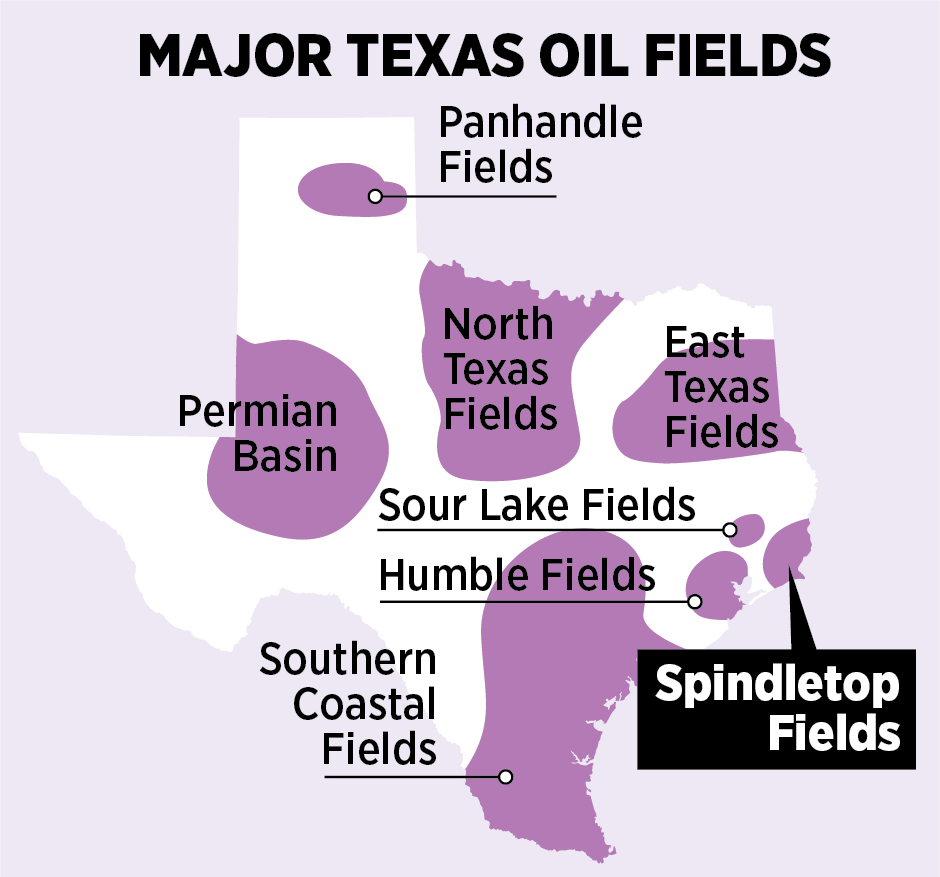
The oil strike at Spindletop revolutionized transportation and industry in the United States. Oil prices fell from $2 a barrel to less than 25 cents a barrel. This helped enable the popularization of automobiles over the next few decades and the mechanization of farm work. After railroads converted from coal to oil, steamships followed.
Among the oil companies that got their start in or around Spindletop: the Texas Company — which later became Texaco — the Gulf Oil Corporation, Sun Oil Company — which later became Sunoco — the Magnolia Petroleum Company — which later merged with Mobil — and Humble — which later became Exxon.
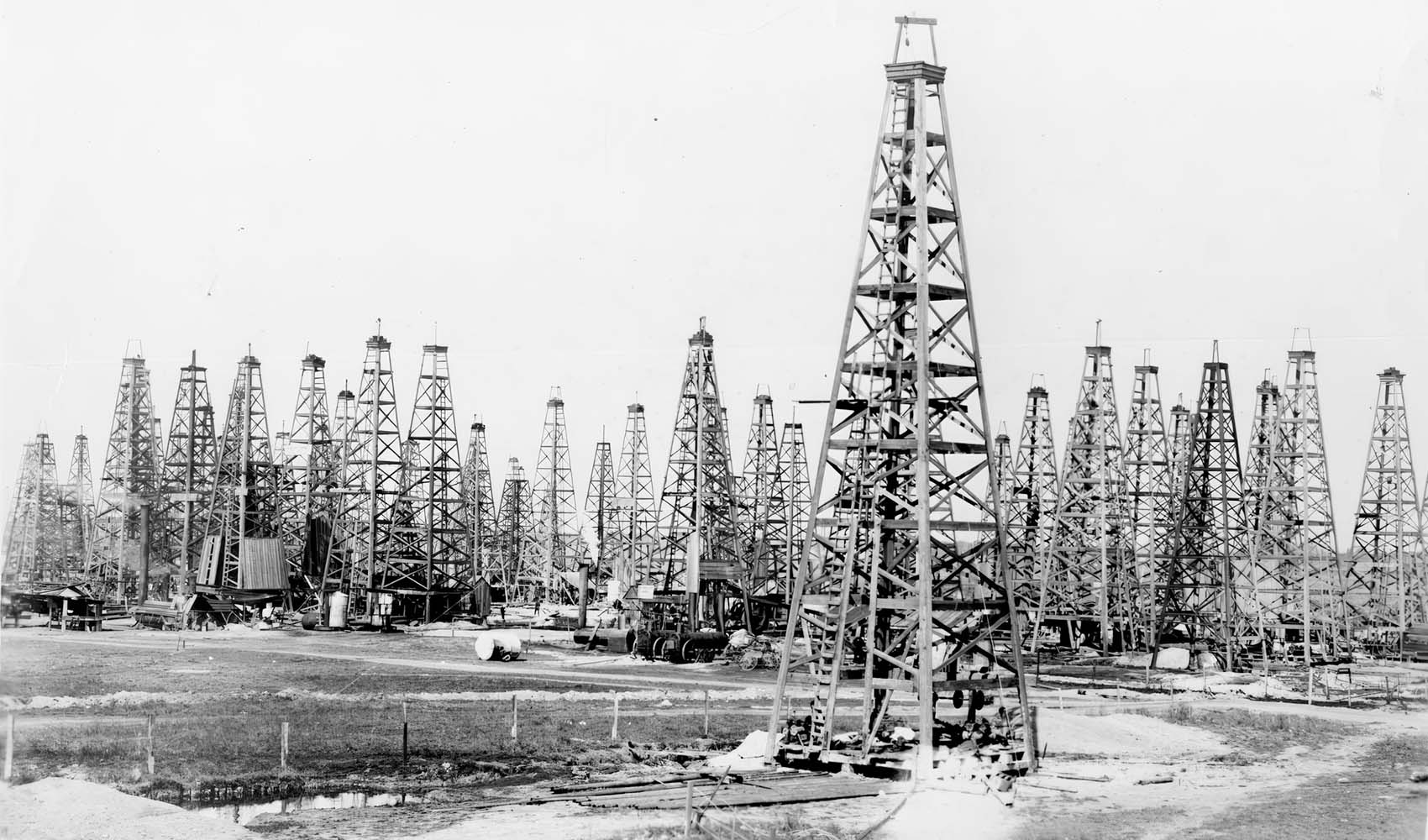
By late June 1901, there were 13 gushers on Spindletop. By the end of 1901, the Spindletop field hosted 138 wells. Photo from University of North Texas Libraries.