
When Democratic President Joe Biden took office in January 2021 and the Republican leadership of the Senate — no longer representing a majority of the chamber — still capable of following through on its promises to block Biden’s legislative agenda, Senate Democrats found themselves reversing course to now be in favor of doing away with the filibuster.
That didn’t happen. But it seems to come up every few years.
What Is The Filibuster?
The short answer: Did you ever see the classic 1939 James Stewart movie “Mr. Smith Goes to Washington?” At the climax of the movie, Stewart’s Sen. Smith — see the photo above — takes the floor of the Senate and talks for hours in order to block legislation he opposes. That’s a filibuster. Or, at least, the Hollywood version of one.
The long answer: The filibuster is a delaying tactic: A way for a small group in the Senate to block action by the majority. There are 100 senators, so it typically takes at least 51 to pass legislation. But senators are also permitted to speak as long as they want and on any topic they want — unless three-fifths of the Senate — that would be 60 senators — votes to invoke cloture. Which is essentially an order to sit down, shut up and let the Senate vote.
The word “filibuster” comes from the Dutch word “vrijbuiter,” meaning pirate or plunderer. Which should tell you a little about how the technique has been used on Capitol Hill.
How Has The Filibuster Been Used?
The Constitution doesn’t mention the filibuster. It just says that the House and the Senate can set their own rules. As the number of representatives grew, however, the House elminated the filibuster as a way of limiting debate.
Eventually, the Senate had to find a way to do the same. So in 1917, the Senate adopted what came to be called Rule 22, which created the notion of cloture to end a filbuster — with the support of two-thirds, at the time, of the Senate.
Cloture was first invoked to end a filibuster against the Treaty of Versailles — the treaty that ended World War I — in 1919. The chart at left shows how often motions were filed to invoke cloture (light blue) and how often cloture was invoked (dark blue).
One of the most famous filibusters was held June 12 and 13, 1935, by Sen. Huey Long of Louisiana, who opposed President Franklin D. Roosevelt’s New Deal legislation. He spoke for 15 hours and 30 minutes.
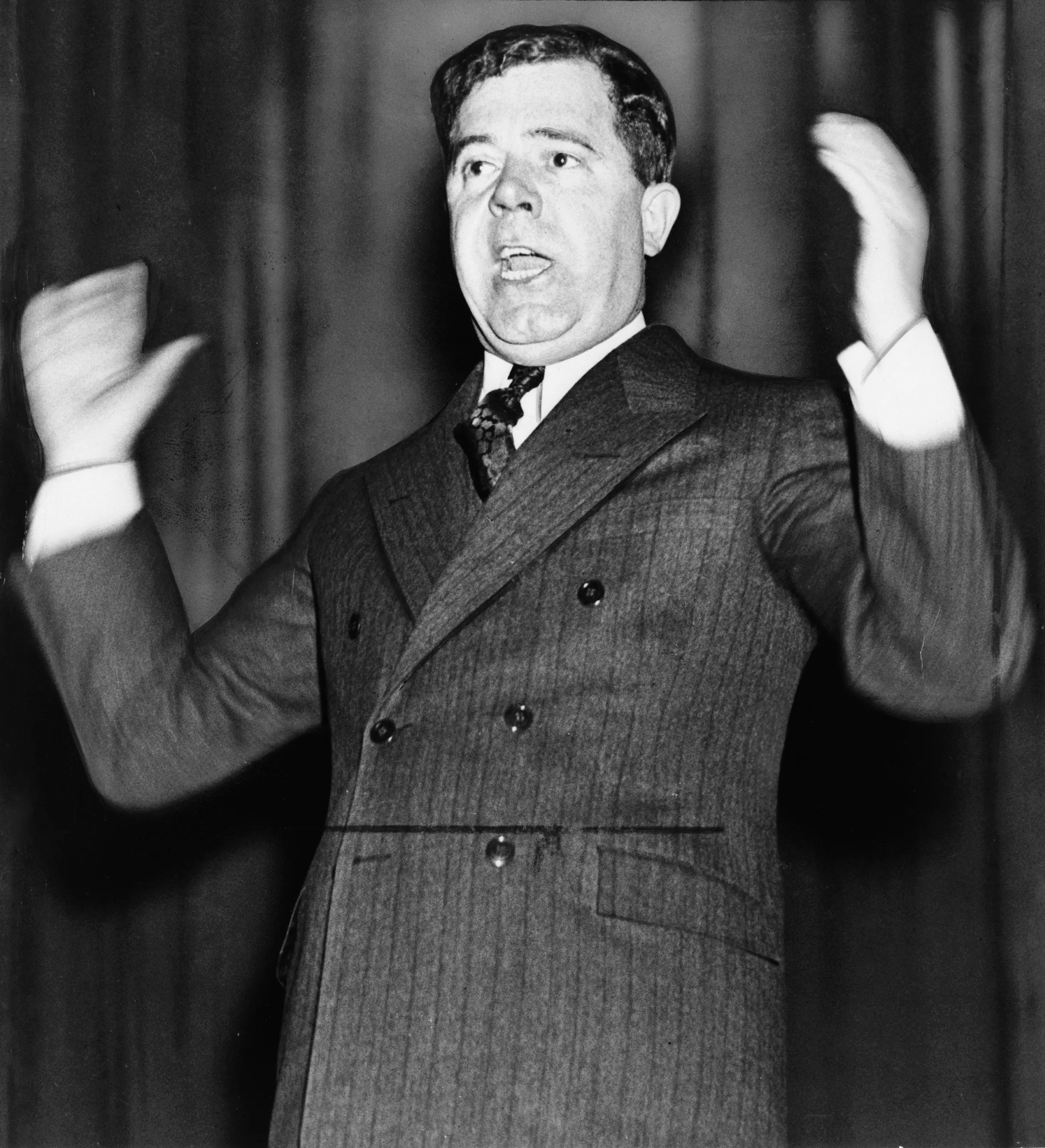
Huey Long
Naturally, Long ran out of things to say long before he ran out of steam. He ended up reading the Constitution aloud and even resorted to reading and explaining his favorite recipies for things like fried oysters and potlikker.
Long was defeated not by his Senate colleagues or parliamentary procedure, but by his own bladder. At 4 a.m., Long was forced to run for the men’s room. With Long having yielded the floor, the Senate voted down his proposal.
Two days later, however, Long was at it again — filibustering against FDR’s proposed Social Security Act.
Southern senators used filibusters to block civil rights legislation in the 1950s and 1960s.
The longest filibuster in the history of the senate was conducted by Sen. Strom Thurmond of South Carolina, who spoke for 24 hours and 18 minutes in an attempt to block the Civil Rights Act of 1957.
In order to prepare for his ordeal — and mindful of the foe that had brought down Long — Thurmond took daily steam baths in order to dehydrate himself so he wouldn’t need a bathroom break. Thurmond read the Declaration of Independence, election laws of each state, and George Washington’s farewell address.
The act eventually came up for a vote and passed. A similar effort to block the Civil Rights Act of 1964 by Thurmond and other Senators lasted 60 days but was ended by a cloture vote.
.ae09005c9ad3.webp)
Strom Thurmond
A Growing Effort To Eliminate the Filibuster
The filibuster has been under attack for years. In 1975, the Senate changed the number of votes needed for cloture from 67 to 60. When Democrats threatened to filibuster against four of George W. Bush’s judicial nominees in 2003, Republicans launched a filibuster against the Democrats’ plan to filibuster — in essense, an anti-filibuster filibuster. This prompted Democrat Harry Reid to filibuster for eight hours — yes, creating an anti-anti-filibuster filibuster, wrote Peter Carlson, who, at the time, covered the Senate for the Washington Post.
The logjam over Bush’s nominees ended when a bipartisan group of senators who came to be called “the Gang of 14” negotiated a settlement. But the increasing use of the filibuster — and corresponding attempts to end them with cloture — would come up time and time again. In 2013, Senate Democrats responded to what they considered GOP obstructionism by voting to eliminate the use of the filibuster to block presidential nominees except to the Supreme Court. In 2017, with Republicans running the Senate again, that was extended, allowing a simple majority to confirm Neil Gorsuch to the Supreme Court.
In 2021, Democrats were aware that Republicans could use the filibuster to make it difficult to pass legislation sought by the new Biden administration. Some Democrats mentioned altering Senate rules to eliminate the filibuster entirely.
Senate Minority Leader Mitch McConnell held up work by the new Senate for a week when Democrats would not promise to keep filibuster and cloture rules the same.
Democrats agreed, permitting the Senate to go about its business. This time.
Cloture Votes Throughout History
The filibuster is nothing new, but its usage over time has increased more and more. Below, read the number of cloture votes filed and the amount invoked since the 1900s.