
When The Night Meets The Morning Sun: The Shirelles
The Shirelles were four high school friends from Passaic, New Jersey, who recorded a number of memorable songs in the early 1960s.
"Will You Love Me Tomorrow" became the first No. 1 hit by a Black female group on Jan. 30, 1961 — 65 years ago today.
Four Teens From Jersey
Four high school schoolmates in Passiac, New Jersey, enjoyed singing together in school shows and at parties. In 1957 — when three of the girls were 17 and one was 18 — they decided to enter a local talent show under the name the Poquellos.
The mother of one of their classmates was a talent manager. She signed the girls, who changed their name to the Honeytunes and then to the Shirelles — in honor of their lead singer, Shirley Owens.
In 1958, the quartet wrote the song that would be their first single, “I Met Him on a Sunday.” Their manager licensed the recording to Decca Records, which turned it into a local hit. The group’s manager, however, felt like the Shirelles’ work should be bringing in more revenue.
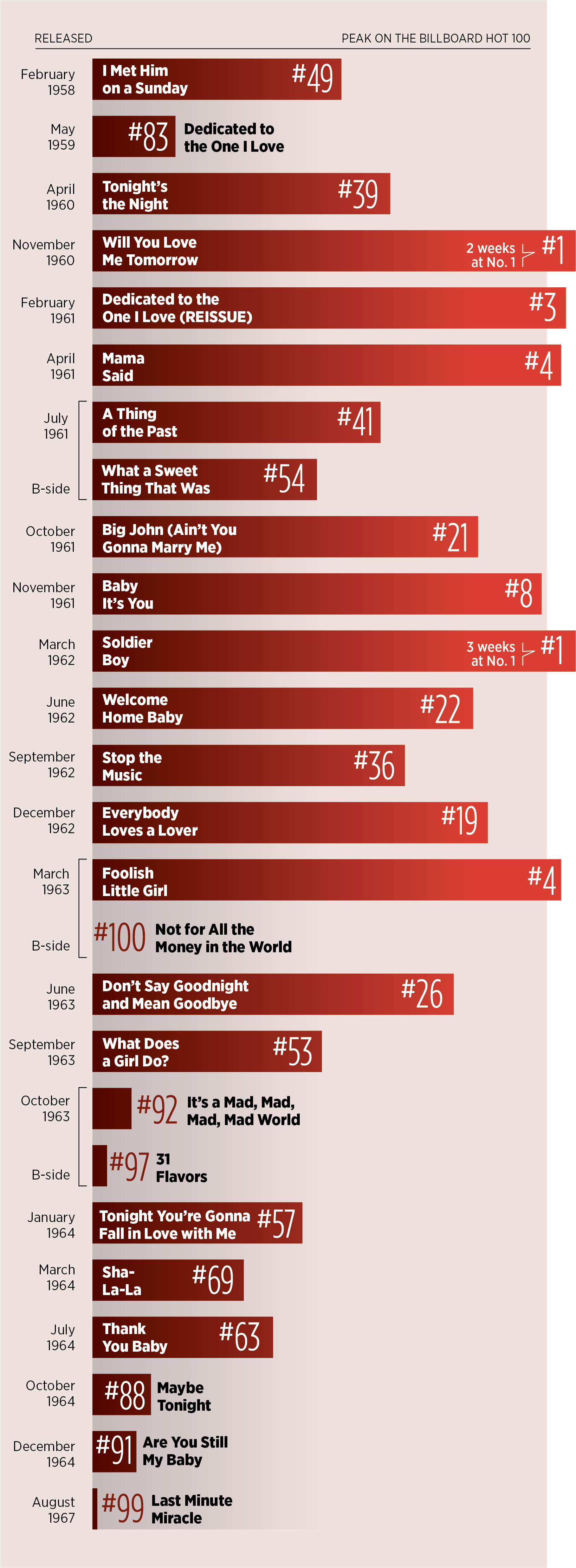
When the Shirelles’ arrangement with Decca expired in 1960, their manager created her own record label, Scepter Records. At that point, the Shirelles’ career took off. Over the next three years, the group would land six singles in the Billboard Top 10 and two would peak at No. 1.
Their first No. 1 single, “Will You Love Me Tomorrow,” made the Shirelles the first girl group — and the first Black women — to top the Billboard Hot 100. Granted, the Hot 100 hadn’t been launched until August 1958. Before that, there had been an array of Billboard charts — one for record sales, one for radio plays, one for jukebox plays ...
But most of the top Hot 100 hits had been by men or male groups. Connie Francis and Brenda Lee had released two singles each that had landed at No. 1 in 1960.
Things went south for the Shirelles after they turned 21. Their contract specified that a percentage of their revenues were to be placed into a trust fund and paid out when each member came of age. But that didn’t happen — their manager had kept the money for herself.
The Shirelles then left Scepter Records and filed a breach of contract suit against their now-former manager. The manager sued the Shirelles for leaving before their contract had expired. The suits weren’t settled until 1967.
By that time, the popularity of the Shirelles had begun to wane. Two members left to get married and Dionne Warwick was hired to replace them, making the quartet a trio.
The former Shirelles would continue to tour and to perform alone or in various combinations through 2020.
The Shirelles' Singles Chart History
'Will You Love Me Tomorrow'
While the Shirelles themselves wrote a number of the songs they performed and recorded over the years, what became the best-known single was written by a young songwriting husband-and-wife team, Gerry Goffin and Carole King.
In 1960, the Shirelles’ manager contracted publisher Don Kirshner to help write a single that would be a suitable follow to the group’s first Top 40 release. Kirshner assigned the task to Goffin and King.
King wrote the music while Goffin wrote the lyrics. Kirshner was so delighted with the results that instead of passing “Will You Love Me Tomorrow” along to its intended performers, he offered it to Columbia Records for Johnny Mathis.
The head of Columbia didn’t think it was right for Mathis, so he turned it down. Kirshner later admitted the rejection was “the best thing he ever did for me.”
Tony Orlando then expressed interest in recording the song. But having learned his lesson, Kirshner told him the song contained a girl’s lyric and that no teenage boy would say those words.
When she finally heard the demo track, Shirelles’ lead singer Shirley Owens dismissed it as being “too country and western.” But the group’s producer assured Owens they could do the song in their own style. King and Goffin obliged by adding strings to the track and turned it into an up-tempo song.
“Will You Love Me Tomorrow” was released in November 1960 and hit No. 1 on the Billboard Hot 100 the following Jan. 30. This was despite a number of radio stations banning the song for what they considered inappropriate lyrics.

King — who, herself, was only 18 at the time — had written those lyrics from the point of view of a young woman who worries about what her boyfriend will think of her the next day after a romantic encounter.
King had intended that encounter to seem vague and benign. But some listeners felt it was clear the singer was giving up her virginity.
Nevertheless, “Will You Love Me Tomorrow” sold more than a million copies and was inducted into the Grammy Hall of Fame in 1999.
The B-Side of the single was “Boys,” which the Beatles would cover on their 1963 debut album.