
Multiple sources confirm threat of terror attacks
WASHINGTON – The information that led authorities to issue an unprecedented warning of potential terrorist attacks on financial centers in New York, Washington and New Jersey came from at least three al Qaeda members who were deemed highly reliable, U.S. and Pakistani officials said Monday.
Two were pivotal al Qaeda figures arrested last month in Pakistan in separate raids in which documentary evidence also was found, the officials said. The more important of the two was an al Qaeda computer engineer who relayed communications to the network’s members, they said.
The third is a member of Osama bin Laden’s terrorist network who is in British custody and is cooperating, one official said.
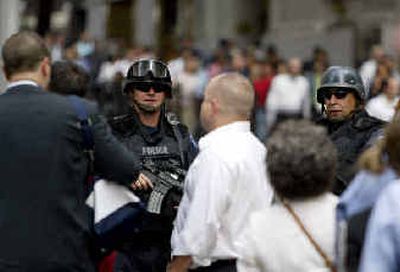
Disclosure of the multiple points of intelligence about planning for the attacks helps explain why the Bush administration decided Sunday to announce a heightened state of alert and identify specific potential targets – even though counterterrorism experts are unsure how far the terrorists’ planning had progressed or whether the plan was even still under consideration.
The terrorists’ surveillance of the five buildings identified in Sunday’s alert began before the Sept. 11, 2001, attacks, a U.S. intelligence official said. Analysts are racing through captured documents to determine whether the surveillance and attack planning are continuing, said the official, who spoke on condition of anonymity because of the classified information involved.
One expert suggested the discovery of the plot and the government’s announcement largely neutralized the threat.
“It kills it,” said Vincent Cannistraro, a former top CIA counterterrorism official. “This is a dead operational plan.”
But Cannistraro said there’s no doubt Sunday’s alert “is a real one … a lot different qualitatively than the previous terror alerts, which have been based on much flimsier information.”
In announcing that the government was raising the threat level to “orange,” or high, for financial districts in New York, Washington and Newark, N.J., Homeland Security chief Tom Ridge singled out specific buildings, including the New York Stock Exchange and Citigroup buildings in New York; the International Monetary Fund and World Bank in Washington; and the Prudential Financial Inc. building in Newark.
Monday, in an interview on NBC’s “Today” show, Ridge said the quality of the intelligence was “10” on a scale of one to 10.
“There are multiple sources,” he said. “And frankly, as you and I are talking now, there have been a lot of analysts who have been working real hard the past 36 hours, and there may be even more that we’re able to glean from these multiple sources.”
U.S. and Pakistani officials said the key break in unraveling the plot came in mid-July, when authorities arrested Mohammed Naeem Noor Khan, who’s cooperating with interrogators.
While not a senior al Qaeda figure, Khan played a critical role in the organization: He ran a computer operation that helped relay encoded messages from al Qaeda’s leadership – believed hiding on the Afghan-Pakistan border – to its lieutenants, via the Internet. His information could be invaluable in helping to understand al Qaeda’s structure and methods of communication.
The second break, officials said, came when U.S. and Pakistani intelligence agents seized a senior al Qaeda operative, Ahmed Khalfan Ghailani, a native of Tanzania who was wanted in connection with the 1998 bombings of U.S. embassies in Nairobi, Kenya, and Dar es Salaam, Tanzania.
Ghailani and others were captured after a July 25 shoot-out in the eastern Pakistani city of Gujrat.
It remained unclear Monday how much of the plot against U.S. financial centers was divulged by Khan and how much was the fruit of Ghailani’s capture. Officials said there was disagreement between the FBI – which has Ghailani on its list of “Most Wanted Terrorists” – and the CIA over the relative worth of the suspects.
The information about specific U.S. buildings that were being targeted and details of terrorists’ surveillance of them – such as what security guards were wearing and how many people passed by in a given period – came from Khan, said the U.S. intelligence official.
Added a Pakistani diplomat: “Some information we got from him only.”
But other U.S. and Pakistani officials said information on the plot also was found on computer laptops seized when Ghailani was arrested — apparently sent to him by Khan.
Counterterrorism experts in the past have criticized the Bush administration’s frequent raising of the color-coded terror alert level, saying increases were based on weak intelligence, exhausted the usefulness of such alerts and was done primarily to protect bureaucrats from criticism should an attack occur.
But in this case, the detailed information dovetailed with a broad stream of intelligence reporting suggesting al Qaeda would attempt a major attack in the United States between now and January’s presidential inauguration.
The source of such reports include the operative in British custody, who’s knowledgeable of al Qaeda’s intentions and is cooperating, one official said.
“The level and the texture and the quality of (the intelligence), you can’t rule out it (attack planning) is ongoing,” the U.S. intelligence official said of the decision to raise the alert level. “When you see that kind of reporting … you really need to take notice.”