
Messenger off to visit Mercury
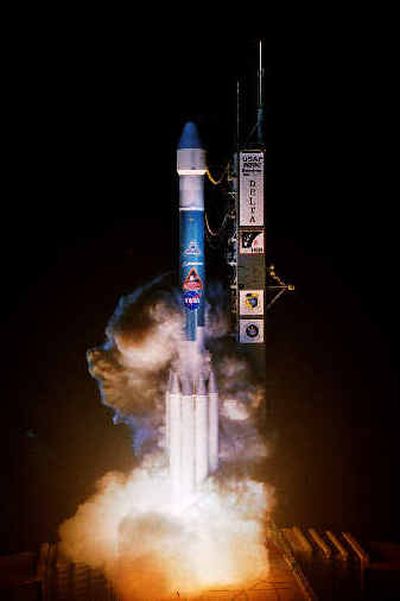
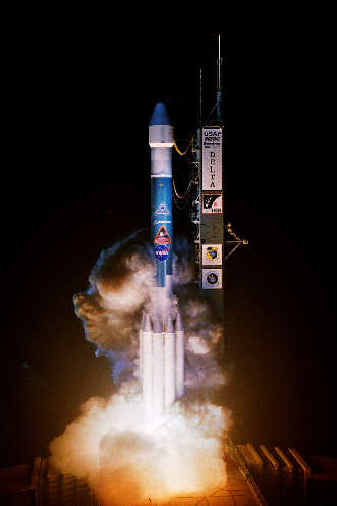
The National Aeronautics and Space Administration’s Messenger probe began its seven-year journey to Mercury early Tuesday, blasting off from Cape Canaveral, Fla., at 2:16 a.m. after a day’s delay caused by Tropical Storm Alex.
Alex cleared the cape area about an hour before the scheduled liftoff, allowing the 1.2-ton craft to begin its voyage after shedding the last stage of its Delta launch vehicle.
Although Mercury is about 50 million miles from Earth – a distance that would take less than three months on a direct route – Messenger will follow a convoluted path designed by Chen-Wan Yen of the Jet Propulsion Laboratory in Pasadena, Calif. Its journey will total nearly 5 billion miles as the craft sweeps repeatedly by the inner planets to slow it enough to orbit Mercury.
The craft will make 15 orbits around the sun, swooping by Earth once, Venus twice and Mercury three times before it sheds enough speed so that it can fire its rocket and enter an orbit around the solar system’s innermost planet in 2011.
It will be the first visit to the innermost planet, where temperatures range as high as 850 degrees, since Mariner 10 swung by three times in 1974 and 1975. That mission mapped about 45 percent of Mercury’s surface, revealing a heavily cratered planet with a surface that has not been altered by the volcanism, erosion and earthquakes that have transformed the surfaces of Venus, Earth and Mars.
Planetologists hope that, with the exception of the cratering, Mercury’s surface will turn out to be as it was when it was created along with the other planets 4.5 billion years ago.
Once in orbit, Messenger will circle the planet once every 12 hours in a near-polar orbit, mapping the surface with a suite of seven instruments that will characterize its composition, surface structure, iron core and magnetic field.
That field is of particular interest because Mercury, which is slightly larger than our moon, would normally be considered too small to have a magnetic field. It does so, researchers believe, because its iron core makes up about two-thirds of its volume, twice as much proportionally as Earth’s core.
Planetologists hope the satellite will reveal whether Mercury’s core is still liquid or has solidified.
The satellite carries a special shield of ceramic fiber to protect it from the sun’s blistering rays. Even so, the orbit is designed to swing from a low point only 124 miles above the surface to as far away as 9,400 miles, where the satellite can cool off before nearing the surface again.
Messenger is managed by the Johns Hopkins University Applied Physics Laboratory in Laurel, Md.