
Area hospitals feeling pain of cash crunch

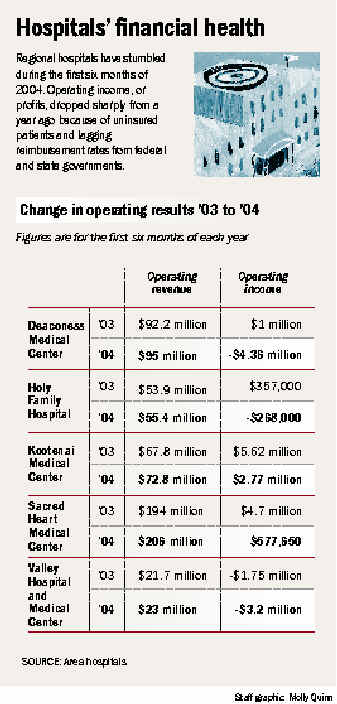
The region’s five major hospitals labored through the first six months of 2004.
Three lost money and the only two profitable hospitals, Sacred Heart Medical Center and Kootenai Medical Center, had significantly poorer results than they did in the first six months of 2003.
The financial hit is due to the recurring problem of Medicare and Medicaid reimbursements that fall short of what hospitals are owed, administrators say.
Also, each hospital is dealing with soaring bad debts and higher charity care write-offs.
Hospitals are required to provide care to people in need, no matter their ability to pay. In the Inland Northwest, with its high poverty rate and loss of decent-paying jobs that included health insurance benefits, hospitals are trying to cope with bad debts that so far have doubled expectations.
Garman Lutz, CEO of Empire Health Services, said Deaconess Medical Center and Valley Hospital & Medical Center lost a combined $7.5 million in the first half of the year, compared with a loss of $750,000 a year ago. Empire recently announced the elimination of 150 full-time jobs. The cuts are a blend of layoffs, reduced hours and attrition.
Lutz said the hospital system plans to be operating at break-even levels starting in September with the help of consulting work by PriceWaterhouseCoopers LLP.
The big accounting firm has helped Empire identify about $35 million in new revenue opportunities, supply savings and labor costs, Lutz said. The hospital system expects to pay PriceWaterhouseCoopers about $1 for every $10 in new revenue and savings attributed to the consulting work during the next several years.
“We’ve committed to the board that we’ll be turned around by September,” he said.
Another problem facing the Empire hospitals are fewer patients. Instead of healthier people, Lutz suspects more and more people are living without medical insurance and therefore are hesitant to seek the care they need.
“We think the utilization of medical care is becoming a financial decision rather than a health-needs decision,” he said.
The number of patient discharges at Deaconess, for example, fell by 380 during the first six months of 2004.
The problems facing Empire are shared by competing hospital system Providence Health Care.
CEO Skip Davis has called the higher numbers of uninsured patients a surprising setback to hospitals across the country. It has contributed to the steep income drop at Sacred Heart. The region’s largest hospital showed a $577,670 profit during the first six months of the year, down from a $4.6 million profit during the same period of 2003.
The problems put Holy Family Hospital in the red during the first six months. The sister hospital of Sacred Heart lost $268,000 during the first six months of 2004, compared with income of $357,000 in the same period last year, according to finance officer Kevin Walstrom.
“A lot of that is coming through our (emergency room),” Walstrom said. “It’s being used more for primary care.”
The problems at the Providence hospitals will result in layoffs, Davis has said. The numbers will be announced this month.
Kootenai Medical Center in Coeur d’Alene achieved the best results, although its profits were cut in half from a year ago, at $2.8 million compared with $5.6 million in the first half of 2003, said finance officer Tom Legel.