
The sentinels for mad cow
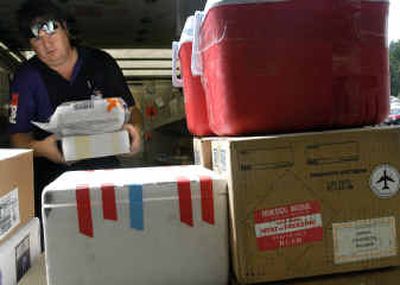

PULLMAN – A Federal Express carrier dropped off 15 samples of cow brain at a Washington State University lab last Wednesday.
It was a slow day for the lab, which was established in June to test hundreds of brain tissue specimens from herds around the region for mad cow disease.
Fulfilling its promise to increase surveillance for bovine spongiform encephalopathy, the USDA designated 12 regional laboratories as testing facilities, including the one at WSU’s College of Veterinary Medicine. The federal agency also earmarked $70 million to pay for the extra testing.
The samples, 3 inches of dense pink matter in plastic vials tucked into small brown cardboard boxes, were delivered to a locked laboratory where two technicians opened and sorted them. The techs took a small section of brain from each vial, liquefied it and then put it through an enzyme-based test that would change from clear to yellow if the test was inconclusive or if the animal had been infected. The process took about five hours.
“This is a very sensitive test,” said Timothy Baszler, the veterinary pathologist who oversees BSE testing at WSU. “But it’s easy to perform.”
Most of the samples are sent from ill animals at Northwest rendering plants or slaughterhouses by federal inspectors. They take the tissue from the obex, the brain stem at the base of the animal’s skull where the disease is most likely to manifest first. Other samples come from farms in Washington, Oregon, Montana and Idaho, taken from animals that die in the field. Still others are taken from a random sampling of healthy cattle headed to slaughter.
“We’re predicted to do between 25,000 and 30,000 samples over the testing period,” Baszler said. Right now, their daily tests run at fewer than 25. “By late fall, we’re expecting to do 150 to 200 samples a day.”
The USDA has a goal of sampling at least 200,000 cattle during the next year, which it says would be enough to offer a 95 percent degree of confidence of catching one positive cow in 10 million.
“We definitely want to sample as many as possible,” said Julie Quick, spokeswoman for the USDA.
She said high-risk populations include older cattle, animals that show signs of extreme nervousness or aggression, and animals that show signs of a central nervous system disorder.
Several advocacy groups, including the nonprofit Consumers Union, argue that that 200,000 is less than 1 percent of the animals slaughtered annually and that by focusing on high-risk populations, millions of potentially infected cows might be missed. Cattle producers are also concerned with the limited testing. A number have called for testing all slaughtered cattle so that foreign customers like Japan, which tests every bovine slaughtered, will regain confidence in the U.S. beef market.
Of the 28,000 tests performed nationwide since June 1, only two have turned yellow and been labeled as inconclusive. After running further tests on the two samples, the USDA’s national lab ruled they did not have the disease.