
Road to freedom
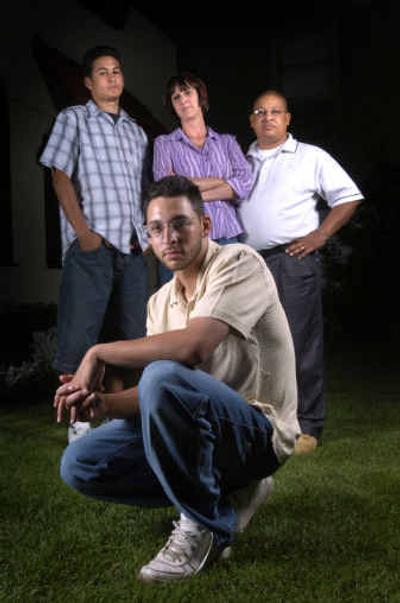
In 1996, Jayson Bush made a mistake that cost him his freedom.
It was a time when police hailed drive-by shootings as evidence that youth gangs threatened the city and politicians demanded that courts sentence juveniles to adult time for adult crime. It was a bad time for a mixed-race teenager from Spokane’s North Side to mess up.
Jayson Bush admits that he was wrong when he responded to racial slurs with anger. He regrets accepting a gun from a friend to protect himself. He knows he deserved to be punished for firing the gun to scare off his tormentors, injuring one of them.
But he did not deserve to be locked in prison until his 40s, he said.
Late last year, the Washington state Board of Clemency and Pardons unanimously recommended that his nearly 24-year sentence for three counts of first-degree assault be commuted to time served. On May 28, Gov. Gary Locke gave his parents, Ray and M’Liss Bush, their son back after eight years behind bars.
“The hardest thing was the night they took him away and the day they gave him back to me,” M’Liss Bush said. “You might think you are free in this country, but every one of us has one foot in jail. All it takes is one stupid mistake and not enough money.”
The 25-year-old man who emerged from the Airway Heights Corrections Center early this summer has changed. He is determined not to let his past define his future. He is holding down two jobs and going back to school. He is no longer the quick-tempered youth who could not walk away from trouble.
“Before, if you call me ‘nigger,’ I’m in your face,” he said. “Now, I try to make you realize the ignorance of what you say.”
As for his parents, they will never forget the students at Gonzaga University’s Center for Law and Justice, the NAACP or any of the other advocates who took up their son’s cause – a cause Carl Mack, president of Seattle-King County NAACP recently called “the greatest civil rights victory I have ever won in my life.”
Shooting and arrest
Jayson Bush’s childhood ended at 17 when he was arrested at Rogers High School two days after a Sept. 22, 1996, incident described by police as a drive-by shooting. An 18-year-old was struck in the upper thigh by a bullet that had apparently ricocheted off a solid object, shattering his femur.
Today, court records and clemency board documents paint a clearer picture of the incident.
Bush, whose mother is white and whose father is African American, lived in the Garland neighborhood. M’Liss Bush is a secretary at Fairchild Air Force Base. Ray Bush, retired from the Air Force, is head of security for Holy Family Hospital.
Jayson Bush attended Rogers after transferring from North Central High School, “where he became the object of constant harassment and threatened with physical violence” from students, according to a report to the clemency board from the law clinic.
“This particular group mostly consisted of juniors and seniors who were identified as a white-power crowd,” Bush said in a hand-written letter to the board.
When Bush complained to the NC principal, he was told “throughout life we are going to be called many things we don’t like,” according to the report.
Bush went to Spokane Police Officer Percy Watkins, who persuaded his parents to take their son out of NC. But the teen continued to run into his tormentors, and the threats persisted. This group, Bush said, had assaulted other minority students, including one who was pulled from a car window and severely beaten.
“I truly believed that they would have tried to seriously hurt me if they had the chance,” Bush wrote the board. “I kept thinking what if they find out where I live or catch me walking home from school, what was I going to do then. Many people think that this sort of thing only happened in the 1950s or 1960s, but it doesn’t, and because I was the only kid who would stand up for myself, I was their main target.”
So Bush got a .357-caliber revolver from a friend, who took it from her father’s collection.
Two weeks later, Bush was picked up at the restaurant where he worked nights by a couple of friends in a Nissan Pathfinder. Soon they were confronted in northeast Spokane by some of Bush’s tormentors from North Central, who were riding in a Ford Mustang. Words were exchanged. The vehicles went separate ways. The occupants of the Pathfinder, disoriented in an unfamiliar neighborhood, stumbled upon the Mustang again. Its occupants were now out of the car, shouting and running toward the Pathfinder.
“I panicked and fired a shot at the empty Mustang and then fired a few times into the air, hoping to scare away the oncoming group,” Bush wrote.
One of the five victims of the shooting admitted to police “he was attempting to provoke the driver and the occupants of the Pathfinder to stop their vehicle” so that he could fight with them, according to police records.
Bush was arrested at his high school on Sept. 24, 1996, at 2:30 p.m. Neither school officials nor police contacted his parents until 10 p.m. In that time, Bush confessed to the crime, but on the advice of a public defender who was working on another case, he refused to sign it. He was charged as an adult with five counts of first-degree assault, one for each of the teenagers who could have been injured.
Awaiting trial
Bush spent a year in the Spokane County Jail awaiting trial. In his written statement to the clemency board, he claims his public defender, Kenneth Knox, would sign the jail register as having visited his client when he had not.
“I was unaware Mr. Knox had been at the prison since he never came to speak with me,” Bush wrote. “This occurred more than six times throughout the representation. Throughout the entire six-month period during which Mr. Knox represented me, I only met with him on four occasions.”
Contacted for this report, Knox, who still works for the county public defender’s office, scoffed at Bush’s allegation.
Knox encouraged Bush to accept a plea bargain offered by the county prosecutor’s office and plead guilty to three counts of first-degree assault.
“Knox kept saying if I go to trial in Spokane, I’ll never get out,” Bush said. ” ‘You’ll get a white judge, a white prosecutor and white jury, and in these times, they’ll put you away for a long time,’ ” he said his attorney told him.
Bush rejected the deal at first until Knox approached his parents, telling them their son faced the possibility of 88 years in prison, Bush and his parents said. The Bushes considered selling their home to afford another attorney.
“I did not want my parents to sell our family home, so I decided to accept the plea agreement,” Bush later wrote. He was sentenced Sept. 26, 1997.
Bush now says he did not realize he would be serving his sentence – 93 months on each of three counts of first-degree assault – consecutively until after his sentencing. Even though it was the low end of the sentencing range and there would be no “gun enhancements” of five years per count, Bush would have to serve nearly 24 years in prison.
“I didn’t ever know about 24 years until I got back to the jail,” Bush said. “I never heard from Kenneth Knox again until the year 2000, when an inmate said, ‘Let me file an appeal for you,’ and then we started trying to get my file.”
Knox denies not informing Bush of the sentence and said it was the best deal he could have expected, considering that the police had an extensive confession and that Bush took detectives on “a guided tour” of the crime scene.
“No way we would have got out of that trial with less,” Knox said.
Finding God in prison
Bush describes prison as “like waking up in hell every day.” He believes he survived by embracing Islam soon after arriving at the corrections center in Shelton, Wash., in 1997.
“Prison is an environment where you have to grow up real quick,” Bush said. “You have two choices: Go down the road that will make you a career criminal … or take the other road and become a person who can use that experience as a means to change your life. I know I chose the second of the two roads.”
But while his religion gave him structure, it also created problems for him, especially after Sept. 11, 2001.
During the year he spent in the county jail, Bush obtained his general equivalency diploma. In prison, he pursued a degree through correspondence in Islamic studies and learned Arabic. He became a leader of the Muslim inmates at the state prison in Walla Walla and because of his good behavior was transferred to the Airway Heights prison in 1998.
At Airway Heights, Bush said, he encountered discrimination by prison staff because of his religion and because he stood up for the rights of minority prisoners. A prison official denied this.
“I had a big target on my back because I spoke out,” Bush said. He said he was subject to more cell searches than other prisoners, “pat-downs” were more physical than necessary, and prison staff made his parents’ visits difficult. For example, M’Liss Bush said she was not permitted to cover her head for Muslim service she attended while visiting her son.
A week after 9-11, Bush’s cell received a more extensive search than usual, and he was placed in segregation.
“After Sept. 11, the heat was on the Muslim community, particularly me because I was the leader,” Bush said. “I told my father I was going to the hole.”
Time in segregation, where lights are continually kept on, routines are disrupted and shackles are used, is considered punishment by inmates. Bush believes he was sent there for being Muslim. During his time in the hole, Bush said he was questioned by corrections officers about his religion, Palestinians, Jews and Osama bin Laden. They asked him where his father was from and whether he was from Afghanistan.
“They try to break you in the hole,” Bush said.
James Key, associate superintendent at the Airway Heights Corrections Center, acknowledged that Bush’s cell was searched Sept. 18, 2001, that he was placed in “administrative segregation” on Sept. 19 and questioned by officers during an investigation prompted by an informant’s tip.
“We received confidential information that Mr. Bush was utilizing his work computer in correctional industries to possibly generate inflammatory materials,” Key said.
The investigation turned up “nothing inflammatory regarding his Muslim faith,” and Bush was returned to his unit, Key said. He denied Bush’s charge that he had been singled out because he was Muslim and said “all the policies and procedures were followed” to ensure prison security.
Nevertheless, the events at the prison prompted the Bush family to seek the help of the Spokane NAACP. It was the third time Bush’s case had been brought before the civil rights organization. This time, the family’s pleas were heard by Florence Brassier, then president of the Spokane chapter.
Appeal for justice
Brassier calls the Bush case “one of the most satisfying things I have ever been involved in.”
In the fall of 2001, she said, the Bushes brought two concerns before the NAACP.
“They had been experiencing unpleasantness from Airway Heights staff, anti-Muslim comments directed toward the family, and they were frightened for him and whether he would be transferred,” Brassier said. “But most of all, they wanted to know what we could do about the sentence.”
Brassier brought their concerns to Speedy Rice, then head of University Legal Assistance at the Gonzaga Law School. After Rice’s departure from Gonzaga, his successor, George Critchlow, directed law student Genevieve Mann to interview Bush at the prison in December 2002. Her mission was to ensure his civil rights were being protected.
The clinic sponsored by the law school gives students credit toward their degrees for providing free legal help under supervision. The clinic typically handles such cases as predatory lending, consumer protection, civil rights and prisoner rights – not commutation.
But Mann came away from the interview believing that Bush did not belong in prison, and she persuaded Critchlow to allow her to pursue the commutation case. She worked on the case until May 2003, when she was about to have a baby. She then handed her work off to two other Gonzaga law students, Vicky Scollon and Michiko Fjeld.
“If I never do anything else in my legal career, I’ll feel like I did something,” Mann later said of the Bush case.
Under the supervision of Critchlow, now interim dean of the law school, Scollon and Fjeld prepared a thorough presentation for the clemency board. They detailed the mitigating circumstances in the case, the lack of preparation by Bush’s counsel, and provided letters from prospective employers who would hire Bush. In the fall of 2003, they even secured a resolution in support of Bush by the regional NAACP.
Included in Bush’s clemency packet were examples of other teenagers who received far lesser sentences for greater offenses, including those of Joshua Kaczor, sentenced to 10 years, and Kory Ludwig, sentenced to two years, after being convicted in 1997 of murdering a Spokane cab driver.
A letter to the board from Brad Reed, then chairman of the Spokane Human Rights Commission, read:
“It is clear in my mind that he (Bush) was made an example of. I urge you to act and make this exemplary inmate and young man the right kind of example. Accept his sacrifice of the past seven years, and set him free.”
Scollon and Fjeld saw in Bush a truly repentant inmate.
“He did commit a crime and deserved to be punished,” Fjeld said. “But the extreme nature of the sentence left you with a sense of injustice. You wanted to do it for him, for his family and society and ourselves. I could not imagine what it would be like if we failed.”
‘A difference can be made’
Many of Bush’s advocates who were present at his clemency hearing cited the heartfelt testimony of Bush’s younger brother, Micheal, as swaying the board members. Others credit the NAACP’s Carl Mack, who made an impassioned plea to one of the two members representing law enforcement on the board. But Mack believes Bush owes his freedom to his own videotaped testimony.
“Jayson said what he did was stupid. Second, he apologized to the victims. Third, he said, ‘These conflicts would come to me every now and then, and I responded wrongly to one of them. Here (in prison), I have to deal with conflict in a nonviolent manner every day,’ ” Mack recounted. “And I started crying because I knew this young man had grown up.”
The Spokane County Prosecutor’s Office took a neutral position on Bush’s request for commutation, letting the board decide the case on its own merits, said Jack Driscoll, chief criminal deputy prosecutor. By statute, the office notified the victims of Bush’s crime. None protested commutation. None could be reached for comment.
“We had a chance to look over his package, which was very well put together,” Driscoll said. “It showed Bush did very well in prison.” He added that he has seen only three such commutations in the six years since he has been chief deputy prosecutor.
“I will never look at the legal system the same way again,” Scollon said. “Because I know that a difference can be made. Injustices do occur and severely impact not just one person’s life, but a whole group of people.”
Bush walked out of prison on June 1 of this year and into the arms of his father, mother and brother.
“They gave me my life back,” M’Liss Bush said. “They fought for him, and they didn’t have to. Now our youngest son has his brother back.”
Bush is now holding down two jobs, as a construction worker for Scollon Enterprises, owned by Vicky Scollon’s husband, Douglas, and as a waiter at the Wall Street Diner. Bush will enroll this week at Spokane Falls Community College and hopes to pursue a law degree from Gonzaga University. His interest is in civil rights, and he would like to help minority kids avoid the mistakes he made.
“One thing that prison taught me is that as a kid you have the world available to you. All you have to do is put your mind to it. But you don’t realize that when you’re a kid because you don’t think clearly.”