
Delegates to beg for peace
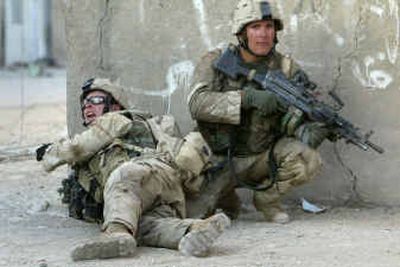
BAGHDAD, Iraq – The deadly showdown between U.S. troops and Iraqi militants in Najaf dominated Iraq’s National Conference on Monday, with tribal and religious leaders deciding to send 60 delegates to the holy city to try to persuade a radical Shiite cleric to call off his fighters.
Aides to Muqtada al-Sadr said the cleric, whose loyalists have been battling the Americans from Najaf’s vast cemetery and revered Imam Ali Shrine since Aug. 5, awaited the delegates’ arrival today. Al-Sadr’s supporters said they welcome the move. “We are ready to accept any mediation for a peaceful solution,” Ahmed al-Shaibany said in Najaf.
U.N. Secretary-General Kofi Annan has offered to play “a facilitating role” to help end the violence if all sides agree, U.N. spokesman Fred Eckhard said Monday.
He said the decision came after Annan spoke to Secretary of State Colin Powell, Iran’s Foreign Minister Kamal Kharrazi, and his new Iraq envoy Ashraf Jehangir Qazi.
The three-day National Conference in Baghdad was supposed to be a revolutionary moment in Iraq’s democratic transformation post-Saddam Hussein, an unprecedented gathering of 1,300 Iraqis from all ethnic and religious groups for vigorous debate over their country’s course.
It also was intended to increase the legitimacy of interim Prime Minister Ayad Allawi’s government, which is deeply dependent on American troops and money even after the official U.S. occupation ended.
But the violence in Najaf, which resumed Sunday after cease-fire talks broke down, has diverted the gathering. U.S. tanks rolled into the Old City of Najaf to within 500 yards of Iraq’s holiest Shiite shrine Monday, witnesses said. Explosions also rocked the cemetery.
Najaf’s police chief, Maj. Gen. Ghalib al-Jazaari, said members of al-Sadr’s Mahdi Army militia broke into his family’s house in Basra, beat up his sisters and kidnapped his handicapped, 80-year-old father.
At the conference in Baghdad, some delegates threatened to walk out in protest of the government’s effort to crack down on the militants, while others called for al-Sadr to abandon his uprising. Still others said the crisis only made the conference more relevant.
Late Monday, Iraqis at the conference agreed to send a delegation to meet with al-Sadr, who has vowed to fight “until the last drop of my blood has been spilled.”
“I think it would be very risky for Muqtada al-Sadr to stand in its way,” said delegate Haider al-Ebadi of the Shiite Dawa party. “The previous negotiations failed because of mistrust. I think they have a chance here.”
The delegation will travel in a convoy to Najaf, 100 miles south of Baghdad, early today. U.N. envoy Ashraf Jehangir Qazi said he would join the mission if invited, spokesman Nejib Friji said.
If al-Sadr agrees to stand down, the conference will have succeeded in turning a crisis that threatened to torpedo the gathering into a startling, symbolic victory showing the potential power of communal solutions in post-Saddam Hussein Iraq.
If he refuses, the conflict will have done little more than distract attention from other pressing issues and damage conference organizers’ efforts to project an optimistic image of national unity.
“We hope he will accept it. This country has seen so much violence and so much bitterness, it’s time that we seek a way out,” said Barham Saleh, deputy prime minister for national security.
U.S. troops have taken the lead in the Najaf fighting, while Iraqi security forces have played a minor role, mainly manning checkpoints. U.S. troops are training Iraqi national guard units for any possible raid on the shrine compound.
Violence persisted throughout Iraq on Monday.
In Baqouba, two civilians were killed and four others were wounded when a mortar hit their house, said Ali Hussein, a medic at the city’s main hospital.
Attackers ambushed a U.S. tank and set it on fire in Sadr City, a Baghdad slum and al-Sadr stronghold, the army said. The crew escaped with minor injuries.
“Security is the No. 1 concern of all Iraqis,” said conference delegate Radha Taki of the Supreme Council for the Islamic Revolution in Iraq. “And the main security problem these days is the escalation in Najaf.”
The conference’s main task was to help form a 100-member national council that will serve as a watchdog over the interim government before elections expected in January. The conference also was meant to discuss reconstruction efforts, a persistent Sunni uprising and other key issues while reassuring the public that all groups will have a voice in the new Iraq.