
Bonuses cheapen true worth
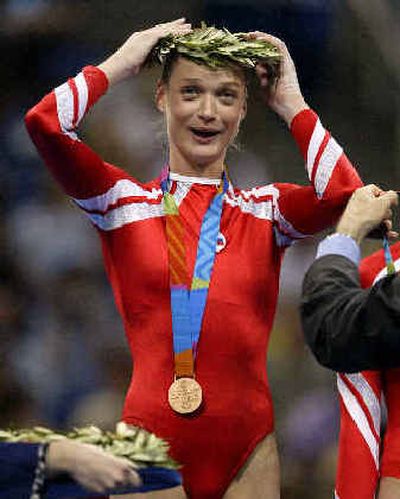
ATHENS — There’s less than $100 worth of gold in the most-coveted of Olympic medals, but winning one can mean hitting the jackpot — especially for athletes from developing countries.
Romanian gold medalists will receive tax-free bonuses of $50,000 — twice what U.S. champions will get. Iraq’s new government has pledged $25,000 per gold. Kenya’s winners will get flat-screen TVs and washing machines along with cash.
Governments, national Olympic committees and corporations have teamed up to ensure the spoils of victory are far more than chump change.
It’s an ancient tradition of the games. Beginning around 500 B.C., Olympic victors were paid 500 drachma — a fortune at a time when a sheep cost one drachma coin — and enjoyed free meals and front-row theater seats for the rest of their days.
Modern-day athletes and coaches, though, have mixed feelings about the Olympic pots of gold.
Romania’s champion women gymnasts, who won the team gold, will receive two cars, a free college education and a lifetime of rent courtesy of the government along with their hefty $50,000 bonuses. In a country where the average monthly take-home pay is $170, that’s wealth most Romanians can only dream of.
Octavian Belu, who coaches the women’s team, thinks big payoffs backfire because athletes tend to quit after their first Olympics. Most of his champions are in their late teens, and he’s frustrated that he has few repeat Olympians such as 25-year-old Russian diva Svetlana Khorkina.
“They collect their rewards and they leave,” he said. “It’s a real problem for me.”
But Olympic payoffs are getting bigger, especially in the emerging democracies of Eastern Europe, where nations are eager to win prestige.
Ukraine will double what it paid gold medalists at the 2000 Sydney Games. Victors will get $100,000 from the government, sweetened by free apartments in Kiev.
Prime Minister Viktor Yanukovych, who heads the country’s Olympic committee, said Ukraine “hopes to join the list of the 15 best countries on the medal chart” by winning at least five golds. So far, it’s won three.
Bonuses of up to $250,000 may await Russia’s gold medalists. The government will pay them $50,000 tax free, but the Russian Olympic Committee is also working to persuade companies to chip in extra bonuses of $100,000 for a gold and possibly $200,000 if Athens is the champion’s final Olympics.
The U.S. Olympic Committee is offering only $25,000 for golds, $15,000 for silvers and $10,000 for bronzes. USA Swimming says it will chip in another $25,000 for golds in the pool. In any case, the best-known and most telegenic American champions get lucrative product endorsements and appearance fees that are rare in the developing world.
It’s not always about the money.
Iranian weightlifter Hossein Rezazadeh, considered the world’s strongest man after lifting the equivalent of three refrigerators to win gold in Sydney, also holds Greek citizenship. But when Greece offered him $20,000 a month to switch allegiances, he refused, saying he was committed to competing for his homeland.