
A passing grade
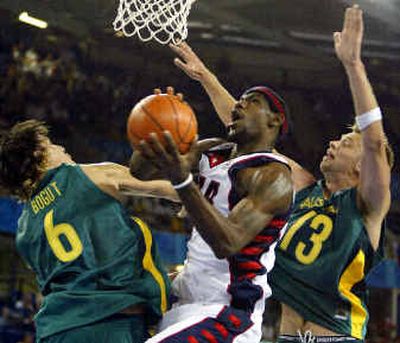
ATHENS, Greece – There were signs here Thursday that the students are starting to pay attention. Sure, they still get restless for recess, but some of the things their teacher, Mr. Larry Brown, is writing on the blackboard are starting to seep through.
It showed when Brown’s class, the U.S. men’s basketball team, won its second consecutive game, defeating Australia, 89-79.
There were times when their minds wandered, when they stood around and watched Australia cut them up with a two-man game off a high pick-and-roll that freed up enough 3-point shots for Australia to build two 12-point leads in the first half, at 31-19 and 45-33.
But in the end, most of them figured it out.
Tim Duncan was the game’s top scorer with 18 points. When his teammates remembered to pass him the ball, remembered that he is 7 feet tall and is, as teammate LeBron James said, “the best player in the world” – then the U.S. team did well.
The player guarding the best player in the world was a 19-year-old named Andrew Bogut, who is 3 inches shorter than Duncan and was playing in only his sixth international game.
Bogut, who will be a sophomore at Utah this season, had a fine game, scoring 11 points and taking down eight rebounds. But near the end of the fourth quarter, Duncan dunked in Bogut’s face. That made the score 77-70 and seemed to awaken the U.S. team, which ran it out to 87-72 in the next 4 minutes.
Brown’s other star pupil Thursday was James, who had eight assists, seven in the second half when the U.S. took control of the game.
James sat with Brown at a table in the interview room after the game and said, “Tim Duncan is the best player in the world, and there is something wrong if we don’t get the ball to him.”
He added: “We know that every team is going to play a zone against us, and we have been working hard on that in practice. We know that we have to find that crease, we have to learn how to make two people guard one. We know that if it is a zone, we have to attack it.”
Brown, who has been preaching the doctrine of team over talent for about a month now, smiled.
“The moment we step onto the floor here, we have to understand that the other teams are better, that the coaching from around the world is better, that the passion for the sport around the world is better,” Brown said.
The U.S. team now has a 2-1 record in pool play and will play a good Lithuania team Saturday.
Costs will top $8.5 billion
Costs for the Athens Olympics are climbing again, expected to top $8.5 billion because of the massive security and overruns in the last-minute scramble to get venues ready.
Deputy Finance Minister Petros Doukas said the latest figure — up from the original $5.6 billion projection and the $7.2 billion revision prior to the Games — was driven by a desire to put on a first-class event.
Hall miffed at coach
Gary Hall Jr. is miffed again: He’s getting left off another Olympic relay team. U.S. men’s coach Eddie Reese told Hall that he won’t be part of the 400-meter medley relay.
“He wasn’t happy with that,” Reese said Thursday.
The three-time Olympian from Phoenix also wasn’t chosen for last Sunday’s 400 free relay final, even though he anchored the United States’ gold-medal teams in the last two Olympics.
“There were a lot of things Eddie did not take into consideration,” Hall said. “I love the relays and I’d love to be a part of it.”
Palestinian disappointed
A frigid, makeshift pool wasn’t exactly the best place to train for the Olympics. Still, Rad Aweisat was disappointed by his showing.
The Palestinian swimmer struggled to finish the 100-meter butterfly in 1 minute, 1.60 seconds — nearly 11 seconds off the world record and the worst time among 59 competitors in the event.
“I feel very bad,” said the 17-year-old said. “I don’t know what happened. Maybe I’m unlucky. All the time unlucky.”
Before the Games, Aweisat failed to meet the Olympic qualifying standard, but he got a trip to Athens as part of a program that lets athletes from developing countries compete.
Aweisat hopes to return to the Olympics in 2008, but needs to improve his training conditions. That’s unlikely since he lives with the omnipresent threat of violence.
“Sometimes when I go training, I don’t know if I’ll get back home or not,” Aweisat said. “Someone may shoot you.”