
Old soldiers, new Army
FORT BLISS, Texas – A tall, lean man holding a weathered wooden staff strode the desert under forks of dry lightning as Friday night turned into Saturday.
He is somewhat akin to Moses, this Lt. Col. John McClellan, shepherding his flock through desert and darkness as commander of all the trainers who are preparing thousands of everyday people from North Idaho and elsewhere to become combat-ready infantry soldiers in Iraq.
In the six hours that saddled midnight, McClellan’s particular flock was 17 soldiers from the Idaho National Guard’s armory based in Moscow – Third Platoon, Bravo Company.
The soldiers, some in their early 20s, some as old as 47, moved at a crisp pace. They were silent, alert, somehow managing to catch each other’s hand signals in the dark as they ground-pounded in battle gear seven miles through sage and cactus.
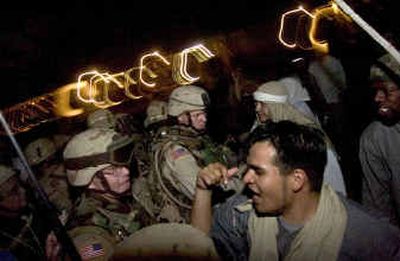
They survived two mortar attacks, an angry crowd in the faux-Iraqi village of al-Wadi, a sudden but intense ambush and firefight that left two men, believed to be Iraqi insurgents, dead. There was a real-world injury, too, when one of the Idaho soldiers ran into barbed wire in the rush to gain a firing position during the ambush. And then there was the discovery of an IED, improvised explosive device, on the outskirts of a second village, al-Mattr.
“This was an interesting mission,” McClellan said.
Interesting in an important way. It showed, McClellan and others here say, an emerging new Army. A new Army with old soldiers.
Many of the soldiers headed to Iraq are National Guard. Wander around the bat cave – what some call the big tent here where some 450 soldiers are bunked – and you see gray hair and you see pictures of children.
When the Traveling Wall Vietnam Memorial stopped near Worley, Idaho, two weeks ago, the average age of the 58,000 fallen soldiers named on the memorial was 19.
The average age in the military right now is 32, one long-time veteran said Saturday.
“And I’d guess that’s even older here,” said Sgt. 1st Class Kevin Kincheloe, a 47-year-old high school counselor and coach from Harrison, Idaho.
Sure, there is still plenty of “HOO-aaah!” around the bat cave, chest-out swagger and heads that are shaved high and tight. But there is also quiet reflection, thoughtful conversations about loss and duty.
“Having older, mature soldiers helps with the mindset of interacting with the civilian population more,” said Capt. Ryan Robinson of Post Falls, commander of Delta Company – the nearly 300 combat engineers who hail from towns throughout North Idaho. “Young kids like the weapons and think it’s fun. The older guys have gotten that out of their systems.”
If the mission in Iraq is to gain the trust of civilians, Robinson said, “It is easier for the Guard to do that, because what we do is go out and work in communities.”
Bravo Company’s commander, Capt. Kory Turnbow, of Pullman, outlined the shifting Army reality for his soldiers during a “hot wash” debriefing immediately after the patrol ended in the wee hours of Saturday.
This is a new Army “where you have to take off your warrior hats,” Turnbow said. “During the Cold War, it was 100 percent battle drills. Where we are going, it’s 50 percent battle drills and 50 percent civilian awareness. We are a modern-day police force.”
McClellan expanded on the point. The idea behind 100 percent battle drills, he said, was to train soldiers so thoroughly that they immediately reacted to threats and wiped them out.
“You didn’t need to think,” the 40-year old McClellan, a 20-year veteran of the regular Army, said.
“This,” he said of Iraq, “is a thinking man’s war.”
And, with Bravo Company, he went back through their encounter with the angry villagers.
“Why were they angry?” he asked.
The training scenario, which evolved all last week, presumed that four Iraqi villagers from al-Wadi have been killed in recent days. The villagers, played by El Paso locals, believe American soldiers did the killing – and they have greeted the patrols with rage and grief.
Bravo Company, in fact, paused at the outskirts of al-Wadi to discuss the situation and decided to enter the village in a “cigar formation” – the soldiers closed up tight in the shape of a football or cigar. It’s also called a porcupine because weapons can bristle in all directions.
But the rules of engagement prohibit the soldiers from even aiming weapons at unarmed civilians and the villagers knew it, getting right in the faces of the soldiers to scream insults, sometimes tugging or pushing and threatening to break up the formation. The soldiers held onto each other to keep from getting separated and shuffled in an ungainly mass, often on the verge of losing balance, through the village and out the other side.
“How many villagers were there?” McClellan asked.
“About 50,” one soldier replied.
In truth, there were about a dozen. But the tension and chaos made it seem like more.
“Yeah, you guys looked very tense. That made me think I could push you around, and it made the villagers very bold,” even though they were unarmed and outnumbered by a well-armed force.
In Iraq, McClellan said, there is no centralized enemy, yet there is a large civilian population that should see the American-led coalition forces as friend rather than foe.
Many of the 59 observer/controllers – or OC’s as the soldiers call them – McClellan supervises at Fort Bliss are combat veterans from Iraq. The training scenarios the Idaho Guardsmen encounter every night are largely drawn from real events.
The training places a premium on soldiers thinking through a situation without going right to deadly force. This is crucial, McClellan said, to win the trust of Iraqi civilians.
Several soldiers here have said this approach makes them uncomfortable because it raises the ambiguity of every encounter. Smile and wave or look intimidating? Shoot first or wait to get shot at?
“This is a new paradigm, and it is happening so rapidly there is no Army doctrine and part of it is being made up as we go along,” Turnbow said of the military realities after the invasion of Iraq and the declaration of a War on Terror.
This is almost too much for Staff Sgt. Tom Kronenburg, a 20-year active duty veteran who lives in Milwaukee but serves with the North Idaho Guard soldiers.
He has stayed alive, he said, because battle drills taught him to see before being seen, to eliminate threats without waiting to see what the bad guy was going to do first.
“I spent 20 years snooping and pooping and now I’ve got to wave and say ‘Hey! Here I am. Are you going to shoot at me?’ “
This goes against his grain, the 37-year-old Kronenburg said, because, “You look at every kid and every kid has a mom and a dad – that part never changes.”
The ambiguous situations encountered in the new paradigm, Kronenburg said, means the soldiers in his squad must be constantly aware of hiding places and nuance and shadows. A moment of doubt or inattention could get them killed.
To avoid that, he walks around Fort Bliss quizzing his squad about hiding places and danger spots.
“To me, my pyramid of people I carry on my back has just grown larger,” Kronenburg said.
This burden of responsibility is shared by many sergeants with the Guard units here, especially because the Guard – though many have previous military experience – are not full-time warriors. They are older – no longer believing they are invincible – and settled in jobs and family
They are Spc. Bruce Evans of Albany, Ore., a 33-year-old construction worker who has been going to Oregon State University to become a corrections officer and who has raised three kids as a single dad for the last seven years.
He firmly believes the presence of coalition troops can “separate the Iraqis from the tyranny of their past” and thinks it will be fascinating to be in the country right after a U.S. presidential election and scheduled democratic elections for Iraqi leadership.
“I’m single with kids and the emotional and psychological side is very difficult. I am all they know – I am there for them every day, get them off to school, cook dinner,” Evans said. The heartache, he said, “doesn’t change how I feel about this. I want to be here. I feel it’s my duty as an American to do this.”
He has had much discussion and given much thought about handling the separation. He has also thought about the prospect of killing or being killed and believes the Guard units – with older, life-experienced soldiers – can think their way out of trouble.
“I think this training can keep us alive,” Evans said.
McClellan, the fast-walking master trainer, agrees. “These guys are not soldiers every day. We didn’t want to take 4,000 good citizens of Idaho, Montana and Pennsylvania and just plop them down in a war zone,” he said.
The training regime, filled with role-playing, is designed to raise awareness, toughen up older soldiers with long patrols and short turnaround times.
“I think they are great Americans to come into this very different world,” McClellan said.”There’s a real sense of duty these guys have,” Post Falls’ Robinson said. “It’s tough on the guys.”
And yet here they are: Evans, Kronenburg, Kincheloe and so many more.
After every long night mission, Kincheloe, the not-so-secret liberal in the bat cave, rolls out of his bunk wishing he could find NPR on the radio, and massages his feet and legs. The former Marine knows that no matter how high-tech the Army gets with lasers and NOGS, night-operations goggles, a ground-pounder can only trust his feet.
As he does this daily ritual, he listens with amusement to the banter and clamor and flood of rumor that runs rampant in the bat cave. He also keeps a serious eye on less-experienced soldiers, feeling, like Kronenburg, the responsibility to share his experience, to offer his back to help carry everyone home.