
Hundreds protest overtime rule changes
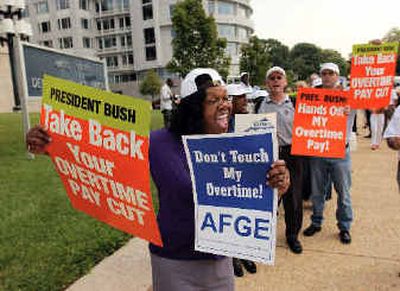

WASHINGTON – Several hundred people rallied outside the U.S. Department of Labor here Monday to protest the Bush administration’s sweeping changes to overtime rules that opponents say could cost millions of Americans their right to overtime pay but advocates say will help clarify archaic and confusing rules.
As the changes went into effect Monday, labor and political activists in front of the labor department yelled, “First they send our jobs away, now they want to cut our pay.”
“The Department of Labor should be enforcing labor laws, not rewriting them,” said Teresa Caruthers, a nurse from Baltimore who spoke at the protest.
But several business groups and representatives of some workers, including members of the National Fraternal Order of Police, have strongly backed the changes. These advocates say the new rules will eliminate employers’ confusion about who is eligible for overtime pay and cut back on lawsuits.
The Labor Department said 1.3 million workers who were not previously entitled to overtime pay are now eligible because all workers earning up to $23,660 a year are covered, up from $8,060 a year, and another 5.4 million whose overtime pay was in question now have it guaranteed.
“Under the new rules, workers will know their overtime rights, employers will know their responsibilities and the department can more vigorously enforce these protections,” U.S. Secretary of Labor Elaine L. Chao said in a statement Monday.
But at the noon rally outside the labor department, AFL-CIO President John J. Sweeney pledged to turn back the rules and Sen. Tom Harkin, D-Iowa, who has been a staunch opponent of the regulations, declared Monday “anti-labor day.”
Harkin and Sen. Arlen Specter, R-Pa., who also spoke at the rally, pledged to continue their fight to repeal the overtime changes.
Meanwhile, as Democratic vice presidential candidate John Edwards campaigned before workers in Wisconsin, he asserted that the overtime changes will strip 6 million of their rights to extra pay for extra hours worked.
“Today, millions of workers will find out that instead of getting time and a half, they’re going to get a hard time from their government,” Edwards said. “More than 60 years of protecting overtime work have been wiped out with the stroke of this president’s pen.”
Edwards and other opponents say more than 6 million workers – including millions who don’t even know they’re affected yet – could now lose their right to overtime pay. Labor leaders also argue that employees may find themselves working overtime because employers can now have them put in the extra hours without pay.
Under the new regulations, all workers earning $23,660 or less are guaranteed overtime pay – the largest increase in eligibility since the Fair Labor Standards Act was enacted in 1938. Employers now do not have to pay overtime to some workers earning $100,000 or more a year, the department said.
The overtime rules were also changed for workers who earn $23,660 to $100,000. The Labor Department says those workers gain stronger protections under the new regulations. But critics say many of them will lose their right to overtime pay because their jobs are being reclassified as exempt from overtime protection.
Workers who are paid by the hour and those currently protected by collective bargaining agreements are not affected by the changes, the department said.
Opponents to the rule changes argue that nurses, computer workers, chefs, insurance claims adjusters, journalists, funeral directors and salespeople lose their right to overtime pay. But the Labor Department says overtime protections are either the same or better for those workers under the updated rules.